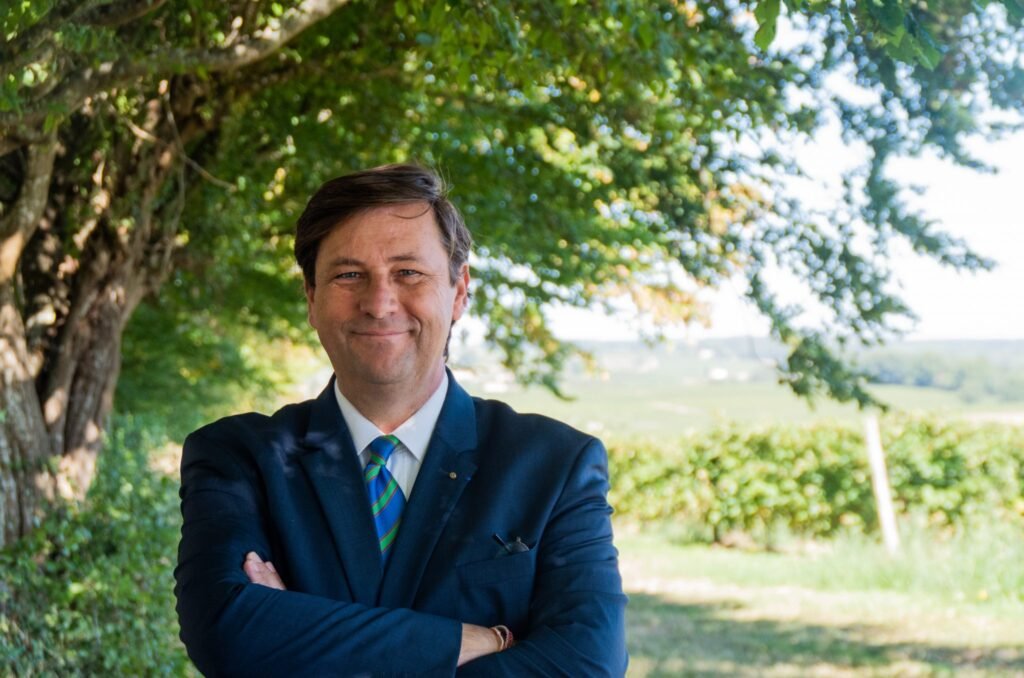
A winegrower in the Gironde, a former mayor and former president of a community of municipalities, and vice-president of Nouvelle Énergie, David Lisnard’s party, where he is also the spokesman for agriculture, forestry, fisheries and rural affairs, Yves d’Amécourt has just published L’humain, l’écologie et la politique (“Humankind, Ecology and Politics”, Éditions du Bien Commun). In it, he argues for putting words back in order: ecology is first and foremost a science, and science alone does not dictate society’s choices. Energy, water, layers of bureaucracy, the strategist State, subsidiarity, the Ministry for the Ecological Transition: here he defends an “ecology of the living”, one that reasons in flows rather than stocks, and in responsibility rather than guilt.
We interviewed Yves d’Amécourt in the spring, after the conference “Donner une ambition au vin français” (Giving French wine an ambition) held on 28 April 2026 at the French National Assembly (“Libérons la viticulture et soyons fier de notre savoir-faire”, in French). Settled for nearly thirty years on a family estate in the Gironde, after ten years as a consultant in value analysis and functional analysis, he served as a local elected official for almost twenty years. Vice-president of Nouvelle Énergie, David Lisnard’s party, he is also a member of the Observatoire français des corps intermédiaires and of the Institut Thomas More.
He has just published L’humain, l’écologie et la politique (Éditions du Bien Commun, 2026, 148 pages), a book which, according to its publisher, is meant to be “not a programme but a compass” to “reconcile people, nature and society for the common good”. He sets out its main arguments for us.
Interview by Jean-Paul Oury.
The European Scientist: You have just published L’humain, l’écologie et la politique. Could you explain the context in which you published this book and what its main arguments are?
Yves d’Amécourt: I wanted to put words back on things.
That may be the starting point of the whole book. We constantly use the words freedom, responsibility, equality, progress, ecology, common good, subsidiarity… But are we still sure we are talking about the same thing?
In fact, I had called my manuscript Réconcilier l’Homme avec la politique (Reconciling Man with politics). Then, after discussion with my publisher, it became L’humain, l’écologie et la politique.
But the original intention remains: to return to fundamentals, to the root of things and to the meaning of words. Because words are not the accessories of thought. They are its tools. And when the tools are distorted, thought ends up being distorted too.
Take the word “ecology”.
Ecology is first and foremost a science: the science of the relationships between living beings and their environment[1]. Yet in public debate we have gradually come to use the same word to designate a science, a public policy, an ideology and sometimes even a morality.
So we must begin by putting a little order back into words in order to put a little order back into ideas. This is all the more necessary because contemporary political ecology has too often become a politics of limits: limiting travel, limiting production, limiting consumption, limiting water use, limiting land take, and ultimately limiting Man himself.
I propose another way of looking at things.
It is obviously not a matter of denying the physical limits of the world. It is first a matter of knowing which limits we are talking about. A limit may be physical. It may be biological. But it may also be technological, economic or regulatory. And human history teaches us that these limits can shift.
Take energy. Humanity today consumes around 20 terawatts of primary power on average. At the same time, the Earth continuously intercepts about 174,000 terawatts of solar radiation[2].
Even though not all of this energy is, of course, recoverable or convertible into useful energy, the order of magnitude is striking: the solar flux is several thousand times greater than humanity’s energy consumption.
Our needs are therefore very far from the physical possibilities of the system in which we live.
This does not mean that energy is free or immediately available. It has to be captured, converted, stored and transported. In other words, the limit we come up against is not only a resource limit. It is also technological.
Take uranium.
With current reactors and an open fuel cycle, we reason in terms of certain resources and certain time horizons. But with recycling and fast-neutron reactors, the use of the material changes radically in order of magnitude: the OECD Nuclear Energy Agency (NEA) estimates that certain advanced cycles could reduce natural uranium requirements by up to about 60 times; other NEA work shows that a fleet of breeder reactors can operate over horizons of several centuries[3]. Technology shifts the limit.
Third example: water.
Metropolitan France receives on average about 500 billion cubic metres of precipitation a year. About 60% returns to the atmosphere through evapotranspiration, and about 200 billion cubic metres feed rivers and aquifers[4].
Compare this with the 28.9 billion cubic metres of fresh water withdrawn in metropolitan France in 2023, excluding hydropower; and it should be remembered that a large share of these withdrawals – notably for cooling power plants or supplying canals – is returned to the environment[5]. This obviously does not mean that all the water falling on France is available everywhere and at all times. That is precisely the point!
The problem is largely one of time and space: water sometimes falls where we do not need it, or when we do not need it, and then is lacking a few months later. Water circulates. It evaporates, condenses, falls, infiltrates, runs off, joins aquifers, rivers and the sea before continuing its cycle.
So the right question is not only: “How much water do we have?” It is also: “Where is it? When is it available? And how can we better manage its journey?”
Man has been an actor in these cycles for as long as humanity has existed. He irrigates, plants, cultivates, selects, develops land, retains water.
He can disrupt natural cycles. But he can also restore soils and ecosystems, reforest where it makes sense, retain water, improve plants, produce more on the most fertile land so as to leave more room elsewhere for biodiversity, forests, landscapes, but also for housing and human development.
That is the heart of the reflection I am pursuing today in a new manuscript, Transmettre (Passing on): moving from an ecology of limits to an ecology of the living; from an ecology of stocks to an ecology of flows; from an ecology of guilt to an ecology of responsibility.
This reflection was born less in libraries than in the vineyards.
For almost thirty years I have watched the climate change. Harvests come earlier, droughts recur, some trees are dying back, others are taking their place. So I have no difficulty recognising climate change: I see it in my vines.
But scientifically observing a phenomenon does not tell us what society we should build in response. This is a fundamental distinction: climate change is a scientific challenge. How we respond to it is a choice of civilisation. And that, ultimately, is what links ecology, freedom and transmission.
We are heirs before we are owners. So the question is not only: “What must we preserve?” It is: “What are we going to pass on?”
Circular administration
TES. In a chapter on autonomy and freedom, you criticise the piling up of bureaucratic layers. As a winegrower, how does this “French disease” affect you? What do you propose?
Y.d’A. Here again, I would gladly start with words. Administering is not governing. Controlling is not making people responsible. Simplifying is not digitising.
I could even answer with a quip: the French winegrower’s problem is no longer just knowing how to make wine, it is still having the time to make it!
I remember the days when, after the harvest, we filled in the harvest declaration. It was a large sheet with two carbon copies, in a register you bought from the tobacconist. We declared the volume harvested per appellation, the lees, the taxes. The tobacconist was authorised by the Customs administration and helped us complete the formality.
Today, everything is computerised. So you might imagine that everything is simpler. It is often the opposite. I declare my harvest to Customs. Then I claim that same harvest with the appellation’s defence and management body. When bottling, I make further declarations to the certification body. When I sell, I declare the movements again. Every month come the shipment declarations. Every year, the physical inventory is compared with the theoretical stock. We even declare our capsules.
And to plant a vine, I must declare the grubbing-up to Customs, then apply to FranceAgriMer for that grubbing-up to be converted into a planting authorisation, before going back to Customs to declare the planting. We have invented circular administration! Even the MSA, our agricultural social security, regularly asks us to declare information it already holds. It is all exhausting!
And above all, it reveals something much deeper: we have built an administration of mistrust. Each rule, taken separately, generally has a justification. It is their accumulation that ends up producing absurdity.
The same absurdity exists in forestry. Foresters are asked to prevent fires while the obstacles to creating a water point or a track, or to clearing undergrowth, keep multiplying. By dint of protecting nature legally, the administration can end up preventing those who know it from actually protecting it.
So I believe we must reverse the logic: start from freedom and responsibility rather than prior authorisation; set objectives rather than describing every means administratively; judge results rather than permanent compliance with procedures. And above all, rediscover subsidiarity.
The person close to the problem obviously does not know everything. But they know things that someone far away will never know.
The expert brings general knowledge; experience brings particular knowledge. An intelligent society organises their encounter. A technocratic society imagines that the former can replace the latter. This is what I call “doing with” rather than “doing instead of”.
Simplification is therefore not just a matter of forms. It is the transition from a society of mistrust to a society of responsibility.
Mitigate everywhere, adapt at home
TES. You devote a chapter to the strategist State. How can it intervene in the economy? Not all plans are equal. We have seen the success of the Messmer plan, the failure of the Plan Calcul (in French) and the absurdity of a plan like the PPE3 (France’s third multi-annual energy plan, in French)… How can we ensure that the State is a good planner, if that is indeed its role?
Y.d’A. Here again, words matter. A strong State is not a State that does everything. A strategist State is not a planning State. Strategy consists in setting a destination and preparing for the long term. Planning becomes dangerous when it claims to decide every path for getting there.
The State must ensure security, sovereignty, major infrastructure, essential networks, certain strategic energy capacities, and fundamental research. It must anticipate risks that the market or individuals cannot bear alone. It sets a course. It must enable!
But it starts to go off the rails when it claims to choose, in place of engineers, entrepreneurs, farmers or citizens, the precise means of reaching that course.
This question also ties in with that of progress. To progress means to move forward. But forward towards what? You can run very fast in the wrong direction.
A new technology is not necessarily progress. Nor is a new regulation. Progress presupposes a destination.
The Messmer plan had that strength: an extremely clear objective – reducing France’s energy dependence – based on a mastered technology, an industrial sector and engineers capable of deploying it.
The Plan Calcul, by contrast, reminds us that mobilising considerable resources does not give the State the ability to foresee how technologies and markets will evolve.
Climate change is precisely what helps us understand this question of scale. Mitigation is global. Adaptation is first and foremost territorial and local.
This is not just a turn of phrase: the IPCC stresses that the benefits of mitigation are global, whereas those of adaptation materialise mainly at the scale of the affected systems, often locally or regionally[6].
A tonne of CO₂ emitted in Bordeaux, Beijing or Chicago ends up in the same atmosphere. The climate effect knows nothing of our administrative borders.
Adaptation, on the other hand, depends on the territory. One does not adapt in the same way in the Gironde, in the Alps, in the Netherlands, in the Sahel or in Bangladesh.
Here, water must be retained. There, a coastline protected. Elsewhere, a tree species changed, a grape variety adapted, an architecture modified, a mangrove restored or a city protected against flooding.
And this is where our system sometimes becomes absurd. When a heatwave arrives, we readily blame the mayor, the farmer, the motorist or the local business for their insufficient contribution to mitigating a global phenomenon on which their individual influence is necessarily infinitesimal.
But when that same mayor, farmer or forester wants to adapt – create a water reservoir, change a farming practice, maintain a forest, plant a new species, develop their territory, install air conditioning – administrative ecology tells them they cannot do it.
We make the local level feel guilty about what it can hardly change, and we prevent it from acting on what it really can change. That is why subsidiarity is also an ecological necessity.
To each level its responsibility: at the international level, coordinating mitigation; at the national and European levels, major infrastructure, energy, research and general rules; at the territorial level, a very broad capacity for adaptation.
The IPCC itself also stresses the importance of local knowledge, which can usefully complement scientific and technical approaches in managing territories[7].
The strategist State must therefore administer behaviour less and make action possible more. The State must know the destination. It does not need to hold the steering wheel of every car.
Science describes, politics chooses
TES. You devote a chapter to integral ecology without ideology. What is your idea? Is it the classic distinction between scientific ecology and political ecology?
Y.d’A. It is our vocabulary problem again!
Today we call three different things “ecology”: a science, a public policy and a political ideology. As long as we do not distinguish between these three meanings, we sustain the confusion.
Scientific ecology observes. Environmental policy acts. Political ecology proposes a vision of society.
All three are legitimate. But they are not of the same nature. The problem begins when the third claims that its choices necessarily follow from the first.
Science can measure a temperature, observe changes in a bird population, study a soil, calculate emissions, measure a CO₂ concentration or model different climate scenarios. It can tell us what is and help us understand what might happen. It cannot tell us what we should want. It cannot decide for us whether to respond to climate change through degrowth or through innovation, through rationing or through abundant, low-carbon energy, through prohibition or through responsibility. Science describes, measures and sheds light on consequences. Politics chooses.
Yet political ecology reasons solely in terms of stocks, whereas living systems also function through flows and cycles.
If I look only at stocks, my first response will be to limit withdrawals. If I also look at flows, a second question arises: how can we act intelligently on them?
How can we encourage photosynthesis? How can we restore soils rich in organic matter? How can we reforest where it is ecologically relevant? How can we restore ecosystems? How can we better retain water when it is abundant so as to use it when it is scarce? How can we produce more on the most productive land so as to leave more room elsewhere for living things?
This is what I call the ecology of the living.
That is the ecology I would like to defend: that of a human being enhanced by knowledge, action, freedom, responsibility and transmission. An ecology of the enhanced human, rather than of the limited human!
“The Republic must not have an official ecology”
TES. Given the ideological baggage weighing on the word “ecology”, wouldn’t it be better to abandon it?
Y.d’A. Ecology is a very fine word when it designates a science. It becomes problematic when we make it designate, at the same time, a science, an administration, a public policy, a political party, an ideology and a morality.
The history of the ministry in charge of these matters is interesting in this respect.
In 1971, in Jacques Chaban-Delmas’s government, under the presidency of Georges Pompidou, Robert Poujade became Minister Delegate to the Prime Minister, in charge of the Protection of Nature and the Environment[8]. It was necessary. The alarm had to be raised. Air and water pollution and the protection of landscapes, nature and living conditions had to be brought to the heart of public action. It was also at that time that the “polluter pays” principle emerged – a very sound principle in my view: whoever is free to act must also answer for the consequences of their action. One could almost have called it, more broadly, the “freedom-responsibility” principle.
And the word “environment” was very apt. Because an environment is always the environment of someone or something.
Speaking of the human environment implicitly placed Man at the heart of the question: the air he breathes, the water he drinks, the soils he cultivates, the landscapes he inhabits, the animals and plants with which he shares his territory.
In this sense, Man was the inhabitant of the world, with the responsibility of taking care of it.
Then we gradually moved from environment to ecology. In 2002, a Ministry “of Ecology and Sustainable Development” officially appeared[8].
This change of vocabulary does not seem trivial to me. Because ecology is a science. Having a Ministry of Ecology is therefore, if we take words seriously, almost as strange as having a Ministry of Geology, of Biology, of Mathematics or of Physics. The State does not have to administer a science. It must rely on it.
But today I would go further: I wonder whether we still need a Ministry of the Environment. That may seem paradoxical. On the contrary, I believe it would be recognising the success of the intuition of 1971.
Fifty-five years ago, a dedicated ministry was needed to remind the other ministries that the environment existed. Today, the environment should be the business of every minister.
I prefer a Minister of Agriculture responsible for both agricultural production and its environmental consequences to two ministers, one of whom explains that we must produce and the other that we must stop producing.
Because ministers come and go, but their administrations remain. And contradictions at the top always end up becoming red tape on the ground.
One says: maintain. The other: don’t touch. One says: produce. The other: reduce. One says: adapt to climate change and retain water. The other multiplies procedures before authorising a reservoir, or even prohibits it.
And what do we do when administrations contradict each other? We create a one-stop shop! And lo and behold, this 1 October sees the opening of a “one-stop shop for hedges” (guichet unique de la haie), designed to centralise regulatory information and administrative procedures for projects to remove hedges[9].
Marvellous. Instead of removing the contradiction, we create a single place where citizens can come and encounter it.
When two ministries contradict each other, the solution is not to create a one-stop shop to receive their contradictions. The solution is to arbitrate. That is precisely what a government and a Prime Minister are for.
I would therefore like the environment to stop being a sectoral policy and become a dimension of all policies.
Agriculture, industry, housing, energy, transport, public works: each field should incorporate the environmental consequences of its decisions and take responsibility for the trade-offs.
This would bring together three things that our administrative organisation has too often separated: decision, arbitration and responsibility.
Because nature, for its part, ignores our organisational charts. A hedge is at once agricultural, hydraulic, scenic, climatic and ecological. A forest produces wood, hosts biodiversity, protects soils, retains water, stores carbon and shapes a landscape. Administration divides. Life connects.
That is why the urgent task now is to simplify our laws, codes and standards, to remove their contradictions and to give public decision-makers back the capacity to arbitrate. And that brings us back to the word “ecology”.
The objective is clear: reduce our pollution, preserve water, soils and biodiversity, reduce our footprint when it becomes excessive, adapt to climate change and pass on a habitable environment.
To achieve this, we need scientific ecology, climatology, agronomy, physics, chemistry, economics and engineering. But none of these sciences can decide for us what society we want to live in. There is an essential boundary between “Science tells us that…” and “Ecology demands that…”.
The first proposition belongs to knowledge. The second belongs to politics. And between the two lie freedom, democracy and the choice of civilisation.
When ecology becomes an ideology serving degrowth, planning or a socialist conception of the economy, these orientations must be debated for what they are: political choices, not presented as the necessary conclusions of science.
Otherwise, Man ends up changing status. He is no longer the inhabitant who protects and whose environment we protect. He becomes the one from whom nature must be protected. I reject that vision. Man does not only take. He plants. He cultivates. He selects. He irrigates. He maintains. He invents. He restores. He protects. He passes on. Between predatory Man, who believes everything belongs to him, and undesirable Man, who should efface himself to give nature back its rights, I prefer a third figure: Man who inhabits.
And if ecology should one day claim to become a religion, with its dogmas, its prohibitions, its sins, its guilt and its official truths, then I would almost be tempted to apply the 1905 law to it!
The phrase will raise a smile, but the idea is serious. The Republic must protect the environment; it must not have an official ecology. Ultimately, I always come back to the same distinction: science establishes the facts, politics sets the objectives, democracy arbitrates between the means.
And I also come back to the meaning of words. Freedom is not the absence of responsibility. Authority is not authoritarianism. Strategy is not planning. Ecology is not an ideology. The environment is not a sanctuary from which Man would be excluded. Progress is not change for change’s sake. And passing on does not mean keeping the world under glass. Passing on means receiving a world, inhabiting it, improving it and entrusting it to those who come after us. We are neither absolute owners of the world nor strangers to it. We are its inhabitants and, for a time, its custodians.
Editorial notes and references
[1] Ecology and interactions among living things. The CNRS presents ecology as the study of living organisms in their interactions with one another and with their environment; functional ecology studies in particular the interactions between organisms and environment and the cycles of elements. Sources: CNRS Ecology & Environment; National Committee for Scientific Research, section 30, “Continental surfaces and interfaces”.
[2] Solar flux and global energy consumption. The solar power incident at the top of the Earth’s atmosphere is about 174,000 TW. Global primary energy consumption reached 620 exajoules in 2023, i.e. about 19.7 TW on average. The ratio between the two is therefore close to 9,000; if one considers the fraction of solar radiation actually absorbed by the Earth system, the order of magnitude is about 6,000. These physical comparisons obviously do not mean that this energy is fully recoverable. Sources: MIT, The Future of Solar Energy, Appendix A; Energy Institute, Statistical Review of World Energy 2024.
[3] Uranium and advanced cycles. The OECD Nuclear Energy Agency and the IAEA periodically publish the Red Book, the international reference on uranium resources, production and demand. The NEA has estimated that cycles based on fast reactors can reduce natural uranium requirements by up to about 60 times compared with certain once-through light-water cycles. NEA work also shows that breeder systems can be self-sustaining for several centuries. Sources: OECD-NEA, Nuclear Energy Outlook; NEA, work on advanced fuel cycles; OECD-NEA/IAEA, Uranium 2026: Resources, Production and Demand.
[4] The water cycle in France. Eaufrance estimates the average annual volume of precipitation in metropolitan France at about 501 billion m³; more recent data presented by the public service put it at about 503 billion m³. About 60% returns through evapotranspiration and about 40% constitutes effective rainfall feeding surface water and groundwater. The French Ministry for the Ecological Transition uses a similar order of magnitude: about 512 billion m³ of precipitation and 200 billion m³ feeding surface water and groundwater. Sources: Eaufrance, “Précipitations et pluies efficaces” and “Les volumes de précipitations”; Ministry for the Ecological Transition, “Origine et gestion de la sécheresse”.
[5] Water withdrawals. In 2023, 28.9 billion m³ of fresh water were withdrawn in metropolitan France, excluding hydropower: 45% for cooling power plants, 20% for canals, 18% for drinking water, 10% for agriculture and 7% for other economic activities. Withdrawals should not be confused with net consumption: a large share of the water withdrawn is returned to the environment. Source: Data and Statistical Studies Department (SDES), Ministry for the Ecological Transition, “Les prélèvements d’eau douce par usage en France en 2023”, 2026.
[6] Mitigation and adaptation. The IPCC explicitly distinguishes their scales: the climate benefits of mitigation are global, whereas the benefits of adaptation materialise mainly at the scale of the affected system, often local or regional. More recent IPCC work nevertheless specifies that adaptation is a matter of multi-level governance, from local to international. Sources: IPCC, AR4, Working Group II, ch. 18; AR6, Working Group II, ch. 18, “Climate Resilient Development Pathways”.
[7] Local knowledge. The IPCC stresses that local knowledge, because it is tied to the precise characteristics of a territory and to long experience of the environment, can contribute to land management, risk anticipation and adaptation, especially when combined with scientific knowledge. Source: IPCC, Special Report on Climate Change and Land, FAQ 7.1.
[8] From the Ministry of the Environment to the Ministry for the Ecological Transition. On 7 January 1971, Robert Poujade was appointed Minister Delegate to the Prime Minister in charge of the Protection of Nature and the Environment, in Jacques Chaban-Delmas’s government. In 1997, the portfolio became “Regional Planning and Environment”; in 2002, “Ecology and Sustainable Development”; in 2017, “Ecological (and Inclusive) Transition”. Sources: Vie publique, history and evolution of the ministry in charge of the environment; Institut de France, “7 janvier 1971 : création du ministère de la Protection de la nature et de l’environnement”.
[9] One-stop shop for hedges. The single hedge regime, created by the 2025 agricultural orientation law, applies to hedge-removal projects declared from 1 October 2026 in metropolitan France. The national portal centralises regulatory information and the filing of applications. Sources: French Republic, “Guichet unique de la haie”; Decree No. 2026-829 of 28 August 2026 on the single hedge regime, Légifrance.
The book
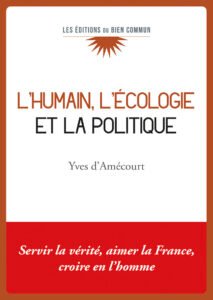
Yves d’Amécourt, L’humain, l’écologie et la politique (“Humankind, Ecology and Politics”, in French), Éditions du Bien Commun, 2026, 148 pp., €12.90.
Read also
- “Agricultural Decline: France is the Deadweight of the EU” Laurent Duplomb (interview)
- Political ecology will be scientific – or be finished
- Beware utopian political ecology
- Let’s do away with the myth of unspoilt nature
- Shortages after the pandemic? Farm to Fork and the Green Deal for degrowth
- Farm to Fork: a lack of strategic vision that will harm Europe’s food sovereignty
This post is also available in:
Leave a Reply