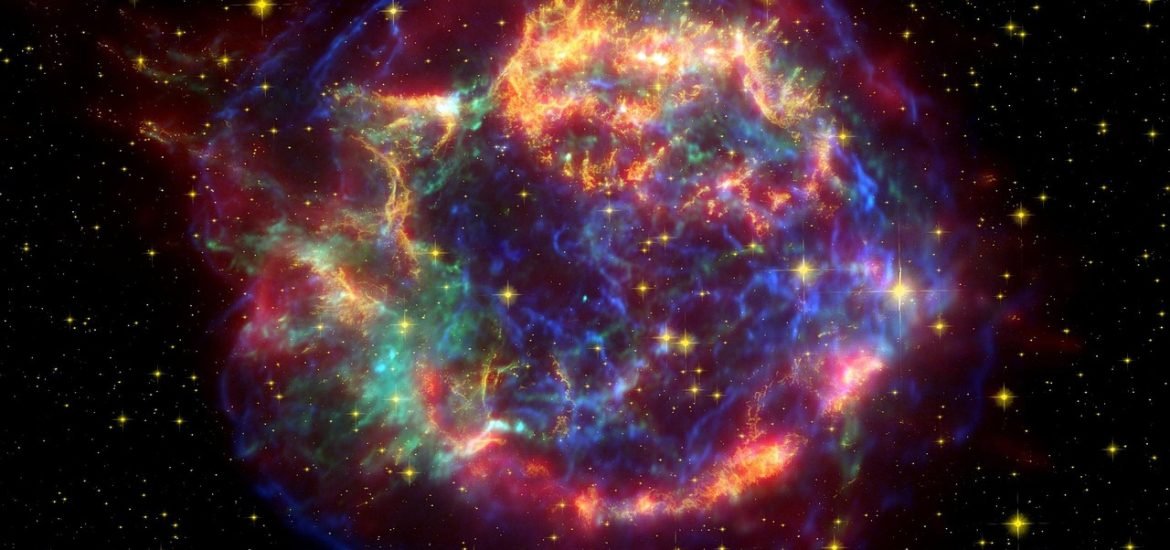
For years, astronomers have pointed to a handful of unusual stars as evidence of hypernovae after enormous stellar explosions thought to be at least ten times more powerful than ordinary supernovae. Now, researchers at University College London (UCL) say those explosions may never have happened. Two new studies published in Monthly Notices of the Royal Astronomical Society argue that regular supernovae can explain these stars perfectly well, once we accept that stellar explosions are messier than previously assumed.
What Was Thought to Be the Smoking Gun
A supernova happens when a massive star runs out of fuel and collapses in on itself, blasting its outer layers into space in a dramatic explosion. The debris then mixes into surrounding gas clouds and later becomes raw material for the next generation of stars and planets.
A hypernova was proposed as something even more extreme: the explosion of an unusually large, rapidly spinning star. The theoretical signatures of these events have been sought in the chemical makeup of extremely old, metal-poor stars in the Milky Way’s halo (the sparse cloud of stars surrounding our galaxy’s disc) and in nearby dwarf galaxies. Some stars seemed to carry chemical fingerprints so unusual that researchers concluded only a hypernova could have produced them.
A New Look at the Chemistry
The UCL team, led by PhD student Anmol Aggarwal at the Mullard Space Science Laboratory, took a fresh look at these claims using a new mathematical model. Their key insight was simple but powerful: real supernovae don’t spread their material evenly in all directions.
“If we look at a supernova today, the star’s materials are not spread evenly. Oxygen might predominantly fly in one direction, sulphur in another. New stars might form from a mix of pieces of the supernova, not its overall mix of elements,” said Aggarwal. “We developed mathematical models that took account of this and found in all cases that stars with a very unusual mix of ingredients were most likely formed from ordinary supernovae. All the evidence we see for hypernovae is suddenly gone.”
The Onion-Layered Star
Second author Dr Ralph Schoenrich, also at UCL’s Mullard Space Science Laboratory, explained how a dying star is built: “Just before a star goes supernova, it has layers like an onion, with heavier elements at the centre and lighter ones further out. Our model looks at how much material from each layer or each region would be needed to fit the observed star.”
He added that one of the big unknowns in astronomy remains how thoroughly supernova debris gets stirred into surrounding gas before new stars form. “We still don’t know how well the supernova material gets mixed before it forms new stars. That is despite decades of work in this area. Our research suggests some mixing goes on, but incomplete mixing. We need to take this into account in our models of how chemicals evolve in galaxies and of how the interstellar medium works.”
Four Stars, One New Explanation
Across their two studies, the UCL team examined four stars that had previously been held up as hypernova “evidence.” In the first paper, they looked at three of them and found that in each case, an ordinary supernova (with uneven material distribution) was a better statistical match than a hypernova.
In the second paper, they tackled a particularly puzzling case: a lone red giant star in the Milky Way’s halo with an exceptionally strange chemical fingerprint. Alongside normal supernova-forged elements, this star carried hefty amounts of very heavy elements like silver and uranium, which are typically produced in two ways: during the merger of two neutron stars (the extremely dense leftover cores of massive stars), or possibly in a highly magnetised hypernova.
Previous researchers had ruled out neutron star mergers, arguing the star formed too early for such mergers to have happened. But the UCL team noticed something interesting about this red giant: it was moving unusually fast and orbiting the galaxy in the opposite direction from most other stars. That pattern is a signature of a star that didn’t form in the Milky Way at all, but was pulled in from a smaller dwarf galaxy.
In tiny dwarf galaxies, metal-poor stars can form much later than in the Milky Way, leaving plenty of time for neutron stars to pair up, orbit each other and eventually merge. With that in mind, and using their new model for asymmetrical explosions, the researchers concluded that the star was most likely enriched by a neutron star merger combined with a single, ordinary supernova.
What This Means for Cosmic History
If the UCL team is right, scientists don’t need hypothetical super-explosions to explain the Universe’s strangest-looking stars. More ordinary (but messier) supernovae and neutron star mergers can do the job, so long as we accept that these events don’t spread their material neatly in all directions.
That shift has ripple effects. It changes how researchers model the chemical evolution of entire galaxies, how they interpret the fingerprints of the earliest generations of stars, and how they reconstruct the family trees of stars like our own Sun. The paradox is that the Universe may be a little less dramatic than we thought, but understanding it just got a bit more interesting.
Aggarwal, A. & Schoenrich, R. (2026). An unexplored enrichment stochasticity and its implications for stellar abundance patterns. Monthly Notices of the Royal Astronomical Society. DOI: 10.1093/mnras/stag610
Aggarwal, A. & Schoenrich, R. (2026). Monthly Notices of the Royal Astronomical Society. DOI: 10.1093/mnras/stag1512