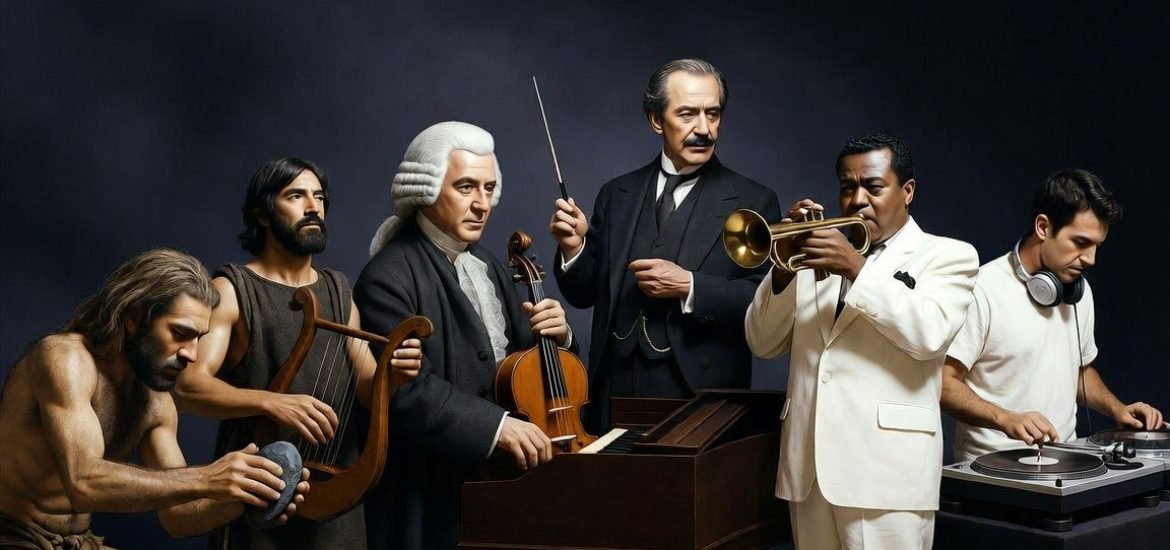
An Italian study published in Scientific Reports has measured, across some 20,000 works spanning nearly four centuries, a simplification and homogenisation of the melodic and harmonic structures of Western music. For jazz pianist, teacher and YouTuber Étienne Guéreau, who has been denouncing “musical impoverishment” for years, it is one more piece of evidence, to be taken with its limitations. Here he discusses the role of streaming platforms, the education of taste, the saturation of tonal grammar and what he regards as a fraud: generative AI applied to creation.
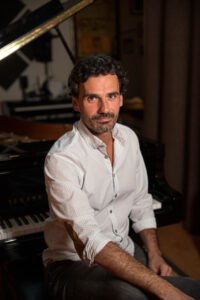
Trained at the conservatoire, Étienne Guéreau was mentored by Bernard Maury, whose classes he took over at the Bill Evans Piano Academy, where he has been teaching for more than twenty years. A pianist, composer and arranger, he moves between jazz, French popular music and studio work, gives lectures and masterclasses, and in 2020 launched the music analysis channel Piano Jazz Concept. He also writes novels and instruction books, and has just published L’élève est le maître. Essai sur l’épanouissement artistique (“The Student Is the Master: An Essay on Artistic Fulfilment”, H&O éditions, 2026), whose afterword is devoted to artificial intelligence.
The study that has reignited the debate, published on 23 April 2026 in Scientific Reports, is by Niccolò Di Marco (University of Tuscia, Viterbo), Edoardo Loru, Matteo Cinelli and Walter Quattrociocchi (Sapienza University of Rome) and Alessandro Galeazzi (University of Padua). The researchers turned some 20,000 MIDI files, divided into six macro-genres (classical, jazz, pop, rock, electronic, hip-hop), into networks in which each note is a node and each transition a link. The result: classical music and jazz remain the most complex genres, but their complexity declines over time – after an initial rise in the case of jazz – until it converges with that of popular genres, with the period 1950–1979 acting as a turning point. The authors stress the limits of their approach: MIDI ignores timbre, production, lyrics and performance, and complexity may have shifted to other dimensions. They describe the explanations put forward (the democratisation of creation, streaming, recommendation algorithms) as “speculative”.
This interview was conducted in the wake of another affair: on 25 September, the Académie Goncourt withdrew Thélyson Orélien’s C’était ça ou mourir from the first shortlist of France’s most prestigious literary prize, citing plagiarism and analyses concluding that the novel was “in all likelihood very largely the product of Artificial Intelligence” – which the author disputes. On this point, Étienne Guéreau does not compromise: in his view, AI has no place in the creative act, and a machine that is unable to defend its work against the public’s taste is not really creating.
Pianist, teacher, YouTuber
The European Scientist: Could you introduce yourself? What has your path been as a pianist – mainly in jazz, but perhaps not only – and what do you do with your YouTube channel?
Étienne Guéreau: I am a jazz pianist, and I went through the conservatoire. I come from Brittany and grew up in Paris. My mentor was Bernard Maury, whose classes I took over at the Bill Evans Piano Academy, where I have been teaching for a little over twenty years. I play popular music, jazz, studio sessions; I compose and arrange. I am also an author: I write novels and instruction books, and I launched a YouTube channel in 2020. I have also sung: singing is my second instrument. But my real second instrument, as I often say, is the pencil.
TES. Can you tell us about your latest book, L’élève est le maître (“The Student Is the Master”)?
EG. It’s all in the title. It is an essay on artistic fulfilment, in which I answer questions about training, stage fright, criticism, failure, teaching, fears, life on tour… In short, everything that makes up a musician’s life and that is not really discussed in this kind of book, which mostly deals with technique. Elsewhere, the musician’s life is either dramatised in novels or described rather crudely. I tell the story of years of touring, of experience in very different settings. I have had a lot of positive feedback: some people tell me they laughed, and many professionals tell me: “I found so many truths in it, so many anecdotes from the job, so many things I have lived through.”
A study, “one more piece of evidence”
TES. You recently devoted a video to an Italian study reported by Science & Vie. The researchers analysed some 20,000 pieces spanning nearly four centuries, in six major genres, and conclude that melodic and harmonic structures have become simpler and more homogeneous. Do these results confirm what you had observed as a musician and teacher? Did you work with these researchers?
EG. What they deployed to reach their result is a real Rube Goldberg machine, and I find it interesting. There are limitations, but I found them fairly honest in their method, particularly in using MIDI to sidestep the problems of form, timbre and so on. I know that musicians and YouTubers are now preparing counter-studies and pointing out the shortcomings of this work: that’s very good. As I have always said, whether studies suit me or not, whether I agree with them or not, they are guides, indicators, tools in the hands of people who think. A study doesn’t tell you everything.
TES. Does this study make it possible to measure something that until now was a matter of impression, and which you denounced in some of your videos, notably the one on the James Bond theme songs?
EG. Yes – the James Bond themes, cartoons… As I said in my video, I don’t hold the truth. I also studied philosophy: I no longer believe in truth. I believed in it when I was young, just as I believed in science; it was an age of great naivety. Even scientists take a step back from these notions: that’s Karl Popper’s falsifiability.
What interests me are weak signals. There is background noise, things taking shape. Today there are enough signals, coming from people who don’t know each other and who say the same thing, for it not to be a coincidence. It can never be quantified mathematically, nor can the opposite be proven by saying: “You can see perfectly well that it isn’t collapsing, that there is still quality.” For those who come from the world before, it is intuitive. And when I do comparative analyses, my demonstrations seem pretty glaring to me. I have been criticised, but in three years nobody has come up with a counter-demonstration, either for lack of desire or for lack of ability. I have always said it would be hard to take the James Bond themes the other way round: start with the latest ones, work back and show that things regress as you go into the past. That hasn’t happened.
TES. The most striking result concerns classical music and jazz, whose measured complexity falls over time until it matches that of pop, rock or electronic music. Jazz apparently first gained in complexity, before declining and then stabilising. How do you explain this from the inside? Is it a loss, or a shift in complexity?
EG. There, I don’t know which works they selected: that is a blind spot of the study. I don’t see how jazz has regressed since Bill Evans. Some forms of jazz are very complex today. There may be a pop jazz, more democratic forms, but there were those before too. When I listen to Brad Mehldau or free jazz, I see no loss of complexity. So I criticise the study too: it isn’t perfect. Instinctively, I would disagree; perhaps it has to do with the samples.
That said, I am wary of my own judgement, because I listen to a certain kind of jazz. What did they label “jazz”? If you take Norah Jones, or Michael Bublé, who reuses Sinatra’s arrangements, the level has been constant since the 1960s. That is not where I see the regression.
TES. The analysis is based solely on MIDI files, and therefore on pitch and the sequence of notes. Fine rhythmic detail, timbre, production, performance and improvisation escape it, and the authors acknowledge that complexity may have migrated elsewhere. Can we really speak of impoverishment on the basis of such a narrow measure?
EG. I think so, because even if you only take the melody, melodic impoverishment leads to harmonic impoverishment: the melody passes into the harmony. You can’t have melodic impoverishment and harmonic enrichment. What you can have is a melodic-harmonic impoverishment offset by formal inflation: sound design, work on timbre, perhaps minimalist music – and I don’t know, by the way, whether the study counts that as impoverishment.
Is that enough to speak of impoverishment? No, it isn’t the only indicator. I take it as one more signal, like the studies on the impoverishment of song lyrics: one study is not enough to say that songs have become poorer, but it gives a cold assessment of vocabulary, themes, diversity, the lexical field. It is one more piece of evidence. That is how I take it.
The real debate: a class reality
TES. Doesn’t the general trend obscure some fine exceptions? In jazz, one thinks of Joey Calderazzo’s improvisations, of the SFJAZZ Collective with Miguel Zenón revisiting the standards, or of Vince Mendoza’s Olympians with the Metropole Orkest. There is harmony in pop too: you have analysed Jacob Collier; there is Louis Cole, or the singer RAYE, who performed with a symphony orchestra at the Royal Albert Hall. Are these artists islands of resistance, or a sign that complexity is coming back by other routes?
EG. First of all, I wouldn’t classify Jacob Collier and Louis Cole as either pop or mainstream popular music. Louis Cole is more electro jazz, modern jazz. Collier may have pop songs, but he has such jazz DNA that I would call it pop jazz.
But that isn’t the real debate. I have been trying to frame it from the start, without being heard: the problem is not musical impoverishment as such. When I dealt with the James Bond themes or cartoons, my conclusion was always that there have always been cultural niches, mediocrity and quality, in every era. I have never glorified the 1980s. When I began my studies, my teachers had nothing but contempt for the yé-yé pop singers of the 1960s.
The difference is the quality of popular music, including pop. When you say pop, you think of Quincy Jones, of Michael Jackson. There was quality across the board, including on television: in France, children exposed to music were necessarily exposed to beautiful, ambitious things. That is what has changed.
Without wanting to get political, the subject is closely tied to social issues: those who promote mediocrity are showing a kind of class racism. In the days of Jacques Chancel’s television shows and Michel Legrand’s theme tunes, there was a democratisation of culture: everyone was entitled to quality music, to quality theatre. These works, these composers still exist, but they have deserted the public space, shunned by advertisers; it is the reign of money. These niches have shifted towards the upper middle classes. The movement is simple: mediocrity for the people. And with AI, things will go from bad to worse. Demanding culture will be reserved for an elite who will send their children to the right schools, to the conservatoire, to dance classes. This isn’t Marxism: it’s a class reality.
On my mother’s side, I come from a working-class background, from Italian immigrants. Culture allowed me to emancipate myself. I am what Bourdieu called a class defector. That is why I have this relationship with culture: in a way, it saved me. If you tell children from the countryside and the suburbs: “You’ll get rap, we’ll leave you Aya Nakamura” (Aya Nakamura is very good), but if you don’t give them the chance to discover anything else, if you don’t train their ears… It’s like taste: you end up going back for another McDonald’s without thinking about it.
Jazz, now a niche music
TES. The study places the transition from richer to more uniform music between 1950 and 1979. What do you think was at stake at that point: records, radio, the industry, the electrification of instruments, the training of musicians?
EG. I don’t know. Standardisation, perhaps, opening up to the world. I didn’t live through the 1950s, but I remember that Ella Fitzgerald, when rock arrived, said in substance – I’m quoting her from memory – that she didn’t think rock would last, because people had too good an ear and rock was too formulaic. Unfortunately, she was wrong. Jazz began to wither, and as Zappa said: “Jazz is not dead, it just smells funny.”
With access to leisure and a form of globalisation, demanding forms may have been abandoned in favour of more immediate ones. What programmers tell me today is that jazz, a popular music in the 1940s and 1950s, has become ever more specialised. It has become a niche music, and festivals find it very hard to fill venues without mainstream headliners.
In France, the real issue is this waste of talent. It isn’t that there is no excellence: there are young pianists, young saxophonists with an incredible level who could pull culture upwards. But they queue up for the three Paris clubs that will book them once every six months. At my age, I am lucky enough to have a profile that allows me to promote my music. Behind me, many young people who ought to be playing will not manage to make a living from it.
Algorithms have replaced artistic directors
TES. The authors cautiously mention the democratisation of creation, streaming platforms and their recommendation algorithms. In your view, who is doing the simplifying: composers, listeners, or the platforms that connect them?
EG. The platforms. Platforms and algorithms go hand in hand; that’s the market. Until the 2000s, as long as the record companies did their job – with a lot of money, abuses and crooks, admittedly – there were artistic directors whose role was to unearth talent and sort the wheat from the chaff. They had real musical culture, a flair, and knew how to support young artists destined to blossom one day, taking the money from the headliners to pay for the smaller acts and build a catalogue, a strong identity. These are commercial companies, of course, but that commercial work always went hand in hand with artistic standards. People said “artistic director”, not “sales director”. Then artistic directors became sales directors, and those people disappeared.
Today, the artistic directors are the algorithms. And the algorithm doesn’t say to itself: “I’m going to suggest something crazy that he doesn’t like yet, too bad if he goes off to another platform.” It says: “He likes that? I’ll lock him in a tunnel, offer him the same thing over and over again, and when he’s done, rather than risk losing him with something new, I’ll send him back to the start. That way I keep him, and it brings in ads, streams and money.” This logic, which locks people into what they like when they could like so many other things, is deadly for culture.
Those who discover new artists often discover them through people like me – there are plenty of others. When I do my reviews or analyse artists, I get loads of comments like: “I didn’t know this, it’s brilliant!” We YouTubers, we content creators, are taking up the historical role of cultural tastemakers, as Jacques Chancel once was. I am free; nobody dictates what I should broadcast. I have no problem criticising the current collapse, because at the same time I never stop promoting today’s quality works. I’m about to turn 50, it’s a small world, but if I said yes to every friend releasing a record, I would end up like those programmes where the press officers decide the playlist – I’m barely exaggerating. And it is very touching when a musician tells me: “The distributor told me we’ve sold 300 or 400 more records since you talked about me.” That gives me a responsibility.
Taste can be educated
TES. If listeners are exposed to increasingly repetitive structures, does their capacity to appreciate rich harmony diminish? What role can music education and channels like yours play in reversing the trend?
EG. Of course. Generally speaking, the French don’t understand music; they are a bit deaf. Our musical culture is very thin, and the rate of artistic practice is catastrophic: we have very good soloists, very good professionals, but the amateurs are poor. On the other hand, we excel at food, wine, fashion, perfume. And everyone understands that the nose can learn to tell a Chanel perfume from a cheap one.
Many French people say: “I don’t know anything about it, but I can tell a good wine from a bad one.” That’s because they have been able to compare: if you take an interest, your palate develops. Any French person understands that you don’t put McDonald’s, a good family meal and a gourmet restaurant on the same level – for me, gastronomy is culture. You can’t eat gourmet food every day, but you can’t eat just anything every day either. That means taste can be educated. It’s as simple as that.
But if children aren’t exposed very early, it’s difficult, because taste is formed in youth; after 18 or 20, it becomes very complicated. Children who saw Harry Potter at the cinema received, without knowing it, all of John Williams’s harmonic frictions: an education in spite of themselves. These composers are the last great popular tastemakers, and John Williams is perhaps the last of them all. I saw that the Harry Potter saga is being remade: the music is totally bland, insignificant.
A grammar that has reached saturation?
TES. According to Gilbert Simondon, language, religion and then technology each follow an S-curve, then saturate and become fixed: “language becomes grammar and religion theology”. He adds that this “stepwise descent towards primitivity and materiality” is a “condition of universality”. Have tonal harmony and jazz reached this point of saturation, at the risk of becoming “grammar”? Is the simplification measured by the study the price of a more universal music, while invention shifts towards rhythm, sound and production?
EG. I agree, and it isn’t new: people have been saying so since Debussy, or Stravinsky. In tonal music, we have explored more or less everything: after Wagner, then Russian Romanticism, Rachmaninoff, we went as far as modulation could go. As Gabriel Yared used to say, the real break isn’t Ravel, who closed the doors, it’s Debussy. Then comes polytonality with Stravinsky, then serial music and spectral music: the last two attempts to make the grammar evolve, which remained small pockets, rather like the Nouveau Roman, or musique concrète. IRCAM is still there, but how does it nourish music today? Not at all. My teachers were already saying it: since Debussy and Stravinsky, no real evolution of the grammar has been possible. With Jacob Collier, people do microtonality, sing between two notes, look for new ways of unfolding harmonies, but the grammar is set.
So we are forced to evolve towards other forms: other rhythms – hence all those odd time signatures – sound design, substantial work on form. And that’s very good. There are only twelve notes; we are not going to reinvent the perfect cadence. But people put words in my mouth: I have nothing against sound design. It’s simply that we shouldn’t give up this grammar on the grounds that we are doing style. Grammar means precisely a basis for speaking, for creating style. What stops a composer from working on sound while, at times, keeping a harmonic treatment? It isn’t about redoing Wagner, Haydn or Ravel, but about keeping the basis of the language in order to offer something else. Even the Nouveau Roman – Michel Butor’s La Modification and the like – had no plot, but its sentences held together.
Music has reached the end of something; it became a foundation a long time ago. But just because we have understood that there are subject, verb, object, signifier and signified, we aren’t going to say to ourselves: “Right, now we stop, we’ll talk by making mouth noises, and it’ll be brilliant, because language has to evolve.” No, that won’t work.
“AI has no place in the creative act”
TES. Tools now generate complete tracks in a few seconds, drawing on existing material, at the risk of accentuating simplification even further. What remains specifically human in the musical act? And what must a young musician learn for their profession to remain meaningful?
EG. On this point, I am very radical: AI has no place in the creative act. It is an aberration. I am appalled. I am preparing a video: I was waiting for the Thélyson Orélien affair to die down a little. The Goncourt people were honest: they are the only ones who rose to the occasion. I am outraged that people are not grasping how serious what has just happened is. Generative AI has no place in art. It is intellectual fraud, theft, parasitism; in music, it is plagiarism, mega-plagiarism, without anyone noticing. It is an insult to genuine creators.
The creative act is solitary, difficult, painful. It is part of a long apprenticeship. Some people say: “After all, if he wrote it with AI and we were moved…” It’s as if someone said to me: “You didn’t notice your eggs weren’t organic when you made your omelette.” Well, come and see how the hen was raised, and then we’ll talk.
TES. Is music first and foremost a combinatorics of notes that a machine can explore, or a lived language, made of bodies, listening and interaction between musicians? Can AI become an instrument in the service of complexity rather than a standardisation factory?
EG. Tech enthusiasts and engineers have often said to me: “Don’t you realise that one day AI will be more brilliant than you?” The afterword of my latest essay is in fact about artificial intelligence. That AI might come up with ever more complex proposals is possible. But if it isn’t an algorithmic copy of what came before, it will be a random sequence, devoid of feeling, of pleasure or displeasure. The machine has felt no emotion, has drawn on no lived experience, no joy, no suffering, no trauma.
Let’s take the reasoning further: suppose it produces a successful work. Who is going to appreciate it? The machine isn’t even capable of judging the quality of its own work, except through user feedback. And what if it produces something good that people don’t like, like Stravinsky with The Rite of Spring – the example I use in my book? Imagine that in 1913 Diaghilev asks ChatGPT for a thirty-five-minute ballet, the AI writes The Rite, it is performed and people tear up the seats – even though it was rather the ballet that caused the scandal. Diaghilev comes back: “It’s a scandal, it’s very bad.” And the machine replies: “No problem, I’ll write something else, I’ll be delighted to compose with you.” Why would it say no? It has no ego to reply: “I know I have made a masterpiece; even if you don’t like it, even if I end up a tramp, I know I’m onto something.” The machine can’t say that. Once you have understood that, there’s nothing more to say.
Machines playing for machines
TES. In Siliclone, the novel I sent you, the coda features an orchestra of machines playing for an audience that is also made up of machines. Is that where replacement by machines leads?
EG. I remember it very well; I read it on the train, there and back. It is exactly the paradox we are reaching, and what I have thought from the start: as long as we are addressing human beings, nobody will convince me otherwise. On the other hand, algorithmic output addressed to other algorithms might, at a pinch, work, like two phones made to talk to each other. The idea of the novel is very good; we have all thought about it. We already have AI-generated content viewed by bots. It’s beginning.
TES. Technically, the machine can do better than humans; but isn’t it incapable of creating ex nihilo, of producing anything other than what it has been given?
EG. It all depends on what you call creation. If you ask it for a random melody, people will say: “See, it has created.” But what will it do with it? What emotion did it feel? What emotion will it arouse? And above all, what will it do with the emotion the listener sends back to it?
To young musicians
TES. In one of your videos aimed at young musicians, you tell them: “Don’t make music unless you are really determined.”
EG. It’s harsh, but I’m sincere. There is room for true amateurism. But for those who imagine they can, as was still possible a few years ago, work a little and land a few gigs, it will be so hard… As my publisher used to say, not everything should be submitted, not everything should be read. I have written loads of novels that I never submitted; I don’t make a record out of everything. You have to know how to choose. Just because you strum a bit doesn’t mean you should make it your profession. Today especially, it is a real commitment, and people have devoted their lives to it.
That’s why I tell them: be good amateurs, and you will be a great audience. We need amateurs: they are the ones who buy records and go to concerts, the best audience you could hope for in a club. For my part, 80 to 90% of the people who come to hear me are musicians. I can see that we need music education. We always come back to that.
The book
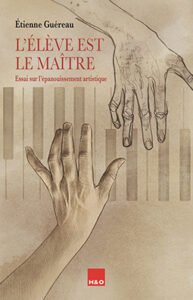
Étienne Guéreau, L’élève est le maître. Essai sur l’épanouissement artistique (“The Student Is the Master: An Essay on Artistic Fulfilment”, in French), H&O éditions, 2026.
Read also
- “Resolution” of Navier–Stokes by AI: A Very Human Dishonesty
- What’s Actually Happening in Your Brain When You Have a Creative Idea?
- The way we appreciate music is genetic
- Schools are shutting out poorer students and girls from creative careers
- The (Up)Rise of Creativity
This post is also available in:
Leave a Reply