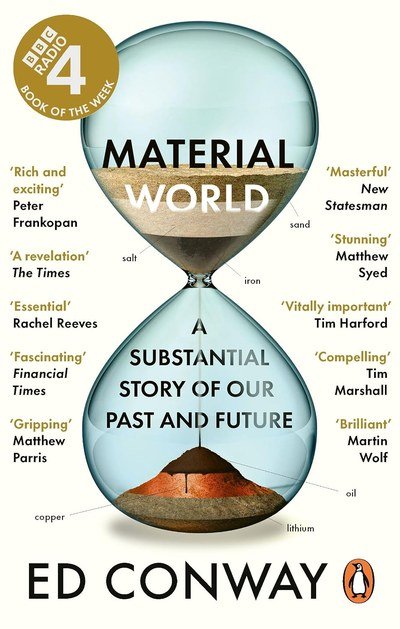
In this op-ed, journalist Robert Jules, former deputy editor-in-chief of La Tribune and co-author of Reforger la France, reviews Ed Conway’s Material World for The European Scientist. Through sand, salt, iron, copper, oil and lithium, the book reminds us that even the most advanced digital economy still rests on mines, factories and processing chains that we have stopped seeing.
In Material World*, published in French as « Matières vitales » (éditions de L’Artilleur), British journalist Ed Conway brilliantly shows, through a fascinating investigation into salt, iron, copper, sand, oil and lithium, how our world depends more than ever on raw materials and their transformation. At a time of climate change, energy crisis and the return of war, it is more essential than ever to remember this if we are to secure our future.
The illusion of an immaterial economy
We like to describe our civilisation as “post-industrial”. Knowledge, services, digital technology and now artificial intelligence (AI) seem to have relegated material production to the background. The most highly valued companies often sell software, platforms or technologies. Our days are largely spent in front of screens. From this arises an illusion: that of an economy gradually freeing itself from physical constraints.
Yet behind every digital service lie mines, factories, power grids and infrastructure. Data centres, telecommunications, hospitals, transport and energy equipment all draw on immense quantities of raw materials. It is this hidden reality that British journalist Ed Conway, economics editor at Sky News, sets out to restore in Material World (2023)*.
Conway contrasts two universes: the “ethereal” world of ideas, finance, software and services, and the material world of mines, quarries, refineries, smelters and chemical plants. The former depends on the latter, but has largely lost any knowledge of it.
To remedy this oversight, Conway chooses six substances: sand, salt, iron, copper, oil and lithium. They are neither the only indispensable ones nor necessarily the rarest, but they make it possible to understand the industrial transformations that have shaped our world.
Sand, from concrete to semiconductors
Nothing seems more mundane than sand. Yet without it there would be no concrete, no glass, no optical fibre and no silicon for electronic components. It contributes as much to the construction of a building as to the operation of the most advanced digital technologies.
Not all sand is alike, however: its composition, grain size and purity determine its uses. Silica destined for electronics must undergo a series of demanding industrial operations to yield silicon of exceptional purity. Each stage involves specialised equipment, skills and companies. Conway follows this chain all the way to semiconductors, showing how much Apple’s products depend in particular on the manufacturing capacity of the Taiwanese group TSMC. What looks like the very emblem of an immaterial economy rests on a long chain of mineral transformations.
Salt, the invisible material of chemistry
Conway then travels to Cheshire, in north-west England, a region historically shaped by salt extraction and the rise of the chemical industry. Sodium chloride is used in particular to produce, by electrolysis, chlorine, caustic soda and hydrogen. These products are in turn used in water treatment, plastics manufacturing, pharmaceuticals and a multitude of industrial processes.
This example sheds light on a crucial distinction: raw materials are not only present in finished products. They can also be indispensable to their manufacture without appearing in them directly.
Iron, both material and means of production
In the Pilbara, in Australia, Conway discovers the gigantic scale of iron ore operations: mines, machinery, transport and facilities mobilise considerable capital and quantities of energy. This ore feeds the world’s steel industry, on which most of our infrastructure depends. Steel holds a special place: it is used to build buildings, bridges and railways, but also the machines that produce other goods. It is at once a construction material and a means of production.
Its geography also reveals the shift in economic power. Whereas China accounted for less than 10% of world steel production in 1990, it now produces more than half of it.
Steelmaking also illustrates the practical difficulties of decarbonisation. In traditional blast furnaces, coke does not merely supply heat: it acts chemically to reduce the iron ore. Switching the source of electricity is therefore not enough. Processes must be transformed, recycling developed and, for some types of production, new routes adopted, such as direct reduction with low-carbon hydrogen.
Copper, the metal of electrification
The journey then moves to South America. At Chuquicamata, in Chile’s Atacama Desert, Conway visits a mine whose sheer size gives a measure of the effort required to extract copper. Enormous volumes of rock have to be moved, crushed and processed, the minerals concentrated by methods such as flotation, and the metal then processed and refined. The author draws three lessons from this. First, demand is rising with the electrification of transport, buildings and industry: cables, motors, transformers and power grids rely heavily on this conductive metal. The recent expansion of data centres linked to artificial intelligence further raises the stakes for electrical infrastructure. Second, declining ore grades in some deposits mean that more rock must be processed to produce the same amount of copper, which can increase energy and water needs. Finally, supply responds slowly: between the discovery of a deposit and the start of production, ten to fifteen years often elapse, sometimes more, the time needed to finance the project, obtain permits, build the facilities and address the concerns of local populations.
Herein lies a major contradiction of the energy transition: rapidly electrifying the economy requires developing the corresponding mining and metallurgical capacity, which takes far longer.
Oil, far more than a fuel
The raw material par excellence, oil drove the rise of transport and industry in the 20th century. But Conway points out that it also has an often-overlooked quality: it is a fundamental feedstock of modern chemistry. Plastics, synthetic fibres, solvents and countless industrial intermediates are all derived from the processing of black gold. The author explains how petrochemistry turns relatively simple molecules into materials with a wide range of properties. This dimension limits hopes of a rapid exit from oil: even if electric vehicles gradually replace combustion engines, some of the materials we need will continue, in the absence of industrial substitutes, to come from hydrocarbons.
Two often-conflated problems must therefore be distinguished: replacing fossil fuels as sources of energy and replacing their role as raw materials. Decarbonising the economy is not only about producing electricity differently; it also means transforming a large part of chemistry and manufacturing chains.
Lithium, the paradox of the transition
The final stage of the investigation is lithium, which has become the emblematic metal of rechargeable batteries. Its lightness and electrochemical properties contribute to the performance of lithium-ion batteries, used in particular in electric vehicles and electricity storage. But a battery does not come straight out of a mine. Lithium must be extracted from ores or brines, notably in the salt flats of South America, then converted into chemical compounds that meet strict specifications. Then come the manufacture of electrode materials, the production of cells and their assembly.
The growth in electric vehicle production inevitably drives up demand, while opening new mines and building chemical plants takes time. Added to this are environmental impacts, conflicts over water use, social resistance and the question of battery recycling. Lithium neatly sums up the paradox of the transition: to reduce some of our dependence on fossil fuels, we must build new mineral and industrial supply chains.
Deindustrialisation is not dematerialisation
Beyond these six stories, Material World offers an economic and geopolitical reading of our times that is rich in lessons. Its first lesson concerns the supposed dematerialisation of advanced economies. A decline in industry’s share of a country’s GDP does not mean that its consumption uses fewer raw materials. A growing share of the necessary production has simply been moved abroad. A distinction must therefore be drawn between the structure of domestic production and the material footprint of consumption. Deindustrialisation is not synonymous with dematerialisation.
The second lesson is that possessing resources is not enough to make an industrial power. Between the deposit and the final product lie operations of extraction, separation, refining, processing and manufacturing, which require specific know-how, investment and infrastructure. Conversely, designing a technologically advanced product does not guarantee control over its production. Industrial power is largely played out in these intermediate, often little-known stages.
Efficient but vulnerable value chains
The third lesson is that globalisation has increased both the efficiency and the vulnerability of value chains. International specialisation, economies of scale and comparative advantage have made it possible to manufacture complex goods at relatively low cost. China’s integration into world trade at the beginning of the century accelerated this organisation. But certain links have become concentrated in a small number of countries or companies. As a result, a local disruption can have global consequences. The semiconductor shortages in the wake of Covid-19, which notably hit carmakers, provided a spectacular illustration.
Security of supply is therefore not measured solely by the abundance of geological reserves. It also depends on refining capacity, industrial skills, transport infrastructure, supplier diversification and the ability to overcome a break in any link of the chain.
Progress does not free us from matter
Finally, Conway brings to light a cultural and political phenomenon: the disappearance of material production from our picture of the world in developed economies. We use objects of extraordinary complexity without knowing the processes that make them possible. This ignorance does not only affect consumers; it also extends to politicians, decision-makers and sometimes economists.
This reality is all the harder to perceive because the materials studied are interdependent. Concrete and steel together form reinforced concrete. A battery uses copper as much as lithium. A light bulb requires glass. A transformer combines, among other things, steel and copper windings.
The book thus invites us to move beyond the misleading opposition between the old industrial world and the new digital economy. The most advanced technologies do not float above the physical world. They depend on it, and this dependence often becomes more demanding as products become more sophisticated. Technical progress does not free us from matter: it makes our ties to it more numerous, more complex and sometimes more fragile.
Ed Conway convinces us of the need to change our view of the world in a book rich in information drawn from his reporting in the field, first-hand accounts, and historical and technical explanations, delivered with real teaching talent. Written in a lively style, this indispensable book also offers the reading pleasure of an action novel.
Further reading
- « We have a gold and copper mine in France, no need to go to Mars » – Interview with Éric Marcoux
- Sulphur shortage may be looming, say UCL researchers
- White hydrogen under Europe’s feet: an overlooked resource for competitiveness and sovereignty — Christophe Hecker (interview)
- Energy addition, still not transition: fossil fuels remain the backbone of progress
- Hasty technological transition and risk of harmful lock-in
- Why the World Is Not Going to Collapse!

This post is also available in:
Leave a Reply