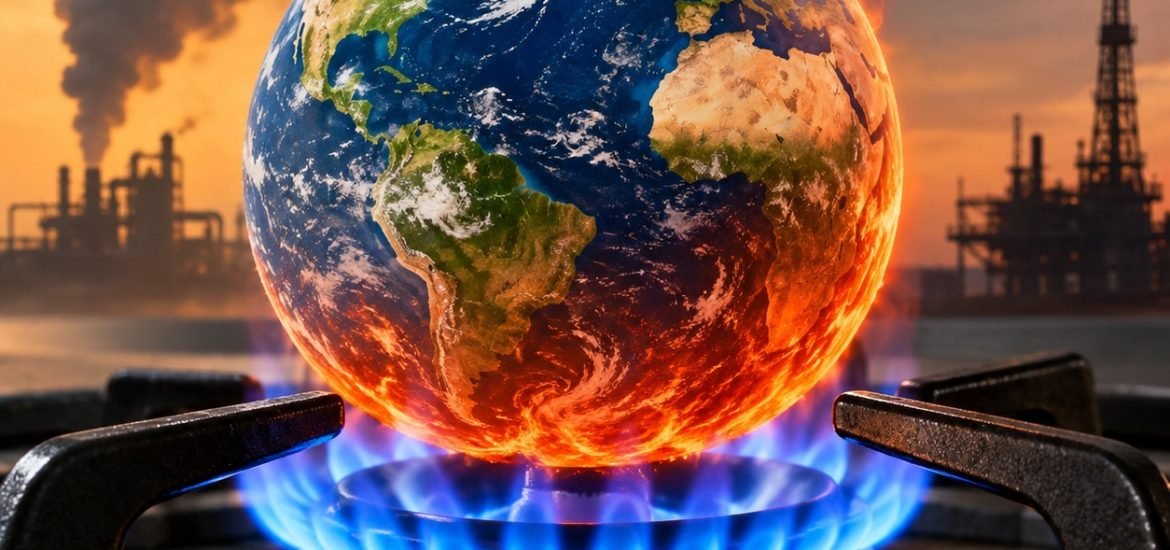
On 2 September 2026, the European Commission approved a German scheme worth more than €35 billion that will, among other things, fund new gas-fired power plants from 2031. Meanwhile, the financing of France’s six EPR2 reactors (the new generation of the European Pressurised Reactor) is still the subject of an in-depth investigation in Brussels. An engineer who graduated from HEI, Christian Semperes spent more than 35 years at EDF working in nuclear power generation, management and training, before becoming a professional coach. Today he is a close observer of French and European energy policy.
In this interview, he calls the Brussels decision an “eco-logical disaster”: Germany’s energy transition, the Energiewende, shut down its nuclear fleet only to fall back on gas. From the 100% renewables vision championed by Barbara Pompili to ARENH, by way of the closure of Fessenheim and the opening of the Landivisiau gas plant, he makes the case for an energy policy grounded in the laws of physics rather than in political posturing, as the 2027 presidential election approaches.
The European Scientist: On 2 September 2026, the European Commission approved a German scheme worth more than €35 billion that will, among other things, fund gas-fired power plants from 2031. How do you interpret this decision?
Christian Semperes: I won’t beat about the bush: it is an eco-logical disaster for the climate and climate change, and it is a disaster for the German economy. Let me explain.
We have just come through a scorching summer that is a consequence of climate change, and the European Commission is approving a long-term investment in gas to generate electricity. Some will tell you that it is meant to prepare for Germany’s coal phase-out. True, coal has a carbon footprint of 1,050 g CO₂/kWh and gas 418 g CO₂/kWh; argued that way, the Commission’s decision is shown in its best light.
However, that conveniently forgets that Germany shut down its nuclear fleet, at 12 g CO₂/kWh, while it was in perfect working order. Had it not closed its nuclear fleet, Germany would not be Europe’s largest emitter of CO₂ in absolute terms, far ahead of Poland, despite having four times as much installed intermittent renewable capacity (VRE) as France. Its imports of French nuclear electricity show that Germany lacks dispatchable, very-low-carbon generation. Since it abandoned nuclear power for ideological reasons, all it has left is gas. The problem is that the CO₂ emitted by burning gas does not stop at the border; it affects the entire planet. Given the planetary priority, logic would dictate replacing CO₂-emitting fossil fuels and, above all, not committing to investments that rely on them. That is why I say the European Commission’s decision is an eco-logical disaster.
As if the climate crisis were not enough, as if a burning planet were not enough, since 2022 and the war in Ukraine the price of gas, among other things, has soared. To prepare for its nuclear phase-out, Germany had tied itself to Russia through the two Nord Stream pipelines. That was a very bad bet. With the blockade of the Strait of Hormuz, gas prices are soaring again. For the next three months, shortages are not on the cards, but the future remains highly uncertain. In the event of a shortage, Germany will have no choice but to burn its cheap coal and lignite. A pretty poor record for the German energy transition known as the Energiewende, so often held up as the benchmark.

TES: In your view, this shows that the 100% renewables vision championed by Barbara Pompili does not hold up. Could you elaborate?
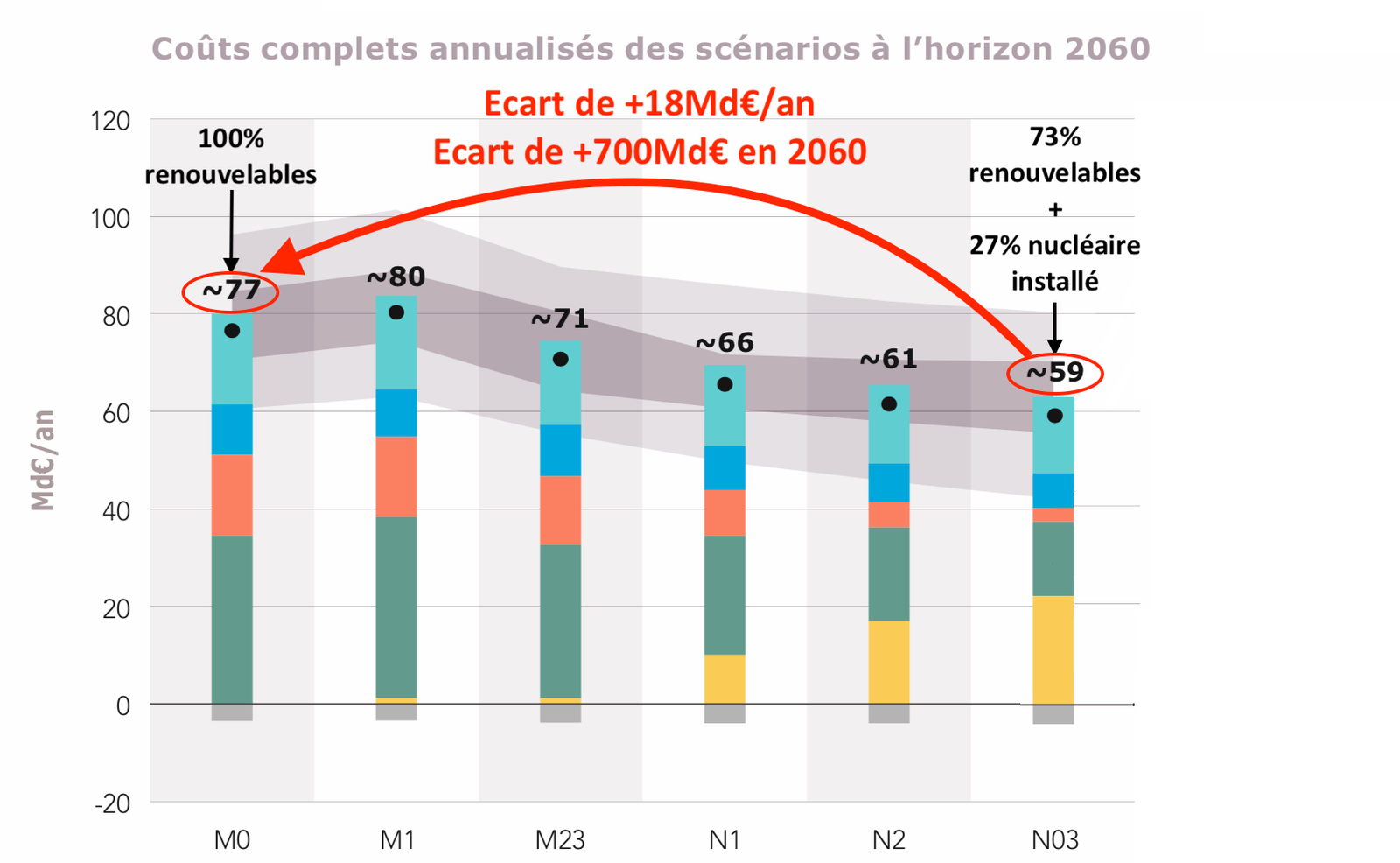
CS: Barbara Pompili acknowledged before a parliamentary committee that she had asked RTE (the French grid operator) to include 100% renewables in its scenario analyses, a scenario she then described as “technically possible” since RTE had analysed it! RTE’s estimate was damning: €18 billion more per year than the scenario with some nuclear. By 2060, €700 billion more in investment, for electricity alone. A bottomless pit.
Intermittent renewables have two major drawbacks: they are intermittent, and the energy they produce is non-dispatchable, meaning it does not adapt to demand. Those in power have understood this very well: in preparation for 100% renewables, it is consumers who must adapt. Remember Élisabeth Borne’s slogan: “turn down, switch off, shift”. To offset these drawbacks, the grid operator therefore needs either storage capacity or dispatchable generation, or both, to guarantee public service around the clock.
Large-scale battery storage will mean plundering the planet’s resources, which are by definition finite, in polluting mines, for batteries that last 10 years at most and will end up as waste. Relying on batteries to make intermittent renewables viable is not environmentally virtuous and remains technically utopian at the scale of a country.
That leaves dispatchable generation to compensate for the intermittency of renewables. And here there are not many solutions if the goal is to fight climate change. Hydropower: to use it, you need suitable hydrological geography. Fossil fuels, gas and coal: the logic of the planetary priority would dictate that we stop using them. That leaves very-low-carbon nuclear power.
In other words, 100% renewables is a utopia; for some politicians it has even become a religion.
TES: You draw a parallel between this decision and what happened recently in France (the closure of Fessenheim and the opening of Landivisiau)?
CS: At the start of Emmanuel Macron’s first term, successive governments followed this logic of replacing nuclear with intermittent renewables. In that spirit, Édouard Philippe’s government carried the Energy and Climate Law (bill no. 1908, tabled on 30 April 2019 and adopted on 8 November 2019), as part of an energy programme providing for the closure of 14 reactors. The two Fessenheim reactors, at 3.7 g CO₂/kWh, safe and in perfect working order according to the independent Nuclear Safety Authority’s 2019 report, were permanently shut down in the first half of 2020. This drive did not stop the government from financing the construction and commissioning, in March 2022, of a gas-fired power plant at 418 g CO₂/kWh in Landivisiau, Brittany, with €40 million a year in public subsidies to a TotalEnergies subsidiary, or €800 million over 20 years.
During Emmanuel Macron’s first term, French energy policy modelled its energy transition on the German approach.
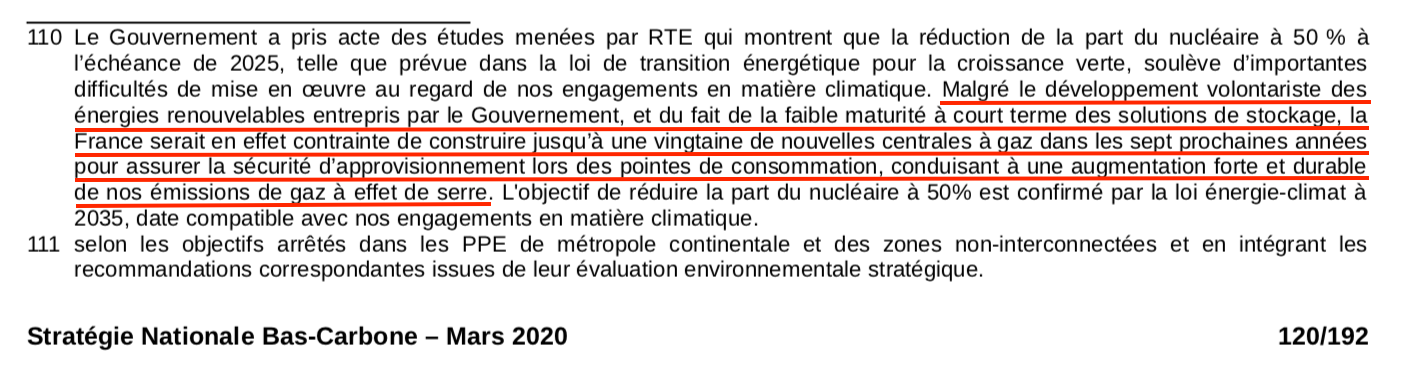
The SNBC, France’s national low-carbon strategy, had warned the French government about the impact of shutting down 14 reactors in its March 2020 document, and I quote: “Despite the proactive development of renewable energy undertaken by the Government, and because of the low short-term maturity of storage solutions, France would indeed be forced to build up to some twenty new gas-fired power plants over the next seven years to ensure security of supply during consumption peaks, leading to a sharp and lasting increase in our greenhouse gas emissions. The objective of reducing the share of nuclear power to 50% is confirmed by the Energy and Climate Law for 2035, a date compatible with our climate commitments.”
TES: Conversely, you are surprised that the Commission opened an in-depth investigation into the financing of the six EPR2 reactors. What bothers you?
CS: In early 2026, Germany asked the European Commission to approve its investment in gas-fired power plants, which it obtained on 2 September of the same year. At the same time, France asked for approval of its investment in six EPR2 reactors. On 31 March 2026, the Commission opened a formal investigation procedure (Article 108(2) TFEU) into the state aid planned to finance these reactors, in particular the subsidised loan covering up to 60% of the total cost (estimated at €72.8 billion). At the end of September, the European Commission’s review is still ongoing, with no end in sight. What is the sticking point? State aid to a group owned by the State itself: that is the sticking point. But how did we get here?
In 2011, under pressure from the European Commission, France introduced, through the NOME law (on the new organisation of the electricity market), a mechanism called ARENH, regulated access to historic nuclear electricity. This mechanism is estimated to have cost EDF €60 billion, more than 80% of the investment in the six EPR2 reactors. In other words, without ARENH, EDF would have been able to self-finance a large part of this investment. Had the European Commission wanted to jeopardise a future investment in French nuclear power, it could not have gone about it any better!
TES: You estimate that ARENH cost EDF €60 billion, and that without it the company could have self-financed its six EPR2 reactors. Could you explain this mechanism to our readers, and say what should change in the European electricity market rules so that nuclear power is treated on an equal footing with other low-carbon sources?
CS: ARENH began in 2011 and ended on 1 January 2026. Its purpose was to force EDF to sell a third of its nuclear electricity output at €42/MWh, below the production costs EDF estimated at around €60/MWh. In other words, it was selling at a loss. EDF sold this volume of electricity to its competitors, known as “alternative suppliers”, which had nothing to invest, nothing to produce, nothing to transmit and nothing to distribute. It was a paper exercise. They bought electricity at €42/MWh and resold it at the market price. To give you an idea, on Monday 4 April 2022, in the middle of the Russian gas crisis, electricity was selling on the market at €2,988/MWh. A tidy profit for EDF’s competitors eligible for ARENH, such as TotalEnergies and Engie, to name but two! But that is not all. To top it all off, after selling its nuclear electricity, whenever EDF was short of electricity to supply its own customers, it had to buy it at the market price. A double whammy! Can you see why, after 15 years of ARENH, EDF has lost around €60 billion?
TES: As the 2027 presidential election approaches, do you think politicians are paying enough attention to these issues?
CS: Electricity touches on major issues such as energy sovereignty and therefore geopolitics, France’s economic activity, continuity of supply, energy prices and therefore purchasing power, the environment, exports and so on. Given the technical complexity of managing an electricity grid in real time, neither the politicians in power nor the various opposition parties have the capacity to approach the subject pragmatically. They use professionals only to pick out what serves their political strategy. In the last century, the interests of France and the French people guided strategic energy decisions. Today, by exploiting fear of global warming, ideology has taken over.
Politicians favour posturing to set themselves apart from the other side. Yet the objectives are simple: guaranteeing electricity as a public service, a distinctly French value that has been forgotten, while at the same time fighting climate change. That is exactly what France’s historic fleet, nuclear and hydro, guaranteed over the long term thanks to the visionary policies of the last century.
Either politicians advocate 100% renewables, ultimately for the ideological goal of 0% nuclear. Indeed, Monique Barbut, the current Minister for Ecological Transition, praised the “ecological” programme of LFI (La France insoumise, the radical-left party), which plans to phase out nuclear power altogether, just like Germany. It would end with gas. Back to square one!
Or politicians advocate 100% nuclear, which is equally absurd. France’s historic fleet, which for more than 40 years guaranteed electricity as a public service around the clock without a blackout, combining safety, very low carbon emissions, dispatchability, economic profitability and electricity prices among the lowest in Europe, half those in Germany, was not 100% nuclear. Hydropower held a prominent place in it.
There is one thing that only electricity professionals can truly understand: the laws of physics in general, and of electricity in particular. If we want to guarantee electricity as a public service, they must be taken into account. We have no choice. Bernard Fontana, the current CEO of EDF, recently reminded us of this in an interview with the SFEN (French Nuclear Energy Society) on 11 June 2026, and I quote: “It has been somewhat forgotten in certain European countries [the laws of physics he had been talking about, Ed.], and they have learned it the hard way.” He was obviously alluding to the Spanish blackout of 28 April 2025. To avoid blackouts, the grid operator needs dispatchable generation that adjusts the grid’s voltage and frequency in real time.
Intermittent renewables? Yes, of course, we need them. But when a customer flips the switch and the appliance turns on, there has to be a generating unit that adjusts its output. The same goes when they switch it off. And for that, you need enough dispatchable generation. Otherwise, in less than a minute, the country can be plunged into darkness: that is what happened in Spain and Portugal. And if we want to fight climate change, we have to ban gas and coal.
In the end, electricity is complex, but it could be summed up quite simply if political posturing did not get in the way.
Further reading
- European energy transition: there’s gas in the air (in French)
- “Germany’s nuclear mea culpa comes when the damage is done” C. Semperes (interview) (in French)
- At 80, EDF is still full of energy! But which kind? (in French)
- PPE 3 (France’s multi-year energy programme): the anti-nuclear vs anti-VRE battle returns (in French)
- “Light at the end of Bernard Fontana’s roadmap?” C. Semperes (interview) (in French)
This post is also available in:
Leave a Reply