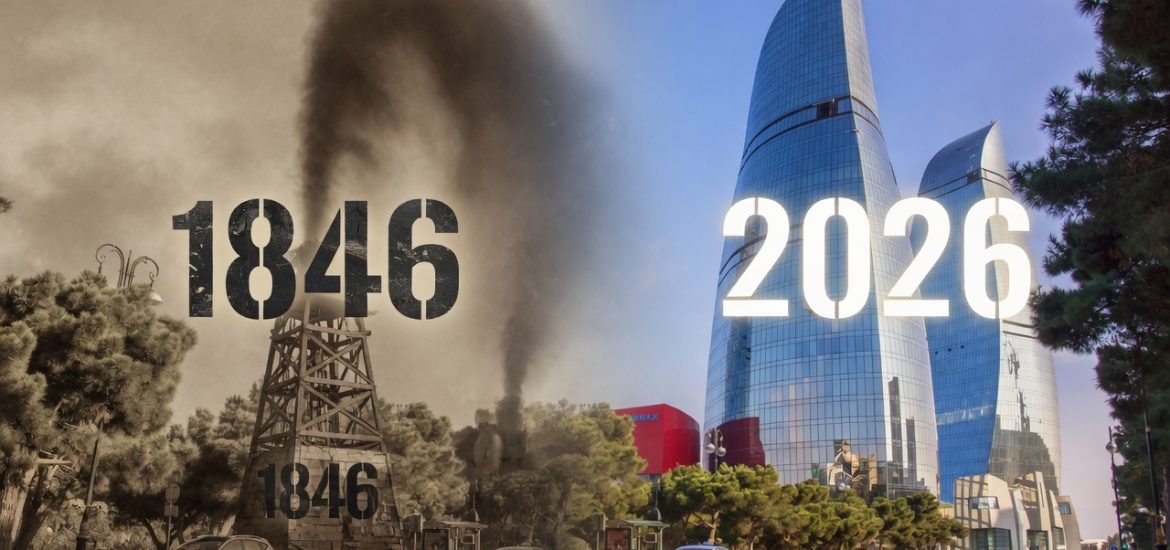
Why is Samuel Furfari, one of the world’s leading energy geopolitics experts, so interested in a country like Azerbaijan that he wrote a book about it? In “Azerbaijan. Geopolitics of Energy in a Changing Eurasia” (Technip Éditions, 2026), he demonstrates that this country plays the role of a true “game changer” on the global energy stage — a role with deep historical roots, as he recalls that the world’s first oil well was drilled in Baku. Secularism, its pivotal energy role, relations with the EU… Professor Furfari kindly answered our questions. This interview will undoubtedly make you want to learn more by reading his book.
The European Scientist: Why is an international generalist energy expert like yourself particularly interested in Azerbaijan?
Samuel Furfari: My interest in Azerbaijan dates back to a very specific moment: the inauguration of the Baku-Tbilisi-Ceyhan (BTC) oil pipeline in 2006, which my Commissioner, Andris Piebalgs, attended. He returned enthusiastic, even though the European Commission had nothing to do with the project. This event was a real turning point for me — a “game changer” in energy geopolitics. For the first time, it became possible to export oil from a completely landlocked region, the Caspian Sea, to the Mediterranean, without going through Russia or Iran. As I was teaching energy geopolitics, I immediately understood that this achievement would permanently reshape. the regional and international energy balance.
The construction of the BTC was both a geopolitical and technological feat. It required overcoming enormous diplomatic obstacles, primarily Russia’s resistance — which could not accept losing its monopoly on the region’s hydrocarbon export routes — and that of environmentalists who were probably manipulated by Moscow. Successfully routing this pipeline through three countries was a true exercise in political engineering. Technically, it was also a remarkable achievement, given the length of the route…
. I used to tell my students: “If the BTC was possible, then anything is possible in energy geopolitics.” That sentence sums up the fundamental lesson of this experience: political will and innovation can overturn even the most entrenched certainties.
After thirty-six years at the European Commission, much of it dedicated to energy security, I was able to observe up close how Azerbaijan, long ignored in the West, became a central actor in Europe’s energy supply. This country stands at the crossroads of worlds and is the heir to a century and a half of petroleum history. It should not be forgotten that the world’s first industrial oil well was drilled in Baku in 1846, thirteen years before Colonel Drake’s well in Pennsylvania. By the late 19th century, the city produced more than half of the world’s oil, thanks to the industrial daring of the Nobel brothers and the Rothschild bankers, who understood the region’s potential before anyone else.
After independence, Azerbaijan managed to reconnect with this energy vocation. The “Contract of the Century,” signed in 1994, opened the door to international investment and the modernization of the national oil industry. The BTC pipeline embodied this ambition by linking the Caspian to the Mediterranean. Today, the Southern Gas Corridor (TANAP/TAP) makes Azerbaijan a key natural gas supplier to the European Union and contributes to the diversification of the continent’s energy supplies.
What fascinates me about Azerbaijan’s journey is how the country has transformed its natural resources into genuine instruments of sovereignty and geopolitical power. Azerbaijan has not been a victim of its geography or history — it has turned them into levers to assert itself on the international stage. When one discovers the many assets this country offers for the new geopolitics of energy, one understands how much the world has changed in this field. It is precisely this transformation that I wanted to highlight in my book.

TES: On the historical and religious level, this country seems to fascinate you — why?
S.F.: On the historical and religious level, Azerbaijan fascinates me deeply because it embodies a unique crossroads of civilizations and tolerance. Even before Islamization, this land was already a major spiritual center: Zoroastrianism left indelible traces there, such as the Ateshgah temple and the eternal flames of Yanar Dag, which still earn Azerbaijan the evocative nickname of “Land of Fire.” This memory of sacred fire permeates the national culture and reminds us how spiritually diverse this land has always been
. And this thread of fire has not been extinguished over the centuries: it has endured through time and is now inscribed in the very silhouette of Baku. When I chose the cover of my book, I settled on the three Flame Towers, these monumental towers shaped like flames that dominate Baku. They seemed to me the most fitting image to capture the country: they embody both Azerbaijan’s centuries-old history , that of a nation that has risen to the global stage in just a few decades. It is precisely this continuity between past and present that I wanted to convey from the very first glance at the cover.
What distinguishes Azerbaijan in the Muslim world is its constitutional secularism, inherited from the Soviet period but deeply rooted in society. Here, the separation of religion and politics is not a slogan: it is a daily reality, in contrast to neighboring Iran, where religion structures the state and public life. This secularism translates into a modern society where women are free and active in all fields, and where veiled women are rare. We are therefore very far from the religious extremism that prevails in other countries in the region.
Another aspect that particularly touches me is the excellent relations between Azerbaijan and its Jewish community, which has been present for centuries, notably in Qirmizi Qesebe, the “Jerusalem of the Caucasus.” This tradition of tolerance extends internationally: Azerbaijan, a Muslim country, supplies nearly half of Israel’s crude oil imports — a remarkable fact that illustrates the country’s ability to transcend religious divides in favor of dialogue and strategic cooperation. It is a rare balance, and it deserves to be highlighted.
TES: How do you analyze the situation in Karabakh? What role does this region play from an energy perspective?
S.F.: Karabakh, before being a contemporary drama, is first and foremost a land marked by major regional powers. Historically, this region long belonged to the Persian sphere of influence before being incorporated into the Russian Empire in the 19th century. It was under the Soviet era — by a decision of the Caucasian Bureau of the Bolshevik Party in 1921, influenced by Stalin — that Karabakh was placed within the Azerbaijan Soviet Socialist Republic with autonomous status, even though its population was predominantly Armenian. This arbitrary decision sowed the seeds of the conflict that would erupt at the end of the 20th century.
Karabakh is also a human tragedy. The first war (1988-1994) saw the occupation of the region by Armenian forces, causing the exodus of hundreds of thousands of Azerbaijanis. The “44-day war” of 2020 allowed Azerbaijan to regain most of the territory, and the September 2023 operation led to the full restoration of its sovereignty — but also to the massive exodus of the Armenian population. These are painful episodes for both peoples, leaving deep scars.
The Zangezur corridor, which would link Azerbaijan to its Nakhchivan exclave through Armenian territory, constitutes a major strategic issue for regional connectivity and the economic integration of the Caucasus.
It should also be recalled that peace between Armenia and Azerbaijan made decisive progress under the aegis of Donald Trump: the Washington summit in August 2025 enabled the two parties to reach a peace declaration and open direct dialogue. Today, Nikol Pashinyan’s electoral victory in June 2026 — the architect of this peace, facing an opposition supported by Moscow — paves the way for lasting normalization. Nothing now stands in the way of a definitive peace, which would benefit not only Armenia and Azerbaijan but also the stability and prosperity of the entire region.
TES: What role does this country play in the current international conflicts (the wars in Ukraine and Iran)? How does it position itself?
S.F.: Azerbaijan practices pragmatic neutrality. In the face of the war in Ukraine, Baku did not openly condemn Russia but seized the opportunity to strengthen its gas deliveries to the European Union, becoming an indispensable energy partner. This position allows it to maintain balanced relations with Moscow while consolidating its partnership with the EU. Azerbaijan has even delivered natural gas to Ukraine — to a country at war with the very one that once supplied it.
Relations with Iran are complex: the presence of a large Azerbaijani minority in northern Iran, border tensions, and rivalries over the Zangezur corridor fuel mistrust. Azerbaijan must navigate relations with Turkey, its natural ally (“one nation, two states”), Russia, the EU, and Iran, skillfully playing all sides to preserve its sovereignty and maximize its interests. This ability to maneuver between great powers is the hallmark of its contemporary diplomacy.
TES: You assert that Azerbaijan has become an essential actor in Eurasian geopolitics. Can you elaborate?
S.F.: Over the past few decades, Azerbaijan has established itself as one of the most strategic geopolitical actors in the Eurasian space. This position stems not only from its abundant hydrocarbon resources but above all from its ability to transform its geographical location — at the crossroads of Europe, Russia, Iran, and Central Asia — into a lever of power and regional influence.
In the energy field, Azerbaijan possesses major infrastructure that strengthens its role as a pivot. The Baku-Tbilisi-Ceyhan (BTC) pipeline, with a capacity of 1.2 million barrels per day, transported around 200 million barrels of oil to the Mediterranean in 2025, offering the EU a credible alternative to Russian supplies and consolidating the energy sovereignty of member states. At the same time, the Southern Gas Corridor, embodied by the TANAP and TAP pipelines, already enables the export of more than ten billion cubic meters of natural gas per year to southern Europe. The target of twenty billion cubic meters, set by the 2022 Memorandum of Understanding signed with Ursula von der Leyen, is technically achievable but depends on the European Commission’s political will to commit to long-term supply contracts — an indispensable condition for the profitability of the investments needed to expand capacity.
Beyond energy, Azerbaijan plays a central role in Eurasian connectivity through the “Middle Corridor.” This logistical route connects China to Europe via the Caspian Sea, the Caucasus, and Turkey, providing a strategic alternative to routes through Russia and long traditional maritime routes. In a context of geopolitical tensions and the search for diversified trade routes, this transit hub function gives Baku an importance that far exceeds the energy sector alone.
It is important to highlight a fundamental strategic choice made by Azerbaijan from the earliest days of its independence: not to lock itself into a purely state-controlled model. Baku quickly understood that its energy future could not rely solely on SOCAR — however solid and ambitious the national company may be — without enlisting the technological expertise and investment capacity of major international oil and gas companies. These partnerships were decisive in developing the complex offshore fields of the Caspian, and they have never faltered: today, majors such as BP, TotalEnergies, and Equinor continue to invest heavily in Azerbaijan, testifying to the lasting confidence that this high-potential growth country inspires in the global energy industry. Many hydrocarbon-rich countries would do well to follow this example in order to bring prosperity to their populations by embracing the market economy and the crucial role of technological innovation.
Azerbaijani diplomacy is distinguished by its agility and pragmatism. The strategic alliance with Turkey, based on deep historical, cultural, and linguistic ties, ensures valuable regional stability. With Russia, Azerbaijan maintains complex but pragmatic relations, preserving its autonomy while keeping a constructive dialogue open. Furthermore, China’s growing interest, within the framework of the new Silk Roads, testifies to the international recognition of Azerbaijan’s pivotal role in Eurasian connectivity.
Ultimately, in a world where the diversification of energy sources and supply routes has become a priority to avoid excessive dependence, every reliable producer gains increased geopolitical value. By modernizing its infrastructure and diversifying its alliances, Azerbaijan establishes itself not only as a guarantor of European energy security but also as a key actor in Eurasian logistics. Its ability to combine sovereignty, pragmatic diplomacy, and infrastructural innovation makes it an indispensable pivot in the new geopolitics of energy.
TES: What kind of relations does the EU maintain with Azerbaijan? Are there areas that could be improved?
S.F.: EU-Azerbaijan relations rest on a paradox: a partnership that has become strategic in practice, but which still relies on a Partnership and Cooperation Agreement in force since 1999 — a text from the pre-Southern Gas Corridor era. Negotiations on a new comprehensive agreement, launched in 2017 and then stalled, resumed in Baku in June 2026, alongside the adoption of the 2026–2030 partnership priorities. The choice of Baku rather than Brussels as the venue for the negotiations speaks volumes about the shift in the balance of power: Azerbaijan is no longer a mere supplier; it is a courted actor that also holds a second trump card with the Middle Corridor to Central Asia.
What could be improved? First, coherence. Brussels asks Baku — as has been said — to increase its gas deliveries while refusing, in the name of its own fossil fuel phase-out policy, to make long-term contractual commitments. Yet no one invests billions in the Caspian upstream without visibility beyond 2030. Second, institutional cacophony: while the Commission and the Council deepen the partnership — as confirmed by the meeting between António Costa and Ilham Aliyev in March 2026 — the European Parliament votes on resolutions calling for the suspension of the 2022 energy memorandum and an end to “dependence” on Azerbaijani gas. This double standard weakens the Union on both sides: Baku sees it only as selective moralism, never applied to Qatar or Algeria.
The recent visit by Giorgia Meloni to Baku — the first by an Italian head of government in thirteen years, while Italy is the primary destination for Azerbaijani energy exports — perfectly illustrates this gap. Coming in the context of the Ormuz crisis, which highlighted the complementary value of a land pipeline amid LNG uncertainties, she proposed that Italy continue to serve as the entry point for Caspian gas into the EU. It is therefore the national capitals, through bilateral diplomacy, that practice the energy realpolitik that the Union’s institutions struggle to embrace.
Clearly, Azerbaijan, through its history, geography, and diplomacy, has become a central actor in energy geopolitics and contemporary world stability. The European Parliament would do well to take note.
This post is also available in:
Leave a Reply