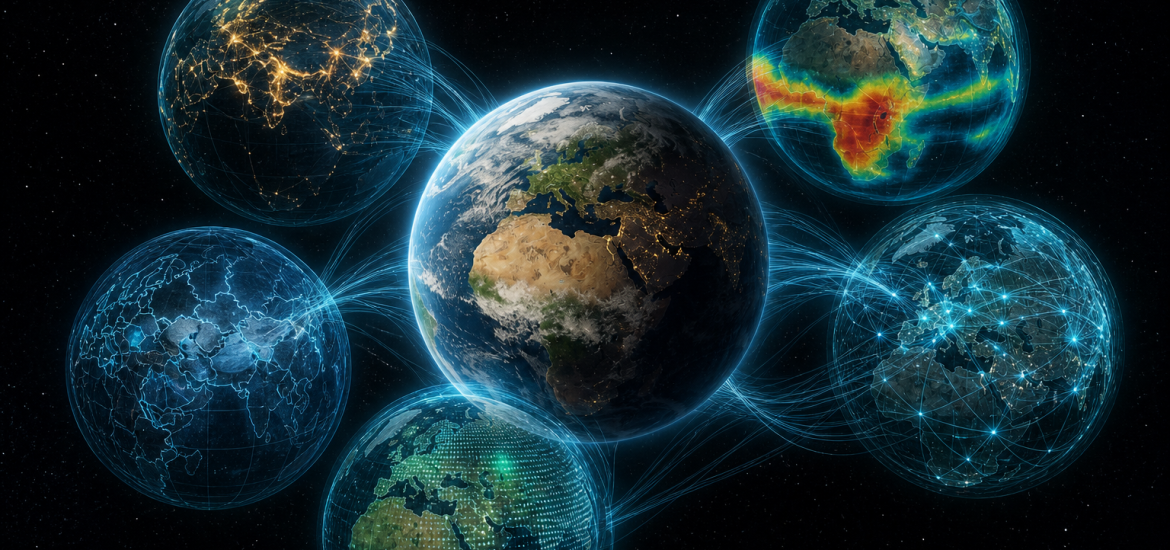
The simulation of populations and of living systems at planetary scale is becoming a new frontier of AI, Belgian prevention specialist Eric Van Vaerenbergh explains in this text.
A race conducted in indifference
Cindynics, the science of dangers and risks, must push European decision-makers to reflect on the durability of our civilization’s well-being.
A new technological race is beginning in relative media indifference: the simulation, by artificial intelligence, of human behaviors, of populations and, eventually, of entire societies and planetary systems.
Light Society: one billion agents
In China, researchers from several major institutions have developed Light Society. Their paper, “Modeling Earth-Scale Human-Like Societies with One Billion Agents”, describes a system designed to simulate networks of up to one billion agents. Each agent can be given a demographic profile, beliefs, goals, memory and social relationships. The system makes it possible, among other things, to study the diffusion of opinions, trust or economic behaviors.
To reach this scale, the researchers combine LLMs, distilled models and precomputed decisions. But the essential point lies less in current performance than in the trajectory: the authors already mention extensions toward epidemics, markets and urban systems, as well as the future integration of real-world data and, eventually, “population-scale digital twins” — digital twins of entire populations.
Stanford, MatrAIx: fidelity and scale
The West is advancing as well. Stanford has shown that it is possible to create agents that reproduce with high fidelity the attitudes and behaviors of 1,052 real people. MatrAIx crosses another order of magnitude with Persona 8B, a base of 8.3 billion profiles intended to evaluate digital products.
Simplistic comparisons should nevertheless be avoided. MatrAIx’s 8.3 billion profiles do not correspond to 8.3 billion autonomous agents interacting simultaneously, whereas Light Society emphasizes collective dynamics at very large scale.
Several trajectories are therefore progressing in parallel: individual fidelity (Stanford), very large-scale demographic representation (MatrAIx) and collective dynamics (Light Society). The real technological leap will likely come from their convergence.
Europe: from demonstrators to infrastructures
Europe is not inactive. Horizon Europe funds, among other projects, TWIN4DEM and WHAT-IF, which combine digital twins, multi-agent models, empirical data and LLMs to study democracies and virtually test certain policies. The European approach places greater emphasis on auditability, citizen participation, ethics and democratic compliance.
But these projects must not remain mere demonstrators. Imagine tomorrow an infrastructure bringing together population, economy, energy, resources, infrastructures, climate, ecology, health, information and geopolitics, gradually fed by real-world data.
Not a machine that “predicts the future,” but a system capable of testing millions of possible futures before acting.
Whoever possesses the best simulator will not know the future. They will simulate billions of futures, eliminate billions of them, then test the millions of most promising scenarios before acting in the real world. This is no longer prediction. It is a form of Darwinian selection applied to future scenarios: test, compare, eliminate, then act. It is civilizational prevention.
A CERN of simulation?
Europe should perhaps consider this challenge as it once considered CERN, the European Organization for Nuclear Research, or Galileo, its European satellite navigation system: a dedicated scientific infrastructure that is sovereign, open, pluralist and auditable, built around our democratic values. It would bring together physicists, computer scientists, sociologists and philosophers, with public audit rules and a formal ban on any predictive use for repressive purposes.
For in this race, power may not come only from whoever has the best AI.
It could come from whoever has the best simulation of the world: the one that makes it possible, in a verifiable way, to choose the decisions that durably maximize human well-being.
SOURCES:
CN: Light Society https://arxiv.org/abs/2506.12078
US: Stanford Generative Agents https://arxiv.org/abs/2411.10109
US: Simulating the World https://arxiv.org/pdf/2608.04205
UE: Social Digital Twinner https://arxiv.org/abs/2505.10681
UE: TWIN4DEM https://cordis.europa.eu/project/id/101178061
UE: WHAT-IF https://what-if-horizon.eu/
Read also
Energy addition, still not transition: fossil fuels remain the backbone of progress
Understanding the Cyber Security Fallout of Geopolitical Tensions
This post is also available in: FR