SpaceX has just obtained the green light from the FCC (the U.S. regulator) for 15,000 satellites capable of connecting directly to phones and has announced the purchase of low-band frequencies at 800 MHz. Is Starlink Mobile preparing to become a full-fledged mobile operator? Ludovic Lassauce, Chief Product Officer of SIMO, an American AI platform for multi-operator connectivity management, analyzes this disruption for The European Scientist, its consequences for historical operators, and the sovereignty stakes for Europe.
From partner to hybrid operator
The European Scientist: SpaceX has acquired frequencies at 800 MHz and obtained FCC approval for 15,000 satellites that connect directly to phones. Musk speaks of “the last piece of the puzzle” to cover all of America. Concretely, what changes?
Ludovic Lassauce: SpaceX has announced the acquisition of up to 14 megahertz of low-band spectrum in the 800 MHz band, previously held by T-Mobile via Grain Management. These frequencies penetrate walls and obstacles better. Until now, the direct connection between satellites and phones worked mainly when the device had a clear view of the sky. With these new frequencies, SpaceX gains a coverage layer capable of penetrating buildings. Combined with mid-band frequencies for capacity and a targeted terrestrial deployment, this allows it to aim for a truly hybrid service, covering both indoors and underserved areas. The authorization to launch 15,000 next-generation satellites in very low orbit strengthens this capacity. The real change is the shift from a partner model to the ambition of an autonomous hybrid operator.
TES: This is the first time an operator would combine satellite and terrestrial network in a single network. Is this a technological disruption, or mainly a business model disruption?
LL: Both, but primarily economic and strategic. Technologically, the direct satellite-to-phone connection already exists. The real break is owning both low-band frequencies for indoor coverage and a massive constellation for outdoor, without relying on a terrestrial operator to lease spectrum. The announced model is hybrid: satellites plus selective terrestrial deployment. Economically, this is a fundamental shift. Until now, the service went through existing operators, such as T-Mobile. With its own frequencies and the ability to operate without going through a traditional operator, SpaceX can now offer a service directly to consumers or businesses under its own brand. It is no longer just a coverage partner, but the ambition of an independent hybrid operator.
TES: In 2023, you told us that operators, in a “near-monopoly,” had done everything to slow down eSIM. After the announcement, Verizon experienced its worst stock market drop since 2002. Is Starlink the disruptive innovation that historical operators feared?
LL: Yes, in the sense that it is the first player that can truly threaten the near-monopoly of outdoor and indoor coverage without being a traditional operator. The stock market reaction — Verizon had its worst day since 2002, T-Mobile and AT&T also fell sharply — shows that the market is finally taking a credible long-term competitor into account. It is not yet a massive substitution threat in dense areas, as pure satellite capacity remains limited. But the signal is clear: a vertically integrated player can enter without the classic barriers. Operators had slowed eSIM to preserve customer lock-in. We are at another level here.
The multi-operator SIM, more necessary than ever
TES: You advocated for a SIM capable of switching from one operator to another depending on network quality, like changing lanes on a highway. With a network that covers everywhere, does the multi-operator virtual SIM still have a future, or does it become even more necessary?
LL: It becomes even more necessary. With a network aiming for near-ubiquitous coverage, one might think the multi-operator virtual SIM loses its relevance. The opposite is true. Even hybrid, Starlink will not immediately have the density and capacity of legacy operators everywhere. A card capable of automatically switching to a local network when native coverage or throughput is insufficient becomes an essential lever. It allows rapid completion of terrestrial coverage, improves the user experience from the start, and avoids having to densify everywhere immediately. Far from becoming obsolete, dynamic orchestration between multiple networks remains indispensable, including for a new entrant that wants to offer a seamless service without waiting for a perfect terrestrial network.
TES: There is a lot of talk about a “SpaceX phone.” Musk denies it, but he has mentioned a “very different” device, optimized to run neural networks. What will the terminal of the agentic super intelligence era look like, on which you are working with the Solis range?
LL: Elon Musk denies a classic smartphone, but he has mentioned a very different device, optimized to run neural networks with maximum performance per watt. The terminal of the agentic super intelligence era will no longer be centered on applications, but on agents capable of orchestrating connectivity, local or remote computing, and interfaces. The radio becomes a managed resource. In this logic, the smartphone itself could gradually transform and become merely an interface between the human and the super intelligence agent, as some, like Mark Zuckerberg, already suggest. Work on more direct interfaces, including those explored by Neuralink, fits into this longer-term evolution. This could also challenge the current model of application stores, where access to services goes through downloaded applications. The agent would then take over. But for this to work, intelligent and orchestrated connectivity will always be needed — this is precisely where the multi-network technologies we are developing find their place. The device would choose the best available link in real time. It could also rely on computing capabilities located in the cloud, and notably in orbit, via the Starlink network. The terminal would then become a lightweight peripheral node, capable of dynamically offloading tasks to space-based resources when relevant.
Europe: the risk of dependence
TES: Europe has its sovereign constellation project, IRIS², and its operators have invested little in the direct connection between satellite and phone. Does it risk becoming a simple customer of Starlink, as it already is of American clouds?
LL: The risk is real if it remains passive. Europe does have a sovereign constellation oriented mainly toward secure and governmental uses, with first launches planned for 2029. But its operators have invested little in consumer direct connection between satellites and phones, nor in satellite-terrestrial integration. Without acceleration on frequencies, partnerships, and multi-access orchestration platforms, it risks finding itself as a simple customer of American solutions for ubiquitous coverage, as it already is largely for artificial intelligence. Sovereignty is not limited to owning its own constellation; it also depends on mastery of the access and switching layers.
TES: Frequencies, sovereignty, concentration of power in the hands of a single actor: what rules should be evolved so that this revolution benefits competition rather than a new monopoly?
LL: There should be open and non-discriminatory access to frequencies and satellite capacities for virtual operators and multi-network platforms. Clear rules on spectrum sharing and leasing, as well as on satellite-terrestrial integration, with coverage and non-exclusion obligations. Support for multi-access models and virtual SIMs, with interoperability and portability, and the prohibition of practices that lock the user or company to a single network. At the international level, coordination on direct connection frequencies and standards to avoid excessive concentration. The goal is to have multiple layers in competition, not a single vertical actor controlling everything.
TES: You work from Singapore, between Asia and the United States. What excites you most about this new stage of connectivity?
LL: What excites me most is the shift from an operator-centric model to a true quality-of-service-oriented model, where it is the application — and no longer the network — that chooses the most suitable link at a given moment. For fifty years, mobile telecommunications have operated around the operator: you take a subscription, you are on its network, and the application makes do with what it is given. In a world dominated by super intelligence and agents, this model becomes insufficient. An application must be able to dynamically choose its network according to its real needs: minimal delay for inference, lowest cost for massive transfer, sovereignty for certain data, or guaranteed indoor coverage. The challenge is no longer just to have connectivity everywhere, but to give applications the ability to select and orchestrate the best network at every moment. This is a fundamental change in how mobile telecommunications have operated for decades. From Singapore, what strikes me most is the necessity for countries to choose an open model rather than locking themselves into monopolies or closed ecosystems. This choice will have a direct impact on their growth and competitiveness. In Asia, markets like India or China, traditionally more opaque and closed on interoperability, will see their competitiveness at stake. Those that adopt multi-network architectures driven by applications will be better equipped to serve super intelligence uses and accelerate their development. Those that remain closed risk slowing local innovation and becoming more dependent on external solutions. The issue is no longer only technological, it is economic.
Interview by The European Scientist.
Ludovic Lassauce is Chief Product Officer of SIMO, an American AI platform for multi-operator connectivity management for connected devices, which also markets its own Solis device range. Based in Singapore, he has more than twenty-five years of experience in wireless telecommunications (Cisco-Jasper, Ericsson, Singapore Power, Tata Communications). He is a graduate engineer from ESIGETEL-EFREI and holds an MBA from the Booth School of Business (University of Chicago). He also serves as a start-up mentor for A*STAR Central.
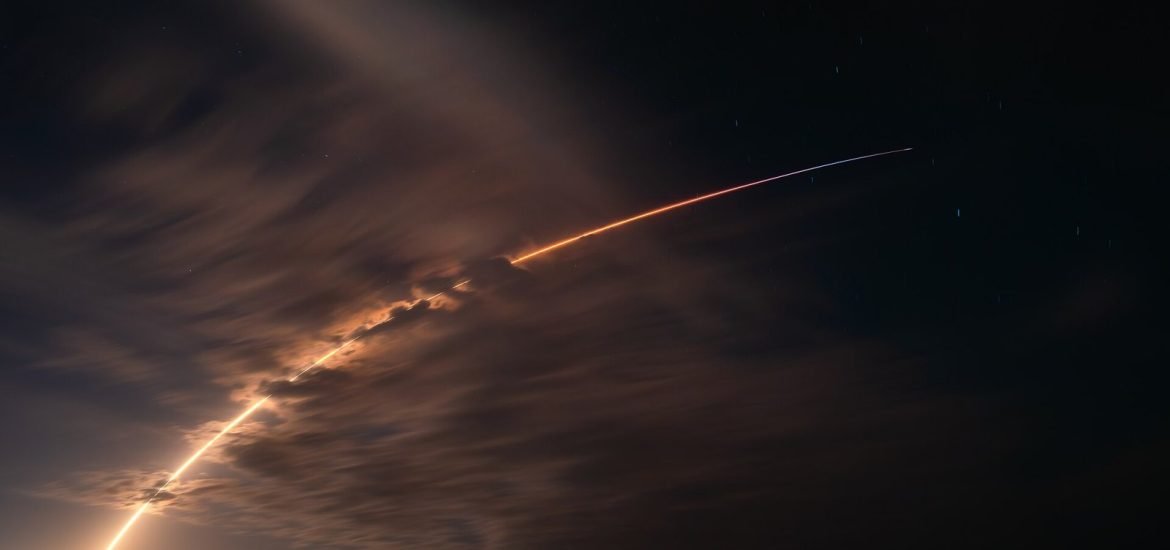
Illustration: a Falcon 9 rocket carrying Starlink satellites (Starlink 6-48 mission) launches from Cape Canaveral, 10 April 2024. U.S. Space Force photo by Joshua Conti, public domain, via Wikimedia Commons.
.jpg)
This post is also available in: FR