In his review of Walter Isaacson’s The Innovators, Jean-Paul Oury argued that France and Europe had “missed the digital revolution”. The physicist François Vazeille, who spent more than half a century working on CERN experiments, disagrees: the Web, the world’s largest computing grid and an exemplary partnership between laboratories and industry all grew out of European fundamental research. In his view, the “President of the future” would do well to remember it.
I read with great interest Jean-Paul Oury’s review of Walter Isaacson’s book (in French). I have not read the book itself, and I dispute neither Europe’s lag in platforms and venture capital nor the value of the lessons the author draws from it. But one milestone in the timeline caught my eye: the announcement of the World Wide Web by Tim Berners-Lee, who wrote the proposal for it in March 1989 and announced it publicly in August 1991. Slotted in between Bell Labs, ARPA, Intel and Apple, the Web risks being taken for yet another American invention. Yet it is a European creation.
The Web, a Geneva invention
The Web was born at CERN, the European laboratory for particle physics, which straddles the French-Swiss border. Its experiments bring together scientists from more than a hundred countries, most of whom work from their home universities. Before the Web, these scattered researchers (I was one of them) communicated by telephone, post or fax, even to send each other diagrams or program listings. The Internet existed, but it remained the preserve of specialists.
The man behind the breakthrough was a Briton trained as a physicist, an Oxford graduate of 1976: Tim Berners-Lee. In March 1989, he handed his group leader, Mike Sendall, a proposal for a hypertext information system (CERN Archives). He was then working in CERN’s computing division, the same division as René Brun, a former PhD student at my laboratory in Clermont-Ferrand who went on to write software used by generations of physicists, right up to the LHC’s ATLAS and CMS experiments. Together with the Belgian Robert Cailliau, Berners-Lee invented the HTTP protocol and the HTML language. By the end of 1990, the first server and the first browser were up and running. On 30 April 1993, CERN put the software in the public domain instead of patenting it, and that is what allowed the Web to spread.
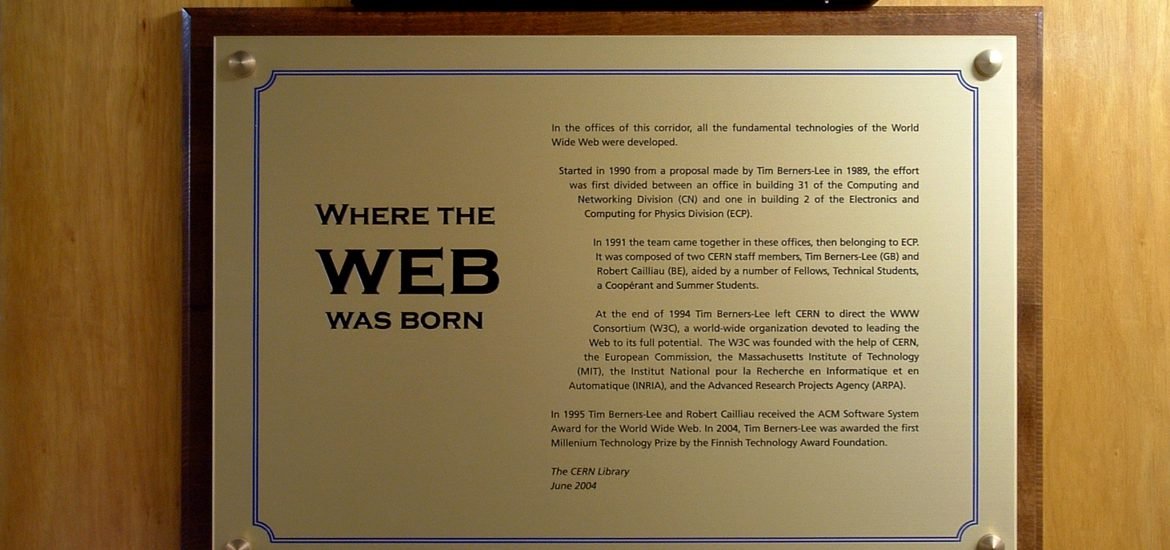
A plaque in a CERN corridor records that this is where the Web was born. As an aside, a few years earlier, in the early 1970s, the Clermont-Ferrand team occupied one of those offices. And I confess that when I stop at a red light behind a van displaying its three “W”s, I feel more than a little proud, even though I had absolutely nothing to do with it.

Some will object that Europe failed to profit from it. The first mainstream browser, Mosaic, came out of an American university in 1993. In 1994, Berners-Lee moved to MIT to found the W3C consortium there, and CERN decided that developing the Web lay outside its mission (CERN). All of this is true. But choosing openness was not a weakness: it is what made the Web universal. At the opening ceremony of the London Olympic Games in 2012, Sir Tim Berners-Lee, knighted in 2004, appeared in the middle of the stadium, seated at a NeXT computer like the one that served as the first server. He tweeted “This is for everyone”, a message instantly displayed on thousands of light panels in the stands. That evening, watching on television, I also saw a display of lights circling the stadium simulate the paths of particles in a CERN accelerator.
The worldwide computing grid: the other quiet revolution
When I started out, collision data were recorded by hand or on paper rolls, then copied onto punched cards. The LHC changed the scale of things. The challenge was no longer just to build the largest machine on the planet and giant detectors such as ATLAS, the experiment I worked on, which weighs 7,000 tonnes. Every laboratory also had to be able to analyse the data. ATLAS brings together more than 5,500 members from some 245 institutes in 42 countries, and ALICE, CMS and LHCb faced the same problem.
CERN’s answer was to pool its own computers with those of the laboratories and of the large national computing centres: this is the Worldwide LHC Computing Grid (WLCG). The idea of a “grid” had been put forward in the late 1990s by two Americans, Ian Foster and Carl Kesselman, as CERN readily acknowledges. But it was in Europe that it became the largest operational infrastructure of its kind in the world. According to CERN, the grid combines about 1.4 million computer cores and more than 1.5 exabytes of storage (an exabyte is a billion billion bytes) spread across more than 170 sites in 42 countries. More than 12,000 physicists have near real-time access to it, and more than two million tasks run on it every day. In practice, a researcher submits an analysis program, which runs wherever machines happen to be free at that moment, anywhere in the world, and the results then come back to them.
This is not a luxury reserved for enthusiasts of the infinitely small. The same technology has been used to search for drugs. In 2005, the WISDOM project, led in part by the LPC in Clermont-Ferrand, used the European EGEE grid to screen by computer the affinity of hundreds of thousands of molecules for malaria targets: 42 million molecular “docking” calculations, which led to new inhibitors confirmed in the laboratory. The exercise was repeated in 2006 against avian flu. In this way, many more leads can be explored, much more quickly, before moving to the lab bench. This medical use later allowed the LPC to bring in biologists: the laboratory now has a “Health and Environment” division.
Public research and industry: nothing “impure”
In his interview with TES (in French), Maurice Allègre, the former government delegate for computing in charge of the Plan Calcul, explains that “at the time, it was impossible in France to get universities and industry to work together” and that “it was considered impure by the people at the CNRS”. He adds, incidentally, that “today, fortunately, things have changed”. I cannot judge the 1960s. But I can testify that, for more than thirty years, in my field, the exact opposite has been true.
The French laboratories involved in the LHC come under either the CEA or the CNRS. The CNRS ones (IN2P3 institute) are joint research units (UMRs) run with universities, which guarantees close cooperation between CNRS staff and university academics: my laboratory in Clermont-Ferrand is UMR 6533. In our discipline, physicists design their detectors themselves, with their engineers and technicians, after an R&D phase that lasted some fifteen years in the case of the LHC. The components are then mass-produced in very large series (tens of thousands of electronic boards, for example) by leading-edge manufacturers, selected through international calls for tender against very strict specifications.
The partnership often goes further. For the ATLAS hadronic calorimeter, for which our group was one of the main teams responsible from design through to operation, we needed compact, high-performance photomultipliers (sensors capable of detecting a single photon). A renowned Franco-British company based near us did not follow up. So we spent several years working with a Japanese manufacturer, Hamamatsu, to adapt a highly innovative tube to our needs. The manufacturer itself presented this product as the fruit of its collaboration with our laboratory. It went on to win the worldwide call for tender against European, Russian and American competitors, and delivered some 10,000 tubes. Each batch was validated on a test bench designed in Clermont and replicated in the other laboratories. This 2,900-tonne calorimeter is today the heaviest component of ATLAS, and the community regards it as the best-performing hadronic calorimeter at the LHC. I see nothing “impure” in that. More broadly, fundamental research leads to practical innovations, which stem both from the new knowledge it produces and from the new technical means it demands: that is the whole point of CERN’s knowledge transfer programme, which puts industry in touch with its technologies, expertise and facilities.
CERN, a much-copied model
Among Europe’s handicaps, the review cites the multiplicity of languages (the Union has twenty-four official ones). This has never been an obstacle at CERN, where many more are spoken. The review also praises Bell Labs, which brought together theorists, experimentalists and engineers. CERN does the same, across even more disciplines and on a global scale. The 27-kilometre tunnel dug for the LEP collider, then reused for the LHC, was Europe’s largest civil-engineering project before the Channel Tunnel: its two ends met with just one centimetre of error in 1988. This kind of expertise in underground surveying, which notably involves transferring ultra-precise surface coordinates to the bottom of the access shafts, was also one of the keys to boring the Channel Tunnel. At the LHC’s inauguration on 21 October 2008, its project leader, Lyn Evans, described it as “the largest and most sophisticated scientific instrument ever built”.
This model has been copied. In December 1962, James Watson and John Kendrew, newly awarded the Nobel Prize, visited CERN’s Director-General, Victor Weisskopf. From these exchanges came the idea of a European biology laboratory built on the CERN model. The intergovernmental conference that prepared it first met at CERN in 1969, and the agreement founding the European Molecular Biology Laboratory (EMBL) was signed on 10 May 1973. EMBL now has six sites and 29 member states. More recently, the ITER Organization, which runs the major fusion project, signed a cooperation agreement with CERN in 2008; CERN also works with ESA, ESO and the ESRF.
This is the Europe of science, not the Europe of treaties. It has 25 Member States and 11 Associate Member States, and cooperation agreements link it to several dozen other countries. The United Kingdom left the European Union, not CERN. The United States, Japan, Canada and India have contributed to the LHC, and American physicists come in large numbers. The two rival experiments, ATLAS and CMS, even co-signed a paper on the mass of the Higgs boson in 2015 with 5,154 authors (see my previous op-ed, in French).
What the “President of the future” should be told
The lessons Isaacson draws from the history of the digital age (collective creativity, transmission between generations, diversity of profiles, distributed power) are sound. Physicists have long put them into practice, because that is how science is built. But an analysis centred on companies, whose purpose is to make a profit, misses one dimension: innovation also springs from fundamental research, both from its discoveries and from the tools it has to invent in order to make progress. CERN illustrates both.
Fabiola Gianotti, then Director-General of CERN, made the point in 2018 at the World Economic Forum in Davos, which she co-chaired: “History shows us that major breakthroughs often come from fundamental research. For instance, quantum mechanics and relativity, considered as useless knowledge by many at the time they were developed, are now the underpinnings of much modern electronics and of GPS systems.”
So let us put Walter Isaacson’s book into the hands of the future President of the future, as Jean-Paul Oury suggests, but with a postscript. Innovation is not America’s preserve. Europe has research organisations, national and international, capable of innovating at the highest level. And innovation is not limited to technology: fundamental science also nourishes our culture, from the theory of evolution to the standard cosmological model. The Web itself is proof of this: it was born of a need felt by physicists, and today it is “for everyone”.
About the author
François Vazeille is a particle physicist and former CNRS Research Director Emeritus at the Laboratoire de Physique de Clermont Auvergne (LPCA, CNRS/IN2P3 – Université Clermont Auvergne). A founding member of the ATLAS collaboration at CERN’s LHC, in which he led the Clermont team, he has taken part in sixteen experiments at CERN. In 2017, he received the Fernand Mège Prize from the Académie des sciences, belles-lettres et arts de Clermont-Ferrand for his career as a whole.
Further reading
- The Innovators: the book to put in the hands of the future President of the future (Jean-Paul Oury, in French)
- “There are lessons to be learnt from the Plan Calcul for our industrial policy” Maurice Allègre (interview) (in French)
- Higgs boson, intersubjectivity and spiral dynamics: let us keep a cool head (François Vazeille, in French)
This post is also available in: FR