As traditional aid retreats and private equity and development-bank loans move into cancer care in low- and middle-income countries, Mathieu Morand, Director of the Accelerator Hub at the City Cancer Challenge Foundation (C/Can), argues that money alone will not save lives. With this month’s World Health Summit in Berlin (11–13 October) as the backdrop, he calls on financiers to fund the “invisible infrastructure” – referral pathways, care standards, trained staff and data systems – without which new hospitals and machines never turn into treated patients.
Global health financing is shifting. For years, investment has understandably focused on expanding physical capacity and access: hospitals, equipment, medicines, technology. This has transformed what health systems in low- and middle-income countries (LMICs) can offer.
But infrastructure alone does not create a functioning health system, because a new machine, facility or treatment only improves outcomes when the system around it is ready to put it to work. Investment needs an interconnected system to land in, one that can absorb it and turn it into services patients can actually use. Building that readiness – through care standards, referral pathways, workforce training and data systems – is one of the highest-return investments in global health today.
As traditional aid retreats, LMICs must navigate a dual landscape of private investment and public loan financing from multilateral development banks (MDBs). But whether capital comes from global private equity or from institutions like the World Bank, it is not a gift: it expects returns or repayment and, crucially, systems capable of making it count.
Capital is flowing – but stopping short
Capital, both private and public, is moving into cancer care in LMICs. But in too many places, it stops short of reaching those who need it most.
Private capital flows through individual hospital chains rather than the systems surrounding them. In India, for example, the oncology chain HealthCare Global Enterprises (HCG) drew three successive waves of private equity, culminating in a $400 million controlling-stake acquisition by the global investment firm KKR in 2025. Yet a significant share of India’s population still lacks access to adequate cancer care. Why? Because private hospital care is often unaffordable, and capital expands specialist beds in cities faster than it builds the systems that connect patients to them.
Public capital runs into the same wall. Indonesia’s Health System Transformation Agenda is backed by a $4 billion investment co-financed by the World Bank, the Asian Infrastructure Investment Bank (AIIB), the Islamic Development Bank (IsDB) and the Asian Development Bank (ADB). It is the largest medical equipment procurement programme ever financed by MDBs, equipping some 10,000 primary health centres and 560 hospitals. New equipment alone will not close Indonesia’s diagnostic gap; the system built around it will.
The invisible infrastructure
The fundamental issue is that capital traditionally funds hard, visible assets – beds, hardware and diagnostic equipment. It systematically overlooks the “invisible infrastructure” required to make those assets function: data systems, standardised care guidelines, human capacity and quality-assurance protocols. Why buy more mammography units if existing ones sit underutilised?
Readiness is not a single switch. It is a diagnosis: whether an effective referral system exists, whether facilities have the workforce and equipment to deliver care, whether care quality is monitored, and whether patients are tracked from diagnosis to the end of treatment. Skip the diagnosis, and financing defaults to what is visible – the beds, the machines – and misses the layer that decides whether any of it works. Get that diagnosis right, and capital goes exactly where it is needed, not simply where it is easiest to spend.
System integration: making capital land
So how can finance flow through the whole system, rather than just to single interventions? This is where system integration becomes indispensable: not simply installing infrastructure, but running a systemic diagnosis and building the missing pathways.
City Cancer Challenge (C/Can) works to bring the pathways, the workforce, the care protocols and the data systems together into a single, functioning cancer care journey. This on-the-ground readiness ensures that capital converts into treated patients rather than stranded innovations.
As ministries of finance, regional development banks and multilateral lenders increasingly pivot towards results-based financing, capital alone is no longer enough. What matters just as much is ensuring that the system itself is capable and equipped. That requires operational partners on the ground who can execute complex service-upgrade packages and rigorously track target outcomes, so that systems deliver on their financial and health commitments.
Readiness in practice: Cali and Yogyakarta
C/Can’s work strengthening system readiness shows what this looks like in practice. In Cali, Colombia, fragmented care pathways meant that breast cancer diagnostic delays frequently exceeded 100 days, according to City Cancer Challenge (C/Can) data (2026). C/Can supported the design and implementation of a system coordination mechanism aligned directly with an indicator of the World Bank’s programme to improve access to effective health services in Colombia. C/Can’s programme tracked nearly 200,000 women. By the end of 2025, the same data show, the average time from suspicion to confirmed diagnosis had fallen from 60 to 42 days, even as patient volumes increased significantly.
In Yogyakarta, C/Can worked with local stakeholders to design Indonesia’s first city-level breast cancer programme, laying the foundations for access to quality care. The model is already extending to Jakarta: proof that system-level readiness can scale nationally.
Investing differently
As global leaders gather in Berlin for this month’s World Health Summit (11–13 October), this logic must shape the agenda: durable health systems are built from the ground up, not imposed from the outside. This is not an argument against more investment, but an argument for investing differently: blending traditional capital expenditure with robust allocations for system readiness.
The funding gap remains stark: low- and lower-middle-income countries, home to half the world’s population, carry 56% of the global burden of disease yet account for only 3.2% of global health spending. Development finance institutions, regional banks and private partnerships should not settle for financing point solutions tailored to an insured minority. Instead, they must allocate capital directly to the unglamorous, invisible work of system integration alongside the infrastructure. This is the connective tissue that turns capital into durable health systems and better outcomes for patients.
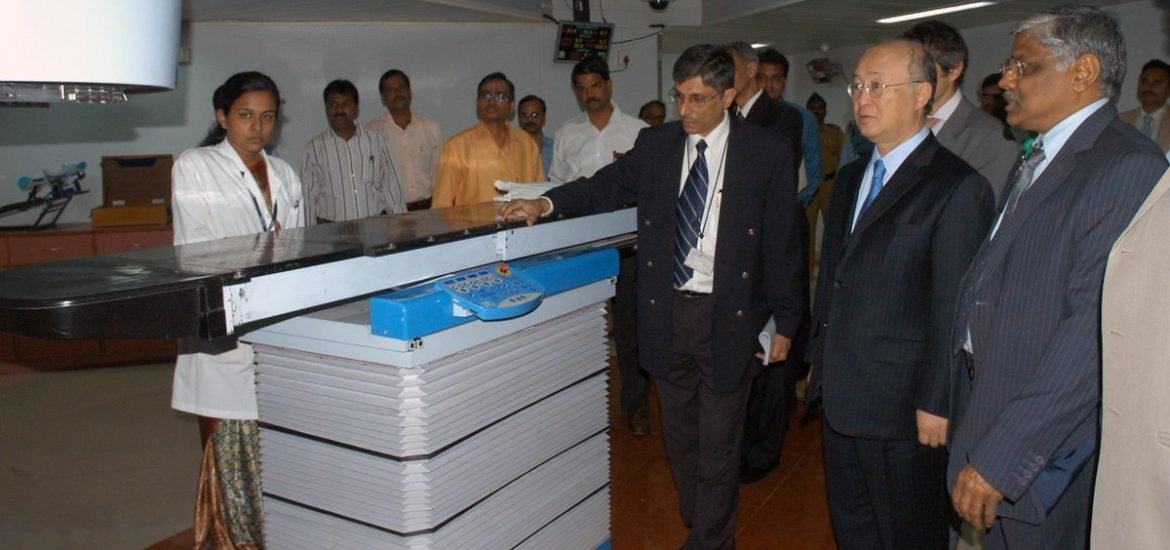
Featured image: a “Bhabhatron II” teletherapy machine at the Advanced Centre for Treatment, Research and Education in Cancer (ACTREC), Mumbai, 2011. Photo: IAEA Imagebank / Wikimedia Commons, CC BY-SA 2.0 (cropped).

About the author
Mathieu Morand is the Director of the Accelerator Hub at City Cancer Challenge (C/Can), leading strategic initiatives to expand the foundation’s impact across borders by enhancing the scalability and replicability of its interventions. He serves as the bridge between health institutions, funders and C/Can’s portfolio of technical solutions. Previously, Mathieu shaped C/Can’s expertise in digital health and health financing and spearheaded flagship innovation projects. Throughout his career, Mathieu has focused on building and scaling organisations in LMICs. Before joining C/Can, he worked in venture capital and private equity as an investment manager and board member for health-tech companies. He also led operations for an Indian health-tech venture in cancer care and began his career as a strategy consultant. He holds a Master’s in Management with distinction from HEC Paris and an MBA from the Indian Institute of Management Ahmedabad.
Read also
- Funds for cancer research not the same for everyone
- Lifestyle changes could prevent millions of cancer deaths, says WHO
- Missing first mammogram increases risk of advanced breast cancer
This post is also available in:
Leave a Reply