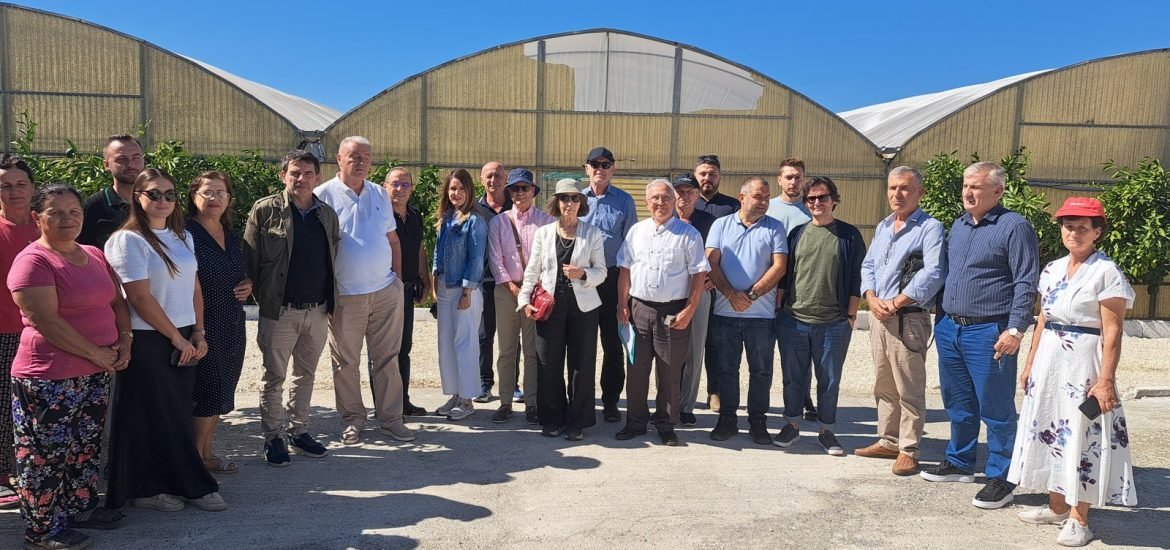
In the second part of his interview with The European Scientist, Nazim S. Gruda, President of the Union of European Academies for Sciences Applied to Agriculture, Food and Nature (UEAA), draws the lessons of the Tirana 2026 General Assembly and explains what the Western Balkans and other candidate countries can bring to European agricultural science. He also discusses the post-2027 CAP, climate-ready horticulture, and why academies must enter the public debate on farming sooner and in plainer language.
This is the second part of our interview with Nazim S. Gruda. Read the first part: “Influence comes from being useful at the right moment”.
Prof. Dr. Nazim S. Gruda is an internationally recognised expert in innovative, sustainable horticulture. He chairs the ISHS Division of Greenhouse and Indoor Production Horticulture and is Editor-in-Chief of both the International Journal of Vegetable Science and the Encyclopedia of Vegetable Science. With more than 450 publications (225+ indexed in Scopus), he is among the most-cited scientists in his field. He has been a Courtesy Associate Professor at the University of Florida (2003) and a Visiting Research Scholar at Virginia Tech (2007). His honours include the Dr. Heinrich Baur Prize (TU Munich, 2003), the National Prize of the Academy of Sciences of Albania (2017), the Distinguished Scientist Award of the Chinese Academy of Sciences (2020 and 2025) and Honorary Membership of the ISHS (2026). He is a Corresponding Member of the Accademia dei Georgofili (Italy), an Honorary Member of the Romanian Academy of Agricultural and Forestry Sciences, a Foreign Member of the Lithuanian Academy of Sciences and a Full Member of the Academy of Sciences of Albania.
Photo: private (Nazim S. Gruda).
Tirana 2026: outcomes and the Western Balkans
The European Scientist: The Tirana symposium focused on “Sustainable European Agriculture and Balanced Management of Natural Resources”. Beyond the speeches, what are the two or three key messages or decisions from the General Assembly that you want European decision-makers to hear?
Nazim S. Gruda: The Tirana theme was chosen deliberately: food security and responsible natural resource management belong together. I would highlight three messages from our discussions.
First, productivity and sustainability can reinforce each other when innovation improves resource efficiency and maintains viable farm incomes. Environmental ambitions need practical tools, investment and scientific support.
Second, water and soil deserve coordinated European attention, alongside responses adapted to local conditions. Their management is fundamental to the long-term capacity to produce food.
Third, we must close the distance between research and farms—and between policymaking and farmers. Our programme therefore extended beyond conference rooms, with visits to the Agricultural University of Tirana, the agricultural technology-transfer centre in Lushnjë and farms in the region.
Our message to decision-makers is to assess sustainability through measurable outcomes on farms, in landscapes and across food systems. Policies also need sufficient stability for farmers to plan investments over years. My invitation to policymakers is simple: bring us in early, and ask us the difficult questions. A challenging discussion today can prevent a costly mistake tomorrow.
TES: Holding the General Assembly in Albania, which joined the UEAA in 2022, and electing an Albanian president with a representative of the Kosovo Academy of Sciences and Arts among the new observers, sends a signal. What can the Western Balkans and other candidate countries (Moldova, Ukraine, Georgia) bring to European agricultural science? What does EU enlargement mean for food systems and research cooperation?
N.S.G.: For me, Tirana’s message is that Europe’s agricultural future must draw on expertise across the continent, including countries outside the EU. Albania contributes Mediterranean–Balkan expertise in vegetables, olives and protected cultivation; Moldova and Georgia bring genetic diversity and experience in viticulture and fruit production; Ukraine contributes expertise in large-scale agriculture and maintaining production under extraordinary pressures. These experiences are valuable as Europe adapts to climate change.
The association of these countries with Horizon Europe provides a framework for cooperation before accession. For food systems, enlargement means linking research with food safety, plant health and production standards, while helping institutions participate effectively in joint projects. Scientific integration can advance before political accession, with benefits on both sides.
UEAA can strengthen these connections, but our outreach extends across Europe. In Tirana, we renewed links and welcomed new representatives from academies in Portugal, Greece, Ukraine and Lithuania. We were particularly pleased to welcome participation from Spain’s Andalusian Academy of Agriculture, established in February 2026. Bringing longstanding academies and new institutions together strengthens the range of expertise available to us. The aim is to turn that diversity into sustained cooperation that benefits researchers and farmers throughout Europe.
Europe’s agricultural challenges
TES: Food security has returned to the top of the agenda with war in Ukraine, climate extremes and trade tensions. Since 2024, the EU has withdrawn its proposed pesticide-reduction regulation, softened several Green Deal and Farm to Fork ambitions in the name of “simplification”, and is now negotiating the post-2027 CAP. Is this a healthy rebalancing towards competitiveness, or a step back that science should warn against?
N.S.G.: I would judge these changes by their consequences rather than give them a blanket endorsement or rejection. Competitiveness matters: farmers need viable businesses to invest in environmental improvements. Simplification is legitimate, but it should reduce unnecessary paperwork without weakening environmental protection.
Withdrawing the proposed pesticide regulation did not remove existing obligations. However, it left unresolved how Europe will achieve its ambitions to reduce pesticide risks. Farmers need effective, affordable alternatives, including integrated pest management, biological control and more resilient varieties.
Science should warn against exchanging long-term resilience for short-term relief. Healthy soils, reliable water supplies and biodiversity underpin productive agriculture. Environmental measures must also account for their effects on yields, produce quality, costs, and farmers’ capacity to adapt.
For the post-2027 CAP, our working group has advocated phasing out environmentally harmful subsidies and rewarding measurable environmental and climate services. Farmers also need stronger risk-management tools and sustained investment in knowledge and innovation. Reform should make these changes economically workable for producers.
We should not pretend that environmental targets are cost-free for farmers, or that environmental degradation is cost-free for society. The aim is competitive agriculture that safeguards the resources on which its future depends.
TES: Climate change is your field of expertise: protected cultivation, soilless systems, controlled-environment agriculture, urban horticulture. Which practical innovations could make a measurable difference for European vegetable and fruit production within the next ten years? What is holding them back: cost, energy, regulation, skills, or acceptance?
N.S.G.: Over the next decade, I see three practical priorities.
First, recycling drainage and recovering transpired water in suitably equipped greenhouses can reduce freshwater demand. Savings depend on the crop and system; however, energy costs must also be considered.
Second, upgrading greenhouses with climate-appropriate ventilation, shading, thermal screens, and heat recovery. AI and digital twins—virtual models updated with sensor and crop data—can help test management strategies, but require validation under commercial growing conditions.
Third, cultivars and rootstocks better adapted to heat, drought or salinity. In orchards, these can be combined with targeted irrigation and protective nets, tested under local conditions.
Technical performance is not enough: growers need a reliable return on investment. Capital costs, energy prices and skills remain major barriers. Vertical farming is particularly sensitive to electricity costs; recirculation demands expertise in water quality and crop health. New breeding techniques also require clear regulatory pathways and grower and consumer confidence. Urban horticulture will not feed Europe, but its lessons in irrigation, nutrient recycling and resource efficiency can benefit other production systems.
Demonstration farms should therefore document investment costs, operating savings, yield and quality over several seasons. That gives growers a credible basis for deciding what works—and what pays.
TES: Scientists often complain that public debate on farming, from pesticides to gene editing and AI, is driven by fear rather than evidence. What should academies do differently to communicate? And what would you ask of journalists?
N.S.G.: Academies must stop assuming that facts speak for themselves. We often enter public discussions too late and use technical language when people want to know what a development means for their food, livelihood or environment. Concerns deserve a serious response, not dismissal as ignorance.
We need shorter statements, plain language and examples from real farms. We must explain what is known, what remains uncertain, who benefits and who bears the risks. Funding and potential conflicts of interest should be transparent. Above all, we should talk with farmers and consumers, not only to them.
I would ask journalists to examine the strength of the evidence, distinguish hazard from risk, and avoid presenting unequal bodies of evidence as a fifty-fifty scientific dispute. They should challenge scientists, industry, campaigners and policymakers with the same questions: What supports this claim? Under what conditions does it hold? What are its limitations?
Academies can help by making relevant experts accessible and responding promptly, while respecting editorial independence. The purpose is to enable informed scrutiny and discussion.
Together, scientists and journalists can make complex questions clearer—not merely louder. Trust depends on explaining both the possibilities of innovation and its limits.
Interview by The European Scientist
This post is also available in: FR DE