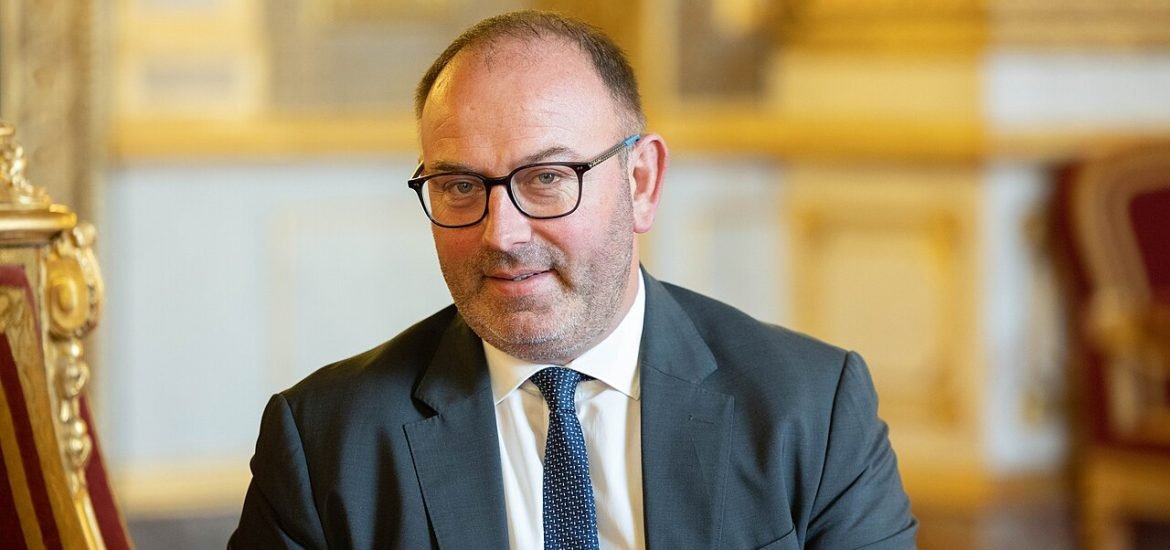
France : Last week, the first conference on the Fight against Agricultural Decline took place in the Senate. During this meeting, organized at the initiative of Senator Laurent Duplomb, experts examined the causes of the French agricultural downturn and analyzed them. The LR elected official from Haute-Loire, who is also a farmer, reviews the explanations for this phenomenon. He questions the reasons for this deficit in the French agricultural trade balance, even as Europe is achieving strong performance. An analysis that allows him to justify the new version of his bill, which had been rejected by the Constitutional Council.
The European Scientist: On Monday, the conference on the fight against agricultural decline took place in the Senate. What was the purpose of this event?
Laurent Duplomb: First of all, it’s about raising awareness: there is more than just a decline. I had already announced it in 2018, and the update of the report confirms the accuracy of my predictions and even worse: for the first time in 50 years, the French agri-food trade balance is plummeting and becoming negative.
But the most important thing is that it’s not Europe that’s plummeting. It’s France alone that’s doing exactly the opposite.
Europe, on the other hand, is doing well, with 50 billion in surpluses, becoming the second-largest global exporter and surplus territory behind Brazil, which is at 125 billion.
Whereas Europe was in deficit and France in surplus a few years ago, now it’s the reverse. From a 12 billion surplus, it goes to a 500 million deficit. If we remove wines and spirits, the real food deficit is minus 13 billion.
The French, to feed themselves overall, spend 13 billion euros to balance these purchases. In an agricultural country that is, I remind you, not only the most powerful in Europe for decades, but especially the largest in terms of cultivable land.
TES: Why, in your opinion, is France the sick man of Europe?
LD: We need to ask why, when France is plummeting to a minus 500 million euro deficit as of the end of November 2025, a country like Spain, which 20 years ago was in a structural deficit, now finds itself with a surplus of more than 18 billion euros. An 18.5 billion gap between France and Spain, even though France has 18% more land than Spain, a partially semi-desert country.
Why have we become the worst student in the class and Europe’s deadweight, perceived by other countries as the ones dragging the system down?
Note in passing that agriculture is not alone in showing poor results: a 5% public deficit, exceeding debt-to-GDP ratio, France’s downgrading within the European financial concert. Alas, we lack the courage to do the necessary work and stop this hemorrhage: look at the pension reform that was aborted.
Through successive renunciations, we have let the hourly labor cost slip away. In the apple market, for example, Poland is our main competitor. The Polish hourly rate is 12 times cheaper than the French hourly rate; it’s no surprise that there’s a competitiveness gap between Polish apples and French apples.
Added to this is our normative capacity (our addiction to over-transposition) that grafts onto a very anxiety-inducing climate. Like during the obscurantism of the Middle Ages, we seek to protect the population through a multitude of rules, norms, prohibitions, obstacles, constraints. These are the fundamentals of our decline.
Finally, we still dream of being a superpower. But who will listen to us if we are incapable of setting the example ourselves? On the contrary, we sit on the rules (for example, we don’t respect the European deficit).
If you score a goal from the stands, I don’t think your opponents will find that normal… because it doesn’t correspond to the rules. Well, that’s France’s problem; it believes it can continue to encourage people and other European countries to listen to what it says.
The other countries have understood that if they followed us, decline would be assured. When we lose 12 billion in trade surplus, and the European territory gains 50 billion in surpluses, part of those 12 billion ends up in the 50… They are produced by Germans, Italians, Spaniards, or others to create value in their country, which benefits the overall value of Europe.
Take the example of the Belgian royal administration, which recently changed its view on the use of acetamiprid for beets in spraying and foliar application. Whereas it required a renewable derogation year after year. At the end of 2025, they granted a definitive authorization for acetamiprid, meaning beet producers will no longer need an annual derogation. They now have an authorization that takes them until the end of the European authorization in 2033. In France, we have highly inflamed, irrational debates on health, on bees…
In Belgium, the legislator has sent a signal to Belgian beet producers. Meanwhile, sugar factories are closing in France (already 6 have shut down); all this contributes to the general impoverishment of the country.
TES: As the speakers at this first conference showed, the decline takes several forms and is not only economic. What do you think of these other forms of decline?
LD: This decline is organized by a particular form of thinking that finds its source in ecologism, a sort of religion that pours into the media and embodies punitive ecology. According to this, every act of production is perceived as an aggression against the environment.
We have reached a point where, after demanding the independence of health agencies, it’s the same people who refuse to listen to them when the results don’t suit them. This is the case with the EFSA on acetamiprid.
And when science is not on their side, they activate the dogma of anti-capitalism, knowing there is a certain porosity between green ecologism and red anti-capitalism. This is seen in the votes in the National Assembly.
These people push a form of framing of thought: “If you do that, you’re going to harm the environment; if you harm the environment, it’s the end of the world.” The planet risks disappearing, and when it’s not the planet, it’s health; when it’s not health, it’s behavior; when it’s not behavior, it’s all the flaws of man, and so on. Everything goes.
And when you argue about the need to produce to live, they reply: “But we don’t really need the economy to live.” An idea that has spread today like ink on blotting paper over the last 30 years.
There are three causes at the origin of this: the precautionary principle inscribed in the constitution, which now governs almost all our actions; the Grenelle de l’environnement; and the environmental charter. All these principles constrain our lives, and the Constitutional Council has to deal with them, as shown by the example of acetamiprid.
TES : Farmers came to testify about their difficulties, such as the president of the hazelnut sector, which is threatened with disappearance by the ban on acetamiprid. Is this one of the reasons why you have tabled a new bill?
LD: If I had to table a new bill, it’s because the problem wasn’t actually solved. The Constitutional Council’s decision to censor Article 2 does not resolve the obvious distress and injustice done to producers in several sectors. Because beyond the law written with five other senators that only covers the sectors cited by INRAE, there are others.
Today, it’s beets, hazelnuts, apples, and cherries that are impacted. French cherry producers are on the verge of extinction, and the price of French cherries is three times higher than that of cherries imported from Turkey.
Not having found the answer to the problems of these sectors, we tried to write, as scholarly as possible, a text that meets the criteria of the clauses in the Constitutional Council’s censorship conclusion.
But other sectors will come forward tomorrow because they are in the same situation: asparagus, endive, kiwi, nectarines.
In 2025, in the article we wrote to authorize acetamiprid and the two associated molecules on a derogation basis, we estimated there were between 12 and 13 sectors affected by these technical dead ends and this growing difficulty in fighting pests. The ones we forgot (between eight and nine) will come back. Otherwise, we’ll have to learn to do without all these sectors in France.
It’s French hypocrisy: how can we say, “I’m still going to eat the same fruit, the same vegetable, but it will come from abroad with exactly the production methods and molecules that I wanted to ban… Get those methods out of my sight.” Fortunately, it seems people are starting to become aware of these things.
TES: Petition from scientists and citizens, cross-party grouping of politicians, alarmist headlines… French society was up in arms against your first bill. How will you resist the pressure this time?
LD: I resisted the pressure the first time! I could have withdrawn the text, which I didn’t do. I went all the way despite these pressures and this media frenzy. I remind you of the results of the joint committee in June: it was adopted by 10 votes to four. The conclusions of this joint committee were voted by 70% of senators and 60% of deputies. That’s more than an honorable result.
In the National Assembly, I think it was a 92-vote margin; there are few texts that pass with a 92-vote margin, especially when they are so divisive and important.
Strengthened by that, we must not doubt; we must continue. And this despite the intimidations, anonymous letters, articles in the media, assassin comments from one or the other, and particularly from LFI and the ecologists. I’ve come to terms with it. And I even think that’s the meaning of the battle.
If we say that the reality of our ills is ideology passing through two prisms of ecologism and anti-capitalism… As a man of the right, I must stand against that.
That’s what I’m doing. I cannot accept that we are forced into single-minded thinking. Because that’s what we’re doing in France.
TES: Chemophobia, animalism, degrowthism… All these words reinforce agri-bashing a little more each day and affect all sectors of the agricultural world. How to get out of this infernal spiral and restore nobility to the agricultural world?
LD: Over the last 30 years, ecologism and anti-capitalism have imposed their logic and even invented a vocabulary that has entered people’s thinking. I’ll give you two examples. Let’s start with mega-basins. The original expression is “substitution reservoir.” In French, we substitute for something that existed. What did we do before? What do we do now?
Before these reservoirs, the farmer pumped directly from the resource, either a river or a groundwater table in the middle of July, in the middle of August. The substitution for that system is to create a reservoir of several million cubic meters or thousands of cubic meters, because the bigger it is, the more it lowers costs and the less expensive it is in terms of investment. So, he creates this reservoir with others to stop pumping in July and August and to pump at a time when everyone agrees there is too much water or at least well above low-water levels, and taking water at that time is less impactful on the environment.
That’s what all French people do when they have a house and the possibility to capture and recover rainwater in a barrel, in order to use it when there isn’t any to water their garden. Alas, the language of ecologism speaks of mega-basins.
Second point, industrial farming. Personally, I see myself labeled as an “agrobusinessman” who would be at the head of an industrial farm. My operation is the French average, 70 animals, 70 cattle per operator. A ridiculous number compared to the model we import through CETA from Canada or Mercosur from Brazil. In those countries, these are models with tens of thousands of animals per operation. And we’re told that French farming is industrial. Yet, it’s the only farming that has remained so family-oriented. And it’s an insult to farmers because the reality of all this is that it still manages to function in France. The economic reality of all this is an investment generation after generation of seven euros to generate one euro of revenue. In what capitalist system do you see investing seven euros to get one euro of revenue? Nowhere. On the contrary, this model should please the LFI and ecologists.
TES: An observatory on decline is good, but it only makes sense if it’s to give a future back to French agriculture. In your opinion, what needs to be done?
LD: What we are doing through the agricultural orientation law by removing the word agroecology 30 times… a sham. It’s not talked about in any European country. Agroecology is only spoken of in a dogmatic way in France.
We need to work on increasing farmers’ income. Between 2010 and 2024, where other Europeans besides France saw their incomes increase by 77%, the French only saw their incomes increase by 15%.
You can increase your income when there are fewer rules, fewer quotas, because you’re helped to invest and thus you can become a little more economically balanced.
When a multitude of rules are created that make production more expensive, by definition it affects income. And today, all these over-transpositions have a figure.
When we say that norms in Europe average half a point of GDP. When Spain is at 0.3 points, when Italy is at 0.8 points, when Germany is at 0.17 points of GDP, France is at 4 points of GDP.
Every day, this weighs on economic activity, like a ball and chain we drag constantly, which prevents us from keeping up with others. So that’s what needs to be changed to restore the true nobility of agriculture.
TES: Let’s talk about Europe to finish… Do you think that the very limited easing of European regulations on NGTs (new genomic techniques), which will probably, given the vote in the ENVI(ronment) committee, be adopted next March by the European Parliament, after six years of a very long procedure, will be sufficient for French and European agriculture to fully benefit from the innovations that these 21st-century biotechnologies can generate?
LD: Any element that reverses this dogmatic desire to eliminate all means of progress and goes against what punitive ecology wants (limiting inputs, GMOs, NGTs) is, in my opinion, in the right direction. And if we finally manage to get out of this obscurantism that paralyzes us and that today allows this minority to terrorize the majority and prevent it from making decisions that go in the direction of some form of progress, then good. The problem is that the battle has already begun and that all continents that have already implemented GMOs and NGTs have taken the lead… will we catch up on this delay? With all these rules, nothing is less certain. But if we don’t start one day by authorizing, we have no hope of catching up or being at the same level as others. So let’s start and go for it.
This post is also available in: FR