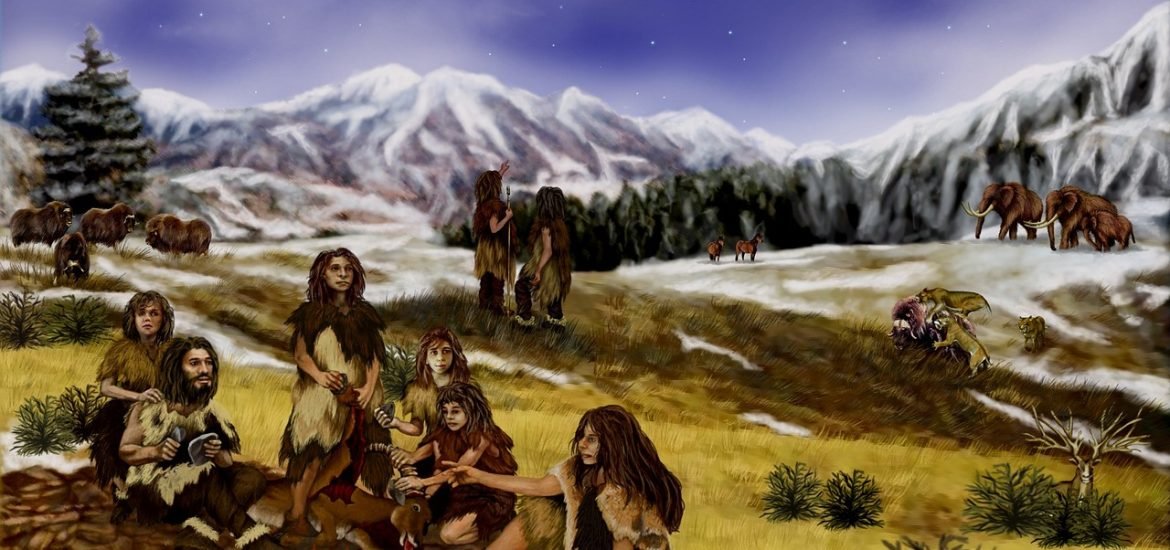
Eight teeth found in a cave in southern Poland have given scientists an unprecedented glimpse into the lives of a small group of Neanderthals who lived around 100,000 years ago, according to a study published in the journal Current Biology. For the first time, researchers have been able to reconstruct the genetic profile of a Neanderthal group from the same place and the same period in Central-Eastern Europe.
What was found
The teeth were discovered in Stajnia Cave in Poland, north of the Carpathian mountains. An international team of researchers, coordinated by Professor Andrea Picin of the University of Bologna, extracted ancient mitochondrial DNA (genetic material passed down through the maternal line) from all eight specimens. The analysis revealed that the teeth belonged to at least seven different individuals.
“This is an extraordinary result because, for the first time, we are able to observe a small group of at least seven Neanderthals from Central-Eastern Europe who lived around 100,000 years ago,” said Professor Picin. “In most cases, Neanderthal genetic data come from single fossils or from remains scattered across different sites and periods. At Stajnia, by contrast, it has been possible to reconstruct a small group of individuals, providing for the first time a coherent genetic picture of Neanderthals in this part of Europe.”
Co-authors Wioletta Nowaczewska and Adam Nadachowski, both Polish researchers involved in the study, added “We had known for some time that Stajnia Cave preserved exceptional evidence, but these results exceeded our expectations. Being able to identify such an ancient small group of Neanderthals in such a complex site is an important achievement for Polish research and for the study of Neanderthals in Europe.”
A possible family connection
Among the eight teeth, two came from young individuals and one from an adult. Intriguingly, all three carried the same mitochondrial DNA. “A particularly fascinating aspect is that two teeth belonging to juvenile individuals and one belonging to an adult share the same mitochondrial DNA,” noted Mateja Hajdinjak, researcher at the Max Planck Institute for Evolutionary Anthropology. “This suggests that these individuals might be closely related to each other.”
In other words, what may have been found in this Polish cave are the remains of family members, perhaps a parent and children, or close relatives, who lived together tens of thousands of years ago.
Connections across a continent
The genetic data also shed new light on how Neanderthal populations were distributed across Europe. The DNA from the Stajnia individuals belongs to the same maternal lineage as Neanderthals found in the Iberian Peninsula, south-eastern France and the northern Caucasus. This suggests that a particular genetic group was once spread widely across western Eurasia, before later being replaced by the lineages associated with more recent Neanderthals.
The finding paints a picture of a population that was far more connected across vast distances than previously appreciated.
A word of caution on dating
The study also touches on an important methodological point. One Neanderthal fossil found in a cave in France (known as Thorin) carries similar genetic signatures to the Stajnia individuals but had previously been dated to around 50,000 years ago. The researchers urge caution about such precise dating when working at the limits of radiocarbon technology.
“Our study is a reminder that the oldest chronologies must be treated with great caution,” said Professor Sahra Talamo of the University of Bologna. “When radiocarbon values approach the limit of calibration, it is essential not to assign more precision than the data can actually support. In such cases, the comparison between archaeology, radiocarbon dating, and genetics becomes crucial.”
Rewriting the map of Neanderthal Europe
Perhaps the broader significance of the discovery is what it says about Central-Eastern Europe’s place in Neanderthal history. Far from being a remote backwater, the region now appears to have been a significant hub for population movement, genetic exchange and the spread of tools and technologies during the Middle Palaeolithic period.
Picin A, Hajdinjak M, Nowaczewska W. First multi-individual Neanderthal mitogenomes from north of the Carpathians. Current Biology, 2026; 36, 2442-2453.e7