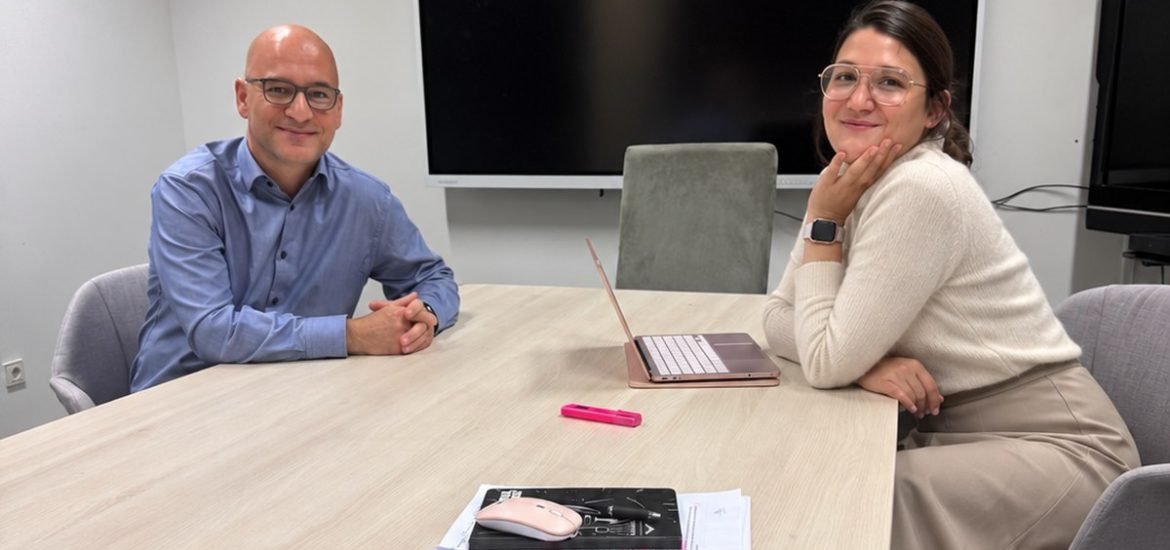
What can a game of backgammon tell us about Alzheimer’s disease? Drawing on her conversation in Magdeburg with Professor Emrah Düzel, Director of the Institute of Cognitive Neurology and Dementia Research and Speaker of the DZNE Magdeburg site, neuroscientist Dr Pınar Şengül argues that research and care should keep the person’s everyday life, and the abilities that remain, at the centre.
The conversation took place at IKND in Magdeburg University Hospital on 20 October 2026.
“These are islands of preserved ability.” Professor Emrah Düzel’s words have stayed with me since our conversation in Magdeburg. As Director of the Institute of Cognitive Neurology and Dementia Research at Otto von Guericke University Magdeburg, he studies how the brain supports memory and how Alzheimer’s disease disrupts it. His explanation also offered a way to think about what families can still share with a person living with dementia.
I had told him about playing backgammon with a man of around 90 who had Alzheimer’s disease. He struggled to describe recent events, yet he could still beat me and call out the dice in Persian, as he had done for years. His relatives were surprised. Düzel recognised in that experience an important part of care: “It is very important to help people feel comfortable, and there are keys to doing that.”
For me, his account connects two responsibilities that should advance together: understanding and reducing the effects of the disease, and supporting the person’s daily life. The details of that connection matter. Düzel’s explanations of memory, risk and care show why attention to the individual belongs throughout the discussion.
Understanding the abilities that remain
Düzel began with the work of his team: “We are trying to understand the circuit mechanisms of memory in the brain.” Memory has different forms, he explained, requiring many brain regions to work together. Studying those circuits allows his team to investigate how Alzheimer’s disease changes memory and how those changes affect everyday life.
Episodic memory, the memory of personal events, presents a particular challenge. As Düzel put it: “Unlike learning facts through repetition, a personal experience may happen only once. The brain therefore needs a system that can form a memory after a single experience.” He identified this as one of the functions affected early in Alzheimer’s disease.
His description of the loss was strikingly concrete: “The changes are a little like the erosion of a landscape. Imagine mountains, trees and lakes. Some trees disappear first, others later, while a mountain may remain for much longer.” He added: “Everything does not fade at once. People lose different bits and pieces of the memory landscape.”
That unevenness helps explain why difficulty recalling recent events can coexist with abilities that remain meaningful. My backgammon experience was not evidence of a treatment effect. It was a reason to pay closer attention to what this person could still enjoy and do.
Interpreting risk carefully
Düzel was equally precise about risk: “Ageing is the strongest risk factor, and we do not fully understand why.” He explained that APOE ε4, a variant of the APOE gene associated with cholesterol metabolism and amyloid accumulation, can substantially increase risk, with two copies associated with greater risk than one. But risk also rises with age in people without ε4. He made the distinction explicit: “It is certainly not the case that everybody develops Alzheimer’s disease.”
I asked how to interpret the 2024 Lancet Commission estimate that addressing 14 potentially modifiable risk factors could prevent or delay around 45 per cent of dementia cases. Düzel replied: “It concerns the population as a whole, rather than an individual person’s risk. It points to the importance of addressing modifiable risk factors across the population.” The figure should therefore not become a personal guarantee or a reason to blame someone who develops dementia.
He also described how risks cluster: “A sedentary lifestyle also tends to occur alongside other risks, such as obesity, poor nutrition and cardiovascular problems. These factors can co-vary.” His account included hearing and vision problems as issues that deserve attention. Asked whether lifestyle changes still matter for someone carrying APOE ε4, his answer was clear: “Lifestyle modification is also effective for people who carry this risk variant.”
Why movement matters
Düzel’s 2016 review in Brain, with Henriette van Praag and Michael Sendtner, explored exercise and memory. In our conversation, he explained why movement interests him: “There is an evolutionary logic to this: when you move, you change location, and the brain expects new information. Movement itself is a signal to the memory system.”
He also pointed to a cardiovascular component and to neurotrophic factors released during more vigorous exercise that can influence the brain. In his words: “These processes can support neural and vascular plasticity, the capacity of the nervous system and its blood supply to adapt.” These are mechanisms to investigate carefully; they do not make exercise a promise of recovery from Alzheimer’s disease.
Finding a realistic starting point
When I asked whether one lifestyle factor should take priority, Düzel distinguished the search for a single decisive mechanism from the question of what a particular person can change. His practical explanation was: “Many risk factors are linked, so it can be useful to identify the change that makes other changes possible.”
He gave two examples: “For one person, that may mean overcoming social isolation. For another, becoming more physically active may help them address several difficulties.” And he acknowledged the difficulty: “It is very hard to change everything at once.” His emphasis was on finding what helps a person change the wider pattern of their risk factors. For me, that argues for support shaped around people’s circumstances.
Düzel also set limits on what emerging research can yet tell us. Asked about the Middle Elbe (Mittel-Elbe) intervention platform and PrecisePrevent, he said: “These projects are discovery science. They allow us to identify promising leads that then need to be tested in larger, multicentre studies.” He placed them within a collective effort across the field. Promising leads still need that next stage of testing.
Treatment and support for families
Genetic information also has a role in treatment assessment. Düzel explained: “APOE status also matters when we consider the newer amyloid antibody therapies. We need to establish a patient’s APOE status as part of that assessment.” In the EU, lecanemab and donanemab are authorised for specified patients with early Alzheimer’s disease, confirmed amyloid pathology and one or no APOE ε4 copy. Other clinical criteria and safety monitoring also apply.
The everyday demands on families remained central to his account: “Caring for someone with dementia is very hard. It is a huge challenge for families, effectively a 24-hour job, and it can change their lives.” He advised seeking specialist care guidance early and finding a medical professional who understands the disease and can provide reliable support.
Düzel then turned to carers themselves: “But carers must also try not to neglect themselves. Their own physical and psychological health needs attention.” He acknowledged how challenging that can be, ending with: “Do not forget yourself.” For that advice to be practicable, families need time, guidance and concrete help from the services around them.
Making room for connection
My commitment to older people has a personal history. After losing my grandmother, whom I loved deeply, I promised myself that I would work on Alzheimer’s disease and explain why older people deserve more attention. Düzel’s response to my backgammon story gave that commitment a practical direction.
“The key may be a piece of music, a song or a particular memory,” he said. “If you can find it for that person, the experience can be rewarding for both them and their family. It can create a moment of relaxation and perhaps even happiness.”
I also encourage a balanced diet rich in plant foods for its potential benefits to cognitive health. For someone living with dementia, some of the most meaningful support we can offer is our time: talking and listening, sharing favourite songs and singing along, or returning to an activity they once enjoyed and did well. Whether it is backgammon, playing the piano or another familiar hobby, we can adapt it to their abilities and enjoy it together at their own pace.
About the author
Dr Pınar Şengül is a neuroscientist and neuropsychologist who received her PhD in Neuroscience from Acıbadem Mehmet Ali Aydınlar University in Istanbul, where her doctoral research applied NMR-based quantitative metabolomics to cerebrospinal fluid and serum in multiple sclerosis. Her work spans clinical biomarkers and neuroinflammatory and neurodegenerative diseases. She is lead author of a 2025 targeted ¹H-NMR serum metabolomics study in possible early-stage multiple sclerosis published in the Journal of Molecular Neuroscience, and of the 2026 International Journal of Molecular Sciences paper, “Serum Metabolomic Profiling Across Five Oligoclonal Band (OCB) Patterns: A Targeted ¹H-NMR Study in Serum.” Since completing her PhD in Neuroscience, she has been working as a freelance science journalist, interviewing scientists from around the world, particularly neuroscientists. She is also a member of the Deutscher Fachjournalisten-Verband (DFJV), an association based in Berlin.
Read also
- Could Alzheimer’s be managed with music?
- Avoiding dementia may be possible with a lifetime of learning, socialising and exercising
- Brain games good for memory in older adults
- Antidepressant medication can accelerate cognitive decline in patients with dementia
- Sleep, wine and exercise can help prevent Alzheimer’s
This post is also available in: DE