While the prestigious journal *Scientific Reports* has just published “Spontaneous cephalic oscillations in vertebrate embryos support the Inside Story scenario of human development and evolution” (*) (**)—a landmark paper in the history of morphogenesis—Vincent Fleury has granted us an exclusive interview. In this article, which summarizes 25 years of his research, he demonstrates that there is an automatic physical tendency toward the human form. Summary and conclusions of his study, implications of these results for morphogenesis, outline of the demonstration, improvements in observation technologies, the role of serendipity, recognition by peers, practical consequences of his research, and the ethical questions raised… the CNRS researcher answers all our questions.
The European Scientist:You have just published a study based on your work in morphogenesis in the journal *Scientific Reports*. You reach the conclusion that “there is a tendency toward *Homo*.” Could you summarize the main ideas for us?
Vincent Fleury: One question that seems to haunt humans is whether there is something automatic about the existence of humans in the Universe, or whether our existence is purely the result of chance. Evolutionary theory gives a large place to chance, while tempering it with a kind of selectionist martingale: animals are not the product of total randomness, but of randomness constantly biased by natural selection. However, animals—including humans—are material objects and are therefore subject to the laws of physics. Are the laws of physics strong enough to explain, from first principles, the existence of humans? Or is chance random enough to make the existence of humans entirely fortuitous and contingent?
The work that has just been published is the first scientific article in a high-level journal to provide experimental evidence of the automatic character of animal formation—and ultimately (or at one extreme) of humans. In this article, I also propose a model explaining how physics constrains human development.
The core of the question is cell division itself. By definition, cell division consists of cutting a mass that is trying to grow. To cut this mass, nature uses polymers that behave like small lassos that strangle and divide the mass. At the root of the growth of living matter, there is therefore a principle of growth (the 3D mass seeks to increase) and a principle of shrinkage (the 1D line forms a filament that seeks to contract to cut the mass in two at each division).
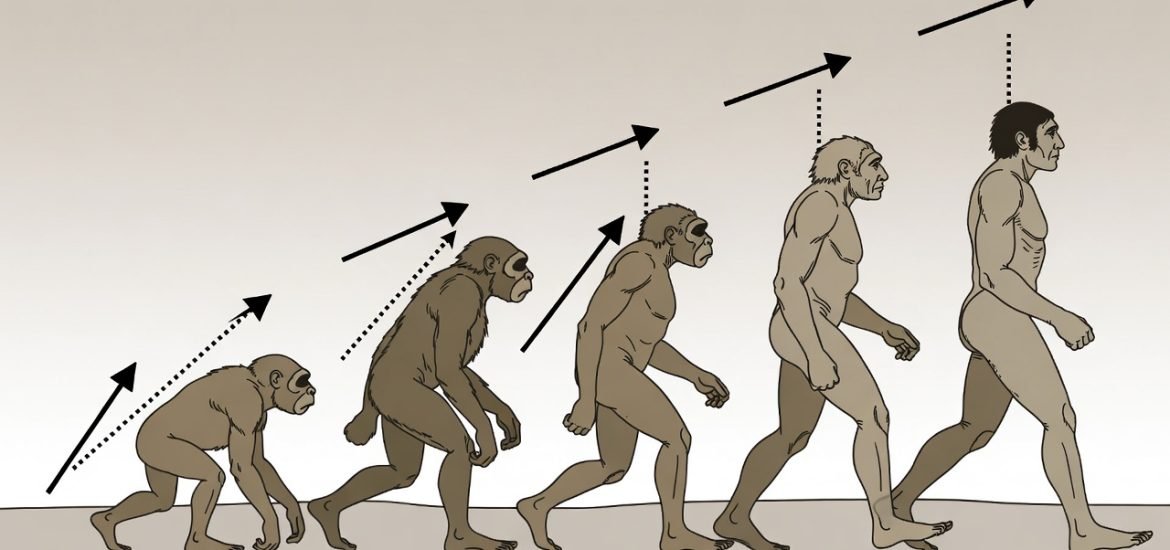
It is the repetition of the competition between these two principles, and its progressive change of scale, that paves a path from a single cell to a very large, forward-flexed brain with a flat face. This is the conclusion of the article: there exists a morphodynamic path that leads to an animal with a large brain, a head strongly flexed forward, and a retrognathic face.
The article demonstrates this in two ways: first experimentally, then theoretically. The experiments show that a decapitated chicken or mouse head, isolated on its own in a Petri dish, spontaneously begins to oscillate and to produce exactly the movement one would expect for evolution: it curls forward while expanding, and vice versa, over hundreds of cycles. I cannot overstate how prodigious this spectacle is for a researcher. You decapitate an embryo, leave the head in a Petri dish, and it spontaneously provides the answer to the deepest question that obsesses humans.
As for the theory, it shows that a head traversed by filaments, as it grows, automatically curls while expanding. The calculation demonstrates the existence of a positive correlation between curling, brain expansion, and mandibular recession. The worst part is that by finely tuning the parameters, it is possible to obtain expansion without flexion—but in that case, the flexion forces must be adjusted exactly to the value that precisely antagonizes the flexion caused by expansion. This is what is called a “marginal” or “measure-zero” case—i.e., impossible in practice.
This is the paradox of the origin of man: generically, the values push toward a human; there is no need for fine-tuning of parameters. On the contrary, preventing this outcome would require extremely fine adjustment of the parameters. It is preventing the evolution of humans that requires fine-tuning. I am extremely grateful to the reviewers and editors of the journal for having recognized the validity of this epistemological reversal, which is explicitly stated in the conclusion.
Creationists and physicists alike talk a lot today about the fine-tuning of the constants of the Universe for this or that. What my work shows, is that there is no fine-tuning of evolutionary biology toward humans. The trajectory is there; it is getting off that trajectory that requires fine-tuning.

TES: Why, in your view, do these results announce a paradigm shift?
V.F.: Yes, it really is a paradigm shift. On the technical level, it has been proven that the way nature manufactures animals strongly constrains evolution. That in itself is a reversal. On the molecular level, the actors are clearly identified. We discover that in reality “everything fits together” and that the ingredients needed to make animals are fewer and less complicated than previously thought. Nature does not go off in all directions.
It proceeds in three stages: in the first stage, the fertilized egg is broken into small pieces forming circles and rays, a bit like a bullet impact on a windshield. Then the circles and rays deform and wrinkle the surface, which in a few hours turns into a tube with holes, because the tractions on the circles roll up the surface, and the tractions on the rays roll up like a turtleneck while perforating the tube. Basic animals are tubes with holes. Then the tube-with-holes rolls up while expanding to produce, at the extreme, the shape of the human head. It is almost automatic from start to finish. Chance is there to provide the morphogenetic noise that allows the ratchet to advance. In the end, the paradox is that it is more difficult to prevent this phenomenon than to produce it—and mathematics, or at least numerical simulation, says so. I sense this is going to cause a stir.
TES: How did you sketch out your demonstration? How many years of research does this represent? Could you detail some of the steps?
V.F.: While rereading the manuscript for the proofs, I asked myself the same question. It is in fact the culmination of 25 years of research, which fortunately went in the right direction. In the end, something crystallizes all at once that you did not expect.
The origin of this work dates back to the AIDS years. Around 1995, I changed fields and moved into biology in an attempt to be useful. I started with blood vessels, where physics clearly played a role (pressures, flows, etc., are measured there by physical methods). Then, seeing that there was a coupling between the vascular system and the shape of embryos, I became interested in the mechanism of embryonic morphogenesis.
I observed hydrodynamic vortices in embryos and that morphogenesis proceeded from a global movement driven by a ring located at the periphery of the embryos. Then I observed that there were several nested rings, then rings and rays that matched the early divisions. From there, things follow logically: once you understand that pulling on an edge with filaments folds a surface (like pulling on a sweater), you understand how the bodies of embryos form, then the sense organs (at right angles): the rings create the body tubes, the rays create the ducts of the sense organs.
Next, the expansion of the head that curls between the filaments can be modeled with fairly advanced engineering techniques (finite elements, elasticity, etc.) with which I am more comfortable. What is very difficult is to perform experiments that demonstrate these new laws. That is where luck comes in.
While doing electrical stimulations on embryos in the context of regenerative medicine research, I noticed that within certain parameter ranges I could increase head development—but in that case it curled forward—or decrease it, in which case it uncurled backward. With a physical method, I could send a chicken toward the past (more lizard-like) or toward the future (more mouse-like) from an evolutionary point of view!
Later, by chance, I observed that isolated heads oscillated on their own.
TES: What role did improvements in observation technologies play in your work? Since it’s fashionable, do you use AI to assist you in your research?
V.F.: Certain technical advances played an essential role. First, imaging techniques, particularly all the image analysis and processing software, most of which is now free, such as ImageJ, initiated by Wayne Rasband at the NIH. Somewhere in the world, colleagues I don’t know improve these programs and make them available. Thanks to these tools, I was able to measure embryonic movements with very high precision, sometimes better than one-thousandth. Displacements of a tenth of a pixel are routinely measured in images.
I was also able to use very powerful calculation software developed by colleagues who make it available to the community. To be precise, I used FreeFEM++ by Frédéric Hecht and Olivier Pironneau at INRIA, with a rather uncommon feature: point-by-point curvature calculation on the mesh. I contacted Charles Dapogny, one of the developers, who provided me with a new procedure that allowed me to perform some of the very difficult calculations appearing in the article.
Finally, an entire section of the article uses fluorescent labeling of smooth muscle alpha-actin (markers developed in recent years for molecular-scale imaging of contractile molecules) and a Fluo-4 AM calcium wave reporter that allows calcium flashes to be seen during contractions. These products are now commercially available and commonly used by scientists.
One must understand that the markers allow us to see the position of the molecules, the reporters allow us to measure their activity, time-lapse microscopy allows us to film embryogenesis as a whole, and the models allow us to link these movements to one another and to modifications induced by arbitrary changes in parameters.
Ultimately, the article couples the molecular spatial scale with the scale of the entire organism, the scale of the second (calcium flashes) with the scale of embryonic development and the millions of years of evolution. Indirectly, I also obviously benefit from debates and discoveries in paleontology.
Yes, I use AI from time to time to generate presentations on this or that question. For example, recently I wanted to understand why poorly oxygenated tissues are yellow. The AI immediately gave me a complete lecture on oxyhemoglobin.
I notice that my students use it all the time. As soon as you give them a problem, their reflex is to ask ChatGPT. I also gave a student the exercise of writing an experimental protocol in English. The result was so perfect that I wonder if she didn’t do it with AI. Another beginning student produced an absolutely brilliant PowerPoint for his internship with lots of beautiful figures. I would be very surprised if he had spent hours doing that with a box of colored pencils.
I am a bit ashamed to realize that my students are much more comfortable with AI than I am. I have seen philosophers debating AI. They give them dissertations to write, then ironize about the result (pathetic in their eyes) and explain that AI will never replace a human being, etc. They don’t realize what is at stake. The stake is not whether a philosopher can write a brilliant dissertation that gets 18/20 on the baccalaureate. The stake is the phenomenal acceleration of knowledge and its organization. In a few seconds, AI gives you a structured answer to any question, with access to all library catalogs. It is a fabulous lever, an accelerator. Not to mention automatic code or web page generation.
It doesn’t bother me at all that students use AI for their work. Only the result counts. If they know how to use the tool well, then by definition they are good students.
TES: One of your hypotheses seems to give a large place to serendipity, particularly regarding an observation you made somewhat by chance. Is that the case?
V.F.: Yes, chance played an important role twice, and I am very happy about it. The first time was when I was able to change head morphogenesis with electric shocks. The second time was when I observed that decapitated heads oscillated, reproducing in miniature what is seen in evolution.
In fact, the decapitated heads do, hundreds of times, what is seen fleetingly in the electric shock experiments. It is therefore a confirmation, by another method, of the intrinsic character of developmental correlations. I think many people would have noticed nothing and would have missed it.
Serendipity is when chance gives you an answer you were not expecting, but to a question you were asking. I would never have thought that a cut-off, decapitated head placed in a Petri dish would start moving on its own and reproduce what is seen in evolution. It is simply insane.
I came to this after noticing that heads started oscillating when the heart was removed. That suggested to me to cut off the head and see what a head alone would do.
Everyone working on this eventually wonders how one could prove something about the mechanism of evolution. It is not obvious to change the shape of a head. You can try genetics, complicated biochemistry, or by making mutants. One imagines the technical difficulties and then the problems of interpretation. And then, all of a sudden, the heads change on their own and give you the answer to the question.
Research is a rather painful monologue. You try to wrest answers from a silent nature to the questions you ask. Serendipity is when nature suddenly seems to speak to you and answer your questions in the best possible way, but not in the way you had imagined. In those moments, you really feel that nature is speaking to you and teaching you a lesson.
For example, fifteen years ago I had published a plausible velocity field to explain the evolution of hominins (below, the pattern of streamlines deduced from the stream function).
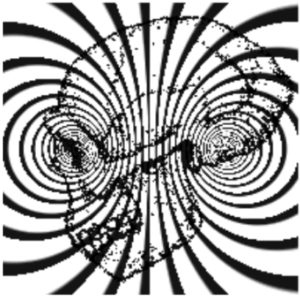
It was heuristic. With very few arguments—a sort of hydrodynamic intuition: “maybe we could explain the evolution of heads with a flow like this.” People literally laughed in my face.
And then, when I traced the velocity field of the movement of the heads as it occurs spontaneously in the Petri dish hundreds of times, I saw this:
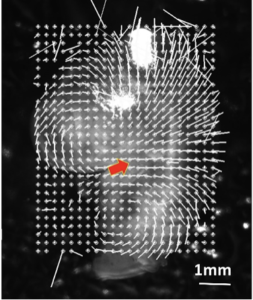
When I saw that appear on the screen, my jaw simply dropped. Those are unforgettable moments.
One must realize that a lone decapitated head in a Petri dish is probably the thing furthest imaginable from an animal interacting with a biotope. If a head reproduces this movement in an hour, two hundred times in a row, in a Petri dish, then the origin of man is not in the biotopes.
TES: Did recognition of your work by your peers take a long time? You admitted in a previous interview that there have been many criticisms of your work. Is that still the case?
V.F.: There are two levels of recognition. First, recognition by your colleagues at the bench. I have never had any problem with my close colleagues or collaborators. All the people I work with in the lab—my students, my lab colleagues—see these experiments up close or from afar and clearly see the volume of work and the tenacity required to achieve a result. I only receive encouragement from my colleagues, my supervisors, former PhD students and post-docs, friends I have kept from previous labs, etc. (and vice versa: I am also there to encourage them, at least by example), not to mention the reviewers who approved the publication. That is the main thing.
Then there is more distant, even institutional, recognition. It is normal that it does not come spontaneously, especially on a subject like this. Authorities wait for confirmation and for things to be solid. As Marguerite Yourcenar said, “it is when one rejects all principles that one must arm oneself with scruples.”
The CNRS has just published a news item on its website about this work, which is proof of a form of recognition. One must understand that this is the first time anyone has dared to explicitly write, in a scientific article and on official websites, that there is a tendency toward human.
What is painful is when colleagues who are not at the bench explicitly and rather poorly harm you on social networks or in committees. It has happened to me; it is not pleasant. You will find here and there on the internet researchers who call me a theoretician physicist with nebulous ideas, even though I have dissected about fifty thousand embryos to get here.
TES: Concretely, what are the consequences of this discovery for morphogenesis? Do you also see consequences for the theory of evolution?
V.F.: Concretely, this work reduces the range of morphogenetic events that need to be considered and places them within a kind of generality. There are not as many parameters as is generally believed. From these ideas, one can moreover simulate the formation of many animals by modifying values like cursors—for example, advancing a head more or less far.
For the theory of evolution, I would say that it does not change much. Evolutionary theory is not really a theory in the physicists’ sense. There is practically no morphogenesis in Darwin’s theory. Morphogenesis appeared with homeobox genes, but the problem with homeobox genes is that they generally presuppose the form on which they are expressed. You will find many images on the internet of genes described on a fly or a vertebrate, but the underlying pattern is already there. These genes do not really explain how the underlying form appears.
For example, for the formation of vertebrate traits, everything is supposed to start from “placodes,” but there is virtually no explanation of what placodes are. My work explains very well what placodes are. Even the existence of a mandible, which is so important in paleontology, has no explanation in developmental biology, whereas it is explained very naturally in my work.
These works therefore explain, to a large extent, how animals form—including humans. Darwinian selection acts a posteriori. These works probably allow us to explain the canalization of evolution, but not selection itself. However, selection is only a sieve that lets through the best-adapted animals; it tells you nothing about which animals are possible.
TES: At the end of your article, can we conclude that physical determinism definitively takes precedence over genetics for explaining the genesis of living forms?
V.F.: It seems to me that yes. A massive leap has occurred in the last twenty years. Genetics provides essential, determining biochemical parameters for the selection of forms, but the repertoire of possible forms “on the shelf” is physical. Obviously, physics produces general laws, so it is not or only slightly capable of dealing with a particular case, and it can disappoint in biomedical applications. In most cases, medicine and biology are interested in particular cases: the molecule responsible for a disease, individualized patient treatment, etc.
TES: Do you see potential applications? If so, what are they?
V.F.: When you work day after day with biological tissues, especially embryos, and apply all kinds of forces—electrical, physical, biophysical, chemical, osmotic, etc.—it inevitably suggests applications. So yes, there are applications under study. I cannot say too much, but we are developing machines to repair organs using our ideas, as others are doing with their own ideas.
We have an ongoing project, quite advanced, on rats; these are pre-clinical experiments on organ regeneration, etc. If you search carefully, you can find it on the European Commission website, since today everything must be declared in detail so that the public is not shocked by animal experiments. These experiments have received approval from ethics committees.
This is perhaps also an opportunity to say that I had a lot of difficulty getting this article published, mainly because of the ethical aspects. On the scientific level, the reviewers were enthusiastic, but on the ethical level, the *Scientific Reports* editors were a bit unhappy. Obviously, it is not very nice to decapitate lots of embryos to try to demonstrate something that is almost philosophical and concerns the origin of man. I don’t know if chickens and mice agree to have their heads cut off for something that does not concern them, or only very distantly.
I tried to do the minimum. I only killed one mouse, but that was already almost too much. The ethics committee had to confirm to the journal that everything was perfectly legal. It is the first time in my life that an editor has requested all the French and European legal texts, as well as all the email exchanges with the ethics committee. I have never seen that. I think it scared them, and they wanted a result like this to be perfectly legally watertight. It is true that the experiments are a bit “gory”—I have been told so, anyway.
(**) L’embryologie physique relance le débat sur l’évolution humaine
This post is also available in:
Leave a Reply