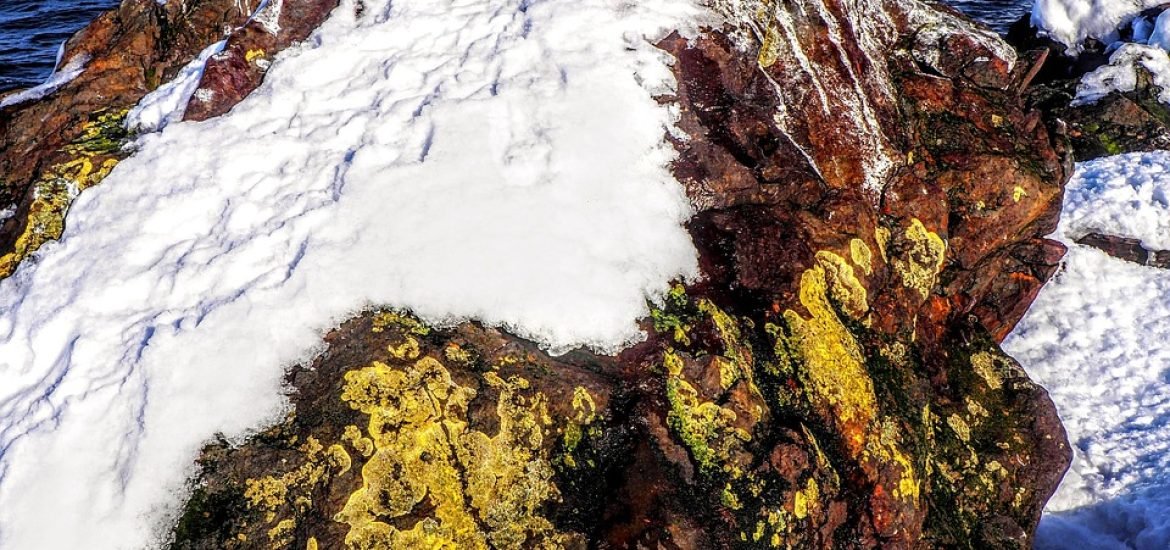
Rising temperatures in the Arctic are causing a type of crust-like organism called lichen to bleach and lose colour, according to a study published in the journal Functional Ecology.
The research, led by scientists from the University of Edinburgh and the British Antarctic Survey, focused on Svalbard, a remote Norwegian archipelago in the High Arctic. Svalbard is one of the fastest-warming places on the planet, with temperatures rising up to seven times faster than the global average. That makes it a kind of early warning system for what climate change can do to fragile ecosystems.
What Is a Lichen, and Why Does It Matter?
Lichens might not look like much. They are the patchy, crusty growths you often see on rocks and soil, but they are surprisingly important. A lichen is actually two organisms living together: a fungus and an alga, working as a team. The alga uses sunlight to make food, while the fungus provides structure and protection.
In the Arctic, lichens are everywhere, and they do a lot of heavy lifting. They absorb carbon dioxide from the air, help hold soil together, cycle nutrients through the ecosystem, and provide food for animals like reindeer. Lose the lichens, and you start to unravel the whole food web.
What Did the Scientists Find?
The research team spent nine years studying how lichens responded to warmer temperatures in Svalbard. To simulate the effects of climate change, they placed small plexiglass enclosures over patches of lichen, which act like miniature greenhouses, trapping warmth and raising the temperature inside.
Over time, they noticed something worrying. The dominant lichen species in the area, Cetrariella delisei, began to bleach. It lost its colour and its ability to photosynthesise, meaning it could no longer make energy from sunlight effectively. In short, it was struggling to survive.
What made the findings particularly striking was that the bleaching was not caused by a sudden extreme weather event, like a heatwave. Instead, it was the slow, steady build-up of warmth over many years that pushed the lichen past its limits.
Sound Familiar? Think Coral Reefs
If bleaching sounds familiar, that is because a very similar thing happens to coral reefs when ocean temperatures rise. Corals rely on tiny algae living inside them to survive. When the water gets too warm, that partnership breaks down, the algae leave, and the coral turns white and eventually dies.
The same basic process appears to be happening in Arctic lichens. The warming disrupts the delicate relationship between the fungal and algal partners. Over time, the balance tips, the partnership weakens, and the lichen’s health declines.
Why This Matters Beyond the Arctic
The decline of lichens could have knock-on effects that go far beyond Svalbard. As a dominant part of tundra ecosystems, they help stabilise soil, support nutrient cycling, and feed the animals that graze across the landscape. Their disappearance would leave gaps that are hard to fill.
Researchers also believe that lichen bleaching could serve as an early warning signal, a visible sign of ecosystem stress that shows up before more dramatic changes occur. Because lichens are so sensitive to environmental shifts, watching what happens to them could help scientists predict what is coming for the wider landscape.
Jiří Šubrt, the lead author and a PhD student at the University of Edinburgh’s School of GeoSciences, stressed the importance of watching these slow changes over time: “Our findings underline the importance of long-term ecological monitoring, mainly because slow-growing organisms such as lichens can take some time to respond to changes in temperature. The visible damaging changes illustrate that organisms that are thought to be resilient might be endangered.”
The Bigger Picture
It is easy to overlook lichens. They are not charismatic animals or towering forests. But this study is a reminder that even the smallest and most unassuming parts of an ecosystem play a critical role — and that climate change is quietly dismantling things we have barely started to understand.
Šubrt, J., García Criado, M., Newsham, K. K., & Colesie, C. (2026). Lichen bleaching as a response to long-term experimental warming in the High Arctic. Functional Ecology, 00, 1–14. https://doi.org/10.1111/1365-2435.70344