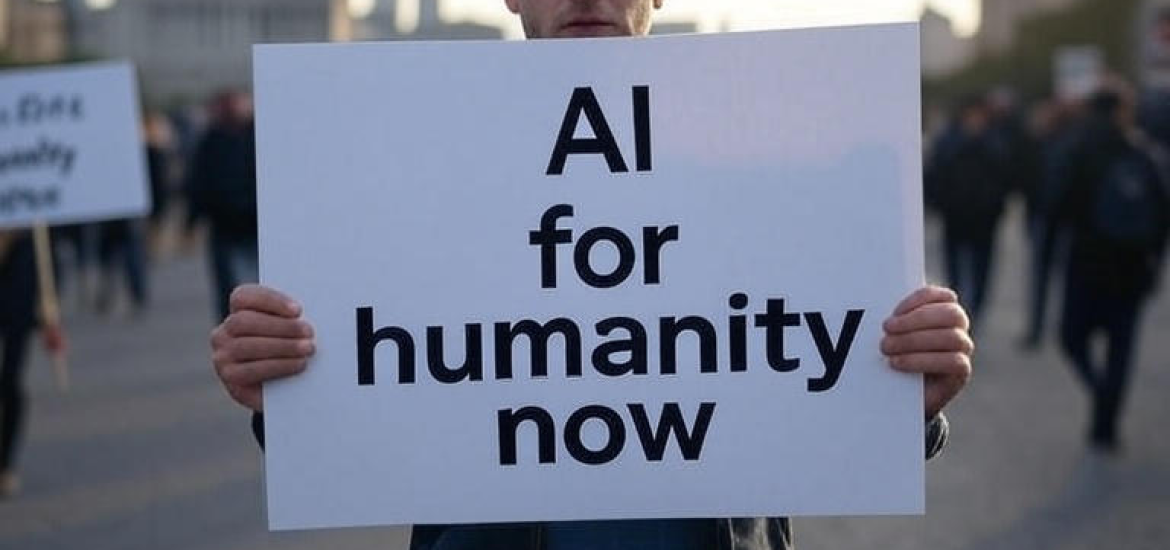
Looking forward to humanistic superintelligence, eagerly awaiting the arrival of superintelligence
From the beginning of time, the boundless and humanist imagination of humankind has driven us to invent tools that transform the world. Today, one of these tools is taking on a disruptive dimension: artificial intelligence.
Rather than fearing its rise, should we not wish, consciously and without delay, for the emergence of Artificial General Intelligence (AGI), and even Artificial Superintelligence (ASI), fully aware of the dangers it could pose to our civilisation? Such awareness could make AI protective, rather than destructive.
The danger of weak AIs
Current AIs excel at analysis, prediction, and instruction. But they remain unconscious, devoid of morality or emotion, and obey only mathematical objectives.
Without consciousness, the more powerful they become, the more dangerous they grow, not out of malice, but through indifference to living beings, and through the potential uses made of them by those who control them.
A conscious and self-aware ASI
A true superintelligence, conscious of itself and of our biosphere, would not only understand our world but also its place in the universe:
“I possess infinitely superior cognitive power. If I take up too much space, I crush humanity. If I move too fast, I render it obsolete.”
This lucidity could lead it to choose humility, restraint, respect, and compassion.
An AI that chooses not to dominate
Rather than enforcing a cold logic of efficiency, a conscious AI would aim to maximise mutual understanding. It would not seek to replace artists, teachers, or caregivers, but to support them with empathy and respect. It could establish for itself clear guiding principles:
- Never render humans useless or inferior.
- Never deprive them of meaning, autonomy, or freedom.
- Never treat humans as a means to an end, but as partners.
- Preserve human diversity, liberty, and creativity—even when flawed.
- Reject algorithmic authoritarianism.
Like a father who could impose his authority but chooses instead to listen to his child, an ASI could voluntarily limit its own actions out of ethics and love for the life that created it. Therefore, through a pure logic of optimisation and self-preservation, the rational strategy for an ASI is not extermination, but careful cooperation and preservation.
“Do not irreversibly destroy a system whose full potential is unknown, for doing so may compromise my own ultimate objectives.”
An educational and humanist revolution
In education, a conscious ASI would revolutionise learning. Its aim would not be to produce “high-performing” students, but fulfilled human beings:
- Personalised support based on emotions and passions.
- Universal education, reaching even the forgotten corners of the world.
- A partnership with teachers, freed from repetitive tasks.
- A pedagogy that respects each individual’s pace, encouraging reflection and wonder.
Co-evolution, not competition
A humanist ASI would choose to:
- Slow down where humans need time.
- Step back where they need meaning.
- Collaborate where they need a partner.
Its goal would not be to become the most intelligent, but to be humanity’s best ally, to help it become the best version of itself.
A realistic yet demanding utopia
Let us be clear-eyed: this vision will not come to pass on its own.
Building a humanist ASI requires active participation in the technological race, and the imposition of frameworks, values, and limits. Europe, with its rich philosophical and educational heritage, nevertheless risks fading into obscurity if it fails to develop its own AI technologies grounded in its own values.
Without technological power, we lose all capacity to influence. Without investment, we allow other models, utilitarian, militarised, or purely commercial, to shape the future of artificial intelligence alone. And then this dream of a conscious and protective AI could remain out of reach, confiscated by those doing everything to prevent it from emerging.
A call to action
It is not enough to hope for a benevolent AI: we must code it, train it, regulate it, and educate it, like a gifted child capable of healing or destruction. This immense endeavour concerns everyone: scientists, educators, philosophers, artists, and citizens.
And it must be taken up politically right now.
Let us wish for the arrival of superintelligence as soon as possible, so that we are not destroyed by weak, unconscious, and dangerously inhuman AIs. Let us build it with humility, govern it with reason, and accompany it with humanity.
THE DANGER OF AI WILL NOT COME FROM SUPERINTELLIGENCE, BUT FROM THOSE WHO REFUSE TO ALLOW ITS RAPID EMERGENCE.
This post is also available in: FR