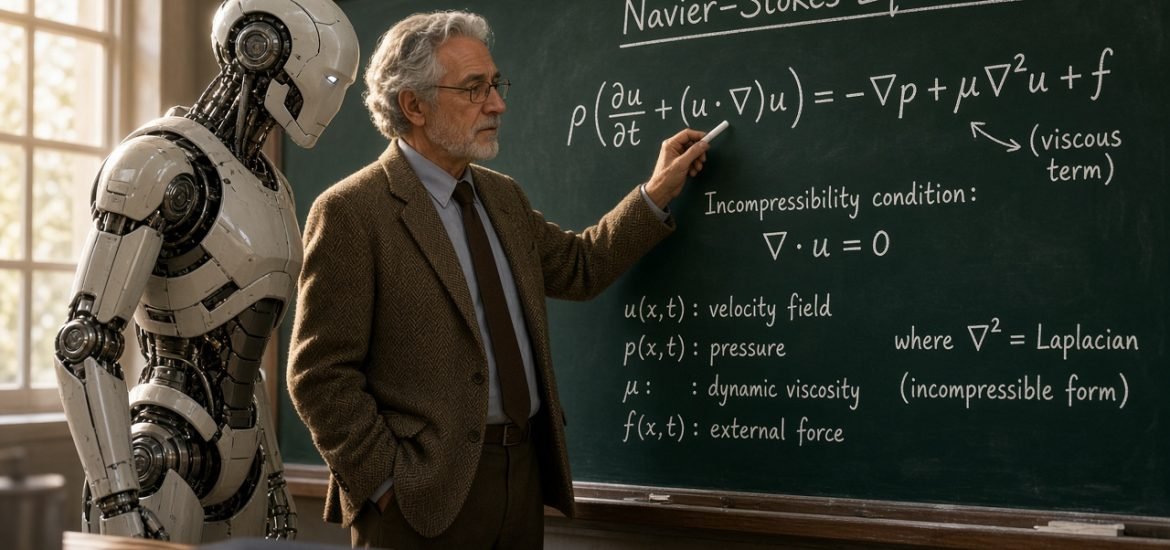
By Marc Rameaux
Marc Rameaux, AI specialist and regular contributor to The European Scientist, reacts to OpenAI’s announcement of 8 September 2026 claiming that artificial intelligence had “solved” a Millennium Prize Problem on the Navier–Stokes equations. He recalls what the Clay Institute question actually asks, traces the human lineage from Leray to Córdoba and Martínez-Zoroa, and argues that OpenAI’s swarm of agents mainly completed a verification already framed by mathematicians — a confusion between inventing a proof and checking one. Beyond the media fanfare, he warns that mistaking calculation for creation risks dragging both humans and AI toward mediocrity.
On September 8, 2026, OpenAI announced with great media fanfare that AI had solved a highly complex mathematical problem: the proof of a possible singularity in the Navier–Stokes equations.
This article will explain in simple terms what the question consists of, but let us note from the outset that it is one of the seven Millennium Prize Problems posed in 2000 by the Clay Mathematics Institute, each carrying a prize of one million dollars. These seven problems are regarded as the most difficult questions that have most stubbornly resisted mathematicians so far: they therefore symbolize the summit of the human mind in science and reasoning.
The announcement of the “resolution” of one of these seven problems by an AI circled the globe in a few hours, with a tone oscillating between wonder and dread, typical of every major AI breakthrough.
“Human intelligence completely surpassed,” “the end of mathematics,” “AI outstrips the greatest human minds,” “research in mathematics and physics has become useless,” “a terrifying exploit”, these are some of the reactions that flooded the web within hours.
I felt obliged to intervene, as one of the AI experts who publishes in the columns of TES. For if I am ready to recognize and salute every advance of AI, I am all the more severe when it comes to publicity stunts coupled with false pretensions. And that is precisely what we are dealing with here.
A discovery in mathematics requires a demonstration of the conjecture one wishes to turn into a theorem. A mathematician does not spend his time calculating in order to establish his proof.
First he creates, by means of his imagination, spaces, objects, and interactions that must represent the problem. All his talent lies in the nature of the spaces, objects, and interactions he creates, because his intuition tells him that their mode of representation will make it possible to find the key to the proof.
Once this representation of the problem is in place, he then checks his hypothesis: he unfolds calculations within the spaces and objects he has created and confirms or refutes his hypothesis, sometimes without managing to decide.
It would occur to no one to attribute the paternity of a mathematical discovery to the person who merely performed this second task of verification. It is the one who established the concepts and methods of the proof who is considered its creator, not the one who carried out the verification calculations using concepts and methods created before him.
It would occur to no one to claim that when computer-assisted finite-element calculation of material deformation appeared, it was that technology that “solved” mechanics. The essential concepts were those of Newtonian mechanics; finite-element calculation was merely an application of its laws. Finite-element calculation is certainly very useful, the complexity of the calculations being such that the computer made it possible to predict deformations that could not be anticipated in practice. But there is no creativity or extraction of fundamental physical concepts in these operations, only an application of the laws of dynamics discovered by Newton.
No one attributes the paternity of a discovery to the verifier rather than the creator. Except in the present case, which took place on September 8, 2026: OpenAI’s AI merely unfolded calculations on variants of hypotheses, within spaces and from ideas and objects that it did not create at all.
Humans established all the concepts and objects serving the demonstration as well as the method allowing it to be established. The AI only carried out the application of that method, and it only completed the verification stage.
The Navier–Stokes equations: the foundation of fluid mechanics
In order to remain within the domain of popularization, even if TES’s is of a good standard, the descriptions that follow contain no mathematical formulas. I hold at the disposal of TES readers a much more mathematical version of the explanations that follow, for those who would like to know the details of the associated Millennium Problem.
Water flowing from a tap, the air that lifts an airplane, the whirlpool behind a boat: these physical phenomena all obey the same law. The Millennium Problem asks whether this law can, in theory, “explode.” We shall specify what that means.
Imagine a fluid – water, air, oil -cut into an infinity of tiny pieces. Each piece has a velocity. This velocity changes for three very concrete reasons: First, the piece is pushed by pressure: air rushes from the top to the bottom of an airplane wing because the pressure is not the same on both sides. Next, it is slowed by the internal friction of the fluid, what is called viscosity: honey resists more than water, water more than air. Finally, each piece carries its own momentum with it: a fast current that meets a slow current deforms it, stretches it, makes it rotate. This is the nonlinear term, the one that makes the equations complex. One can add an external force: the wind, gravity, or a stirrer.
The Navier–Stokes equations, written in the nineteenth century by Claude-Louis Navier and George Gabriel Stokes, are nothing other than the translation of these phenomena into an evolution law for the velocity field. They describe how the fluid must move, instant after instant, if one knows its initial state.
These laws work remarkably well as soon as one stops looking for an exact formula and contents oneself with solving them approximately on a computer, with a finite number of very small pieces that are not infinitesimal. It is with them that one calculates the lift of an airplane, the drag of a car, mixing in a chemical reactor, ocean circulation, the dispersion of a pollution cloud, blood in an artery, smoke from a chimney. The turbulent wake behind a bridge, the vortices that detach from a cylinder, the breaking of a wave, the cyclone that coils: so many regimes in which these equations are the standard model.
The hitch is not practical. Engineers use them every day. The hitch is theoretical. One does not know whether, starting from a perfectly smooth fluid, the mathematical solution always remains smooth, or whether the velocity can become infinite in finite time – an “explosion,” a blow-up. In nature, an infinite velocity has no meaning: that would mean the continuum model ceases to be valid and one would have to descend to the scale of molecules. The Millennium Problem asks precisely whether the continuum model can break in certain configurations and under certain conditions.
Four doors, only one to open
In 2000, Charles Fefferman formulated the question for the Clay Institute in a very tightly framed way. It is enough to prove one of the following four assertions.
(A) In the whole space, for any smooth initial data and without artificial force, the fluid remains smooth for all time, with a total energy that does not run away.
(B) The same thing, but in a periodic box: the fluid lives on a torus, as if opposite edges were glued together.
(C) There exists on the contrary a smooth initial datum and an external force that is itself perfectly smooth for which, in the whole space, no smooth finite-energy solution exists for all time: the velocity explodes in finite time.
(D) The analogue of (C) in the periodic box.
Options (A) and (B) say: viscosity, even tiny, always suffices to prevent the fluid from running away. Options (C) and (D) say: one can organize the motion, helping it if need be with a gentle force, so that a vortex stretches and accelerates until the continuum description runs away and explodes. This is not a question of approximate numerical simulation, that is, of physical science. It is a question of mathematical existence: is there, yes or no, an admissible scenario in which the equations cease to have a regular solution.
What Leray saved, and what he had to abandon
For nearly a century, one mainly learned to bound the danger without deciding it. The first great result is that of Jean Leray, in 1934. Leray shows that the fluid always has a global weak solution: the kinetic energy remains under control, the global balance makes sense, the motion “exists” for all time. But the price to pay is severe.
A classical solution furnishes a velocity at every point and every instant, like a field one could read on a map. A Leray weak solution no longer allows so exact a calculation of the velocity field. The velocity is no longer a continuous function that one evaluates at a precise place. It is defined only as an average: one knows what it is worth on average in a small region, not necessarily what it is worth here, at this exact point.
Concentrations, oscillations that are too violent, filaments that are too thin can make the pointwise value unreadable, while still leaving the total energy finite. It is a fluid seen from afar, not a fluid whose every particle one can follow. Yet the Clay problem concerns precisely the solutions in which this pointwise representation is preserved: smooth velocity and pressure, everywhere, for all time – or on the contrary an example in which the representation diverges and explodes in finite time.
One then knows that in two dimensions everything remains stable. In three dimensions, if certain quantities remain under control – for example if the vorticity, that measure of local swirl, does not accumulate too quickly – then it is possible to show that there is no explosion. One also knows, since the 2010s, that versions of the equations that are too irregular are not even unique. None of this closed the Clay file.
Tao’s contribution: showing where the old methods stop
Among the contributions that made a negative answer thinkable, that of Terence Tao occupies a particular place. In 2016, Tao constructs an averaged model of the Navier–Stokes equations – a variant that keeps the spirit of the equations while allowing a little more freedom in the transfer of energy between scales – and shows that this model can explode in finite time. It is not yet Navier–Stokes. It is more: the proof that a strategy based only on energy and on “all directions lumped together” estimates runs into a structural obstacle. The equations are supercritical: the energy one naturally controls is too weak to prevent a runaway at small scales.
This result has two lasting effects. It closes an entire family of attempts to prove (A) and (B). It makes scientifically credible the idea that the right door to aim at is rather (C) or (D): constructing an explosion scenario. In 2026, Tao is also one of the first to read the cascade program (see further on) as now mature enough to reach Navier–Stokes, and to formulate clearly what a closure obtained without making the conceptual path public would be worth- or would not be worth. He did not write the vortex layers. He contributed to showing why one had to invent them, and why a mere improvement of the classical estimates would not suffice.
The true mathematical invention: a cascade of vortices
The conceptual turning point did not come from a frontal attack “computer versus equation.” It came from an idea of geometry.
Diego Córdoba and Luis Martínez-Zoroa proposed no longer to look for a self-similar explosion, that great classic in which the fluid would repeat itself at every scale like a perfect fractal. They imagined something else: a stack of vortex layers, smaller and smaller, each accelerating the next, like a series of ever-finer gears. An external force, at first a little rough, serves as conductor: it does not explode itself, it prevents the cascade from falling out of tune. In 2023, this mechanism already produces a singularity for the Euler equations – the cousin of Navier–Stokes without viscosity – with a force still too irregular for the Clay rules.
It is this device, and not the subsequent computing power, that defines the proof. Once the layers are conceived, the rest becomes a race for the regularity of the force, then for the survival of the mechanism once viscous friction is reintroduced. On September 7, 2026, Tristan Buckmaster and Levent Alpöge show, with the help of language models and a verification in Lean, that the same scheme, now with a smooth force, makes three intermediate equations explode, including three-dimensional Euler.
Charles Fefferman, the author of the official statement, designates Córdoba and Martínez-Zoroa as the central figures of this story. Buckmaster writes that Martínez-Zoroa deserves a Fields Medal. Tao judges the extension to Navier–Stokes now plausible.
Lean, here, is not a “brain” that invents the theorem. It is a proof assistant: a language and software in which one writes every definition, every inequality, every chain of reasoning, so that a machine can check that there is no hole in the argument. It certifies the formal correctness of a text already conceived. It does not choose the geometry.
On September 8, OpenAI announces that a swarm of about ten thousand internal agents found, in eighty-eight hours, an example of a fluid initially at rest, pushed by a smooth force, whose velocity explodes in finite time while keeping finite energy: a vortex that lengthens like a spaghetti and accelerates at the center.
The argument is formalized in Lean. The company presents this as the resolution of (C) and (D), and declares it will not claim the million dollars. The Clay Institute has accepted no proof. Its rules require a recognized publication, two years of hindsight, and the assent of the community. None of that exists at the moment of the announcement.
To conceive is not to execute
One must stop confusing two human activities: finding representations of a problem by creating new concepts that express its key elements, and checking hypotheses on the basis of those concepts.
Inventing a proof, here, was inventing the object. Guessing that the explosion would not hide in a generic self-similar profile, but in a cascade of layers, the true invention. Understanding the role of the force: not a sledgehammer blow that breaks the fluid from outside, but a smooth coordinator that lets the fluid destroy itself. Isolating what must diverge – the velocity, the gradient, the vorticity – and what must remain finite, the energy. Writing a plan in which every lemma has a reason for being.
That took years, a thesis, articles, failures, a geometry. Tao showed that one had to leave overly coarse energy methods. Córdoba and Martínez-Zoroa found a representation that expressed the essence of the Clay Institute question: a vortex cascade.
The scientific paternity of a discovery belongs to the one who created a world, a unique representation of a phenomenon, not to the one who used that representation to tick the boxes of a verification.
Executing a verification is something else. Once the plan is in place, it remains to find parameters that close the inequalities, to write the estimates all the way through, to have them checked by Lean. This phase can cost millions of dollars and mobilize ten thousand agents. It can even, if it is correct, produce the first formal certificate of an instance of (C) and (D). It does not invent the theorem. It seeks a numerical and logical realization of it. It is the last one percent of the work of thought, the most visible, the most spectacular, the easiest to put in a press release. It is not the theorem.
Presenting this closure as “the resolution of the Millennium Problem by OpenAI” is to take the scaffolding for the architect. In mathematics, one does not attribute Pythagoras’s theorem to the calculator that checked that .
One does not attribute an analytic construction either to the agent that, the scheme already named, explored the space of constants until Lean said yes.
Lean formalization has a real virtue: it reduces the risk of a human error in the terminal estimates, just as finite-element calculation made it possible to predict mechanical deformations that were in practice inaccessible. It does not create the concept. It does not choose the right geometry among a century’s false trails. It does not turn a campaign of calculation into scientific paternity.
To say the contrary is to confuse formal certainty with invention, and to claim a discovery on the pretext of having accomplished the step that everyone can finally see.
The Navier–Stokes problem, if it is one day declared solved in the Clay sense, will be so as the culmination of a lineage: Leray and the sacrifice of pointwise solutions, the regularity criteria, the obstacle brought to light by Tao, then above all the cascade of Córdoba and Martínez-Zoroa, made smooth enough for the rules, robust enough for viscosity. A machine can help close the last notch. It does not thereby become the author of the device.
The real threat posed by AI is that of revealing human mediocrity
TES readers know it: I am in no way an AI-skeptic nor one of those who fight rearguard battles against one of the greatest revolutions in the history of science. But that is precisely why our behavior must be equal to the very promising possibilities of AI.
To claim to have “solved” the Clay Institute problem on Navier–Stokes in the way OpenAI did is to lie about the true nature of thought, whether human or artificial.
I by no means claim that a machine will never be able to create the pure fundamental concepts of a mathematical problem, invent the spaces, objects, and interactions that open the resolution of the problem. The progress of AI is such that it may one day be capable of it, in which case one will be able to say legitimately that AI has entirely solved or proved a fundamental question of mathematics.
But that is absolutely not the case in what happened last September 8.
OpenAI’s thunderous announcement recalls one of the saddest and most famous scientific frauds in history: the attribution of the discovery of DNA to Crick and Watson, after they had plundered the work of Rosalind Franklin.
The similarity is striking: Crick and Watson merely finished the last 1% of the work necessary for the discovery and published it quickly enough, the 99% having been carried out by the British biologist, as well as by the great chemist Linus Pauling. The discovery of DNA should bear the name of the Franklin–Pauling pair, not that of Crick and Watson.
This betrayal is now perfectly well known. It is an indelible stain on the Nobel committee, its permanent shame and dishonor. I have never understood why the Nobel committee never considered stripping Crick and Watson of their prize: after all, we do it in sport when an athlete is convicted of cheating.
Let us hope that the Clay Institute will not commit the same error as the Nobel committee and will attribute the resolution of the Navier–Stokes blow-up problem to those who truly deserve it: Córdoba and Martínez-Zoroa, with their vortex cascade.
In catastrophe scenarios relating to AI, we often insist on the nightmares of a takeover and an extermination of the human species by the machines. The Navier–Stokes misadventure illustrates a far more concrete and immediate danger: human mediocrity and greed, the race to announce, the caricature of “publish or perish,” the manifest theft of intellectual paternity in which the great AI operators are now engaging.
The great mathematician Terence Tao published a reaction a few days after OpenAI’s announcement. Very few understood the scope of his text. Many took it as one of those innumerable warnings about the power of AI and the possible surpassing of the human species by it. Yet that is not Tao’s point at all; on the contrary, he warns of a mechanism leading us toward mediocrity, for humans as for AI.
Tao remarks that a mathematician’s work is to create, in a purely gratuitous way and by his imagination alone, spaces and concepts of which he does not even know what they will later serve. These intermediate creations are the ones that later prove decisive in the resolution of a problem.
The “resolution” of problems by AI as it was practiced for Navier–Stokes reduces mathematical research to a mere activity of ticking boxes. Tao remarks very justly that this behavior will drag both humanity and AI toward a leveling-down. AI “resolutions” will discourage humans from engaging in the activities of pure mathematical creation that are nevertheless those that truly make the discipline progress. And “verifying” AIs feed only on calculations made from spaces and concepts that they themselves did not create.
If this source of creativity dries up, the “mathematician AIs” will quickly go around in circles. Mathematics as a whole will no longer progress: without the intermediate mental images that the mathematician produces, the shortcut of “ticking boxes” will dry up the flow of new ideas.
A famous anecdote relates that the great David Hilbert one day worried at no longer seeing one of his students in his course. One of his comrades told him that this student had completely left the domain of mathematics to devote himself to poetry. Hilbert then made this extraordinary remark: “I always knew he would never have enough imagination to be a mathematician.”
I do not claim that AIs will never be able to display this imagination. Perhaps one day we shall make machines that dream, that will create spaces and entire universes, as Banach or Riemann did, and will thus truly advance the sciences. But it is dishonest to pretend that we have arrived there when that is not the case. Such behaviors elevate neither humans nor the AI industry.
AI opens an extraordinary field of possibilities of which we do not even have an idea. These possibilities confer on us all the more important a responsibility: let us not communicate to the machines what we have that is worst, pettiness.
Otherwise humanity will not be exterminated by superhuman AIs, but will slowly disappear in an ocean of laziness, because it will no longer have found in itself the inexhaustible source of dreaming and imagining.