Taken by millions of athletes, creatine is one of the most thoroughly studied dietary supplements. Yet many common practices — loading phases, single large doses, “premium” forms or gummies — reduce its effectiveness. For The European Scientist, surgeon Guy-André Pelouze reviews the best practices, the false kidney alarms and the brain-related avenues opened up by this molecule.
Creatine consumption in Europe
Creatine is a fast-growing supplement, driven by the changing culture of well-being and by favourable European regulatory frameworks. Consumer behaviour data indicate that around one consumer in five worldwide uses creatine, with demand rising sharply in Europe. In France, the regulatory framework and new consumption habits are driving the creatine market. Scientific validation is a priority. Faced with a French public historically wary of unsubstantiated claims, creatine’s growing success rests on the strength of its clinical evidence. The rigorous demonstration of the benefits of creatine monohydrate for strength development and muscle recovery has been the key factor in dispelling concerns in France. More recently, clinical findings and small case series have highlighted another target of creatine intake: an effect on the brain.
Multiple formulations
These various formats broaden the range on offer but lack evidence. While the traditional powder remains the most popular for its cost-effectiveness, the industry is gradually moving towards on-the-go products suited to urban lifestyles, such as capsules, tablets, chewable gummies or ready-to-drink liquid preparations.
Primum non nocere
Information and prevention must remain at the heart of scientific priorities. Health authorities such as ANSES, the French food safety agency, consistently stress the need to educate users. The main objective is to prevent the risks of overdosing and the nutritional excesses associated with unsupervised self-supplementation in sport. Nonetheless, the general public remains hesitant about assessing kidney function before any supplementation. No epidemiological data or official census makes it possible to determine exactly how many French people take creatine. However, an analysis of overall trends in supplementation and in the fitness market sheds useful light on the question. Overall supplement consumption is growing: more than six adults in ten in France report having used a supplement in the past two years, in a market worth nearly €2.9 billion. Creatine has had a clear regulatory status since 2006 and the market is very dynamic. Authorised in France for 20 years, creatine monohydrate has become established among people who practise high-intensity exercise and bodybuilding. Domestic demand is growing steadily, fuelled by enthusiasm for hypertrophy and performance optimisation. Prevalence data remain uncertain. In the absence of specifically French statistics, international sports nutrition surveys indicate that around 28% of physically active people or regular gym users take creatine, although the proportion is lower across the population as a whole.
For these various reasons, it is important to summarise the precautions and the conditions for optimising creatine intake.
Is a loading phase necessary?
The lack of scientific justification and the drawbacks of loading phases should lead people to avoid them. Although taking a massive 20 grams a day for seven days aims to saturate tissue stores quickly, this historical protocol is unnecessary and is the main cause of poor digestive tolerance. Recent clinical data confirm a significant increase in gastrointestinal discomfort, bloating and water retention at these high doses, compared with a moderate daily regimen. Continuous intake of a maintenance dose of 0.05 to 0.15 grams per kilogram of body weight a day (i.e. 3.75 to 11.25 grams for a 75 kg man, according to the International Society of Sports Nutrition) achieves strictly equivalent muscle saturation within three to four weeks, while preserving digestive comfort. In animals, simply increasing the dose can cause creatine absorption to fall from 53% to just 16%. Although creatine monohydrate is one of the most rigorously studied supplements in sports nutrition, a great deal of evidence suggests that most users unknowingly reduce its effectiveness. Experimental studies in animals (rodents) show considerable differences in retention of the molecule during loading phases, highlighting the gap between optimal use and needless waste. Whether it is a matter of solubility problems, inappropriate dosing schedules, poor timing or marketing-driven misconceptions, these factors directly impair its bioavailability. Fortunately, these obstacles are easily avoided with a few practical adjustments.
Poor solubility, a source of digestive discomfort
Creatine monohydrate dissolves poorly in cold water (around 14 g/l at room temperature). A standard 5 g serving therefore often remains in suspension in a glass of cool water. Once swallowed, these undissolved microparticles draw water osmotically into the intestinal lumen, causing bloating or cramps. Studies confirm that these problems are twice as frequent with a single dose as with split doses. To remedy this, it is advisable to use lukewarm water and to dilute each serving in a sufficient volume (more than 250 ml).
Splitting the daily dose
Single bolus doses overwhelm the transport systems. Cellular absorption mechanisms have a limited capacity. Experimental studies in animals (rodents) show that bioavailability falls from 53% at low doses to just 16% at high concentrations. Intestinal creatine transporters reach their maximum capacity when confronted with excessive quantities all at once. Consuming a single large serving can therefore strain the digestive system, while potentially wasting a significant part of the product. In humans, transporter (CrT) saturation does exist, but overall absorption data (notably from measurements of the area under the plasma concentration curve) show that absolute bioavailability remains very high (more than 90% for moderate doses of monohydrate). Spreading daily intake over smaller, more frequent servings optimises the efficiency of absorption through the cellular transport pathways. For athletes used to drinking throughout the day this is easy, but those who concentrate their fluid and food intake into a few moments need to adapt.
Carbohydrates and protein: the role of insulin
Tissue uptake of creatine is partly insulin-dependent. Beyond blood glucose control, insulin regulates the transport of cellular substrates. The medical literature shows that taking creatine monohydrate together with carbohydrates or a carbohydrate–protein combination significantly improves intracellular phosphocreatine storage in muscle fibres. Taken on its own, creatine does not trigger this endocrine signal. Eating insulinotropic foods at the same time activates insulin-dependent signalling pathways, which promotes uptake into myocytes (that is, muscle cells) and prevents losses through renal excretion.
“Premium” forms: no proven advantage
Marketing claims attribute superior bioavailability to creatine hydrochloride, buffered forms, ethyl ester or liquid solutions. Yet rigorous scientific literature refutes these arguments: creatine monohydrate remains the most stable compound and the best evaluated in clinical trials. So-called alternative forms impose an unjustified extra cost on users, without providing the slightest additional physiological benefit over the reference monohydrate.
Breaks have no physiological justification
Periodic cessation seems to be a practice borrowed from the world of anabolic steroids, with no basis in creatine metabolism. Muscle stores do not develop any tolerance to supplementation. This favourable feature stems in part from creatine’s ubiquity in the ancestral diet. Continuous intake keeps stores saturated indefinitely. No washout period is needed to guarantee lasting effectiveness: cycling is a missed opportunity to ensure a constant supply of cellular energy.
High creatinine does not mean kidney disease
Raised blood creatinine during supplementation does not indicate kidney disease. The recurrent fear of kidney damage stems from a classic confusion surrounding creatinine metabolism. The physiological breakdown of creatine produces creatinine, which de facto causes a moderate rise in this laboratory value in people taking supplements. Although plasma creatinine serves as an indirect reflection of filtration, this rise simply reflects an expected metabolite and not damage to the kidney tissue. Long-term safety in healthy individuals is well documented. The natural conversion of creatine logically raises serum creatinine in routine check-ups. This response is physiological, but creatinine remains the usual indicator of kidney dysfunction. Any impairment of glomerular function raises this level because less is eliminated in the urine. This build-up in the blood in kidney failure results directly from a reduced glomerular filtration rate (GFR). Since this catabolic waste product of muscle origin is excreted by the kidneys, a lower GFR causes it to accumulate passively in the bloodstream. To avoid false alarms at check-ups, intake should be stopped seven days before the blood test so that baseline values return. When a rapid laboratory assessment is needed, measuring cystatin C is an excellent alternative marker of kidney filtration in people taking creatine, since it is not influenced by exogenous creatine intake (unlike serum creatinine). Conversely, pre-existing impaired GFR calls for caution: below a threshold of 60 ml/min/1.73 m², supplementation should be postponed; this threshold requires the dosage of renally excreted medicines to be checked and calls for specialist medical advice to weigh the benefit–risk balance.
Gummies: underdosing and uncertain quality
Gummy formulations usually deliver reduced doses, ranging from 1 to 2 grams per serving, well below clinically effective thresholds. This format exposes users to a chronic shortfall without their knowledge, skewing their assessment of the supplement. Industrial processing combines this matrix with unnecessary sugar and various additives, adulterating an active ingredient that is neutral to begin with. These excipients run directly counter to the improvement in metabolic profile that people seek by taking supplements. Independent tests have moreover revealed a complete absence of the active molecule in some batches on the market, exposing major manufacturing weaknesses on top of inherent underdosing.
Beyond muscle: the brain and ageing
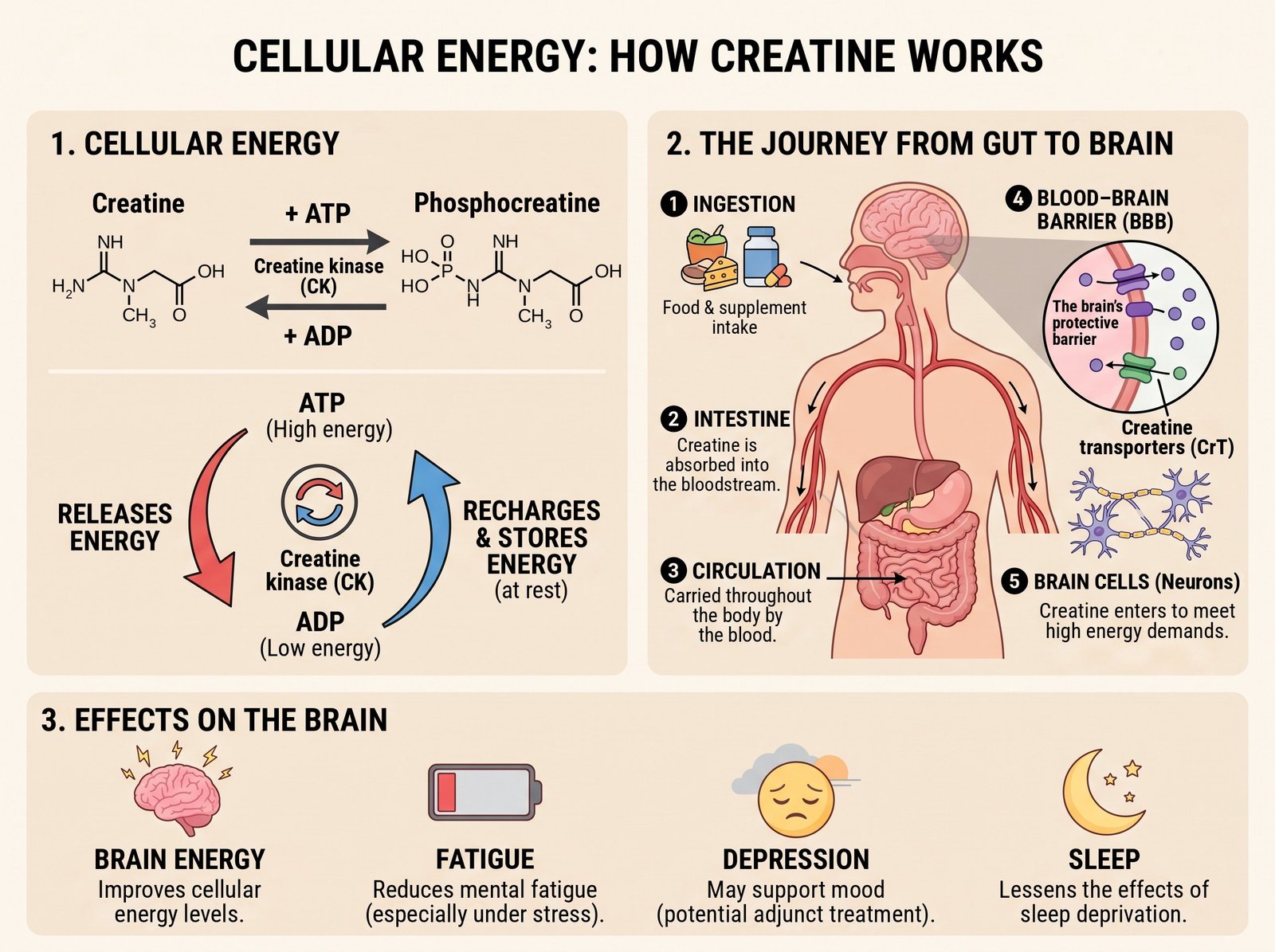
The bioenergetic and metabolic action of creatine extends beyond the muscle cell. By facilitating the rapid regeneration of adenosine triphosphate (ATP), the phosphocreatine pathway provides an emergency reserve during peaks of cellular activity. While this mechanism is well documented in skeletal muscle fibres, it plays an equally decisive role in brain tissue, supporting both the neuronal network and glial cells. Optimising how creatine is taken helps maintain physical functional capacity and preserve energy metabolism as we age. Preventing muscle decline and maintaining cognitive performance depend on the efficiency of mitochondrial and cytosolic processes. From this perspective, creatine intake ensures bioenergetic stability in the face of metabolic stress. Correcting common intake mistakes maximises the compound’s bioavailability, prevents its premature elimination and preserves cellular vitality, offering a promising prospect for overall longevity, although formal clinical evidence still needs to be consolidated.
Creatine is an inexpensive nutritional supplement, with excellent tolerance and clinically proven effects. Ongoing scientific studies on its extramuscular effects are important, particularly to validate its cognitive energising effect.
| Oral creatine: what precautions should be taken? | |||
|---|---|---|---|
| Factor / practice | Common mistake | Impact on the body | Optimal recommendation |
| Solubility and hydration | Mixing in a little cold water; taking 5 g at once, undissolved. | Intestinal osmotic effect drawing in water, twice as many digestive problems. | Dissolve in lukewarm water (more than 250 ml per serving) or split the dose. |
| Loading phase | Taking 20 g/day for 7 days. | Increased stomach discomfort, bloating and water retention. | Continuous maintenance dose of 0.05 to 0.15 g/kg/day (3.75 to 11.25 g for 75 kg); saturation reached in 3 to 4 weeks. |
| Dosing frequency | Taking a single large daily dose. | Saturation of intestinal (enterocyte) transporters (bioavailability falling from 53% to 16% in rodents). | Spread intake over 2 or 3 smaller doses during the day. |
| Nutritional synergy | Taking it on an empty stomach or on its own. | No insulin stimulation, less efficient muscle uptake. | Combine creatine with carbohydrates or protein to stimulate retention via insulin. |
| Choice of form | Buying expensive forms (HCl, ethyl ester, liquid, buffered). | High cost with no evidence of better efficacy or stability. | Choose pure creatine monohydrate, the most studied and effective form. |
| Continuity of intake | Cycling with breaks. | Falling phosphocreatine stores with no physiological benefit. | Continuous intake without interruption to maintain optimal saturation. |
| Sweets / gummies | Using commercial gummies for convenience. | Chronic underdosing (1 to 2 g/dose), added sugars, risk of no active creatine. | Preferably use pure monohydrate powder. |
| Monitoring blood markers | Interpreting a rise in creatinine as kidney damage. | False medical alarm due to the natural breakdown of creatine into creatinine. | Stop supplementation 7 days before a blood test to obtain a baseline value. |
Featured image: creatine monohydrate powder. Photo by Awkwafaba, via Wikimedia Commons, CC BY-SA 4.0.
Read also
- Opinion medicine: it is the patient who takes the risk (Guy-André Pelouze)
- Red meat bashing and human ancestral diet (Guy-André Pelouze)
- “I Eat, Therefore I Live: A Lot of Science and a Pinch of Common Sense” Philippe Legrand (interview)
This post is also available in:
Leave a Reply