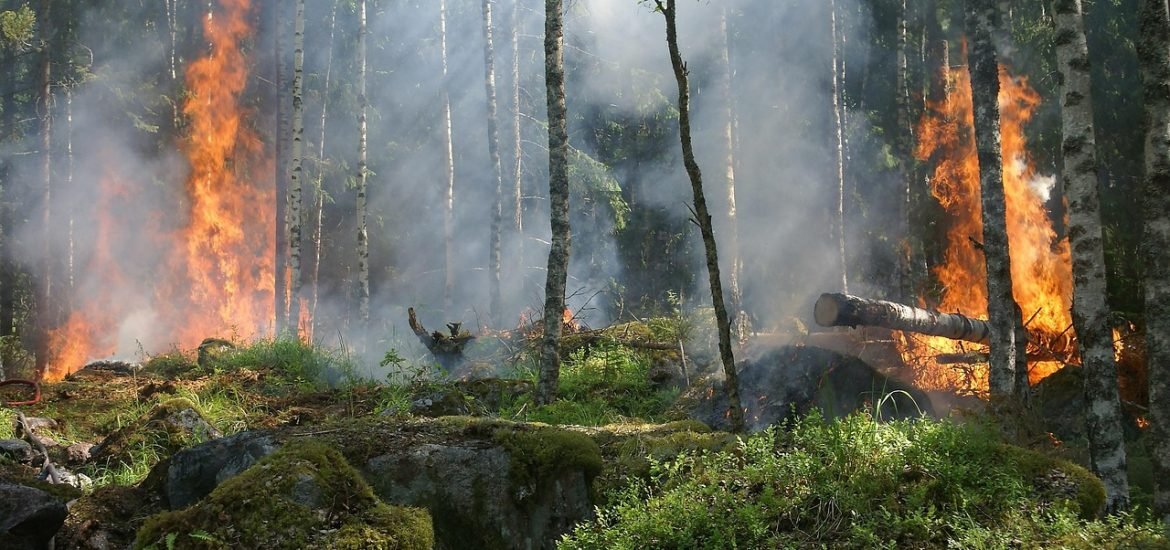
When a wildfire burns through a forest, the visible damage, including charred trees, scorched ground, fades within weeks, but beneath the surface, the effects on the soil can linger for far longer, according to study published in the journal Catena.
A study led by the University of Göttingen, found that wildfires fundamentally alter the structure and chemistry of forest soils, with changes persisting for more than a decade after the flames have gone. Crucially, the research also found that not all forests recover in the same way and that drier woodland soils can remain depleted for many years.
The research team, working with partners in Tübingen, Berlin and Chile, studied forests in two national parks in central Chile: a humid temperate rainforest dominated by ancient Araucaria trees in Nahuelbuta, and a drier mediterranean woodland in La Campana, where hot, dry summers are the norm. They collected soil samples from sites burned at various points in the past, including as recently as two days after a fire to up to 14 years later, and compared them with nearby forest soils that had not burned for decades.
The findings showed that wildfires compact the soil, temporarily raise its acidity due to ash deposits, and disrupt the balance of key nutrients including calcium, magnesium and potassium. In the drier mediterranean woodland, the damage was more severe and longer-lasting: soils showed greater compaction and significant losses of carbon and nitrogen that had still not recovered 14 years on. In the humid temperate forest, deep-rooted, fire-adapted trees and higher rainfall helped soils bounce back more quickly.
“We showed that wildfires do not just burn vegetation but fundamentally reshape the soil – compacting it, redistributing ash and disrupting nutrient cycles long after the flames are gone,” said Professor Yakov Kuzyakov at the University of Göttingen.
“Our findings show that soil recovery is not uniform. Even after 14 years, mediterranean woodland soils in Chile struggled to regain their pre-fire nutrient balance. In contrast, humid temperate forests began to bounce back more quickly due to resilient vegetation and higher rainfall. This means land managers cannot assume that all forests will recover in the same way after wildfires, especially in drier mediterranean woodlands where soils can stay depleted for many years,” added lead researcher Jhenkhar Mallikarjun, a PhD researcher at Göttingen.
The implications go beyond the forests themselves. Healthy soils play a vital role in storing carbon, regulating water and supporting forest productivity, all of which matter for the communities and ecosystems that depend on them. As climate change makes wildfires more frequent and intense, understanding how soils recover is becoming increasingly important.
“Understanding how fire affects nutrient recovery helps predict how forests might cope with more frequent wildfires under climate change and reveals the wider consequences for carbon storage, water regulation and forest productivity. If we ignore the slow recovery of soils and use the same reforestation and management strategies everywhere, we risk undermining restoration investments and the long-term resilience of ecosystems and the societies that depend on them,” concluded Professor Michaela Dippold at the University of Tübingen.
Jhenkhar Mallikarjun, Anna Gorbushina, Yakov Kuzyakov, Moritz Koester, Rodrigo Castro, Anna Yudina, Khaled Abdallah, Francisco J. Matus, Michaela A.Dippold. Post-fire recovery of temperate and mediterranean ecosystems: An interplay between fire severity, soil nutrients, and vegetation from early-stage to decadal-scale dynamics. Catena, Volume 260, 1 December 2025, 109431, https://doi.org/10.1016/j.catena.2025.109431