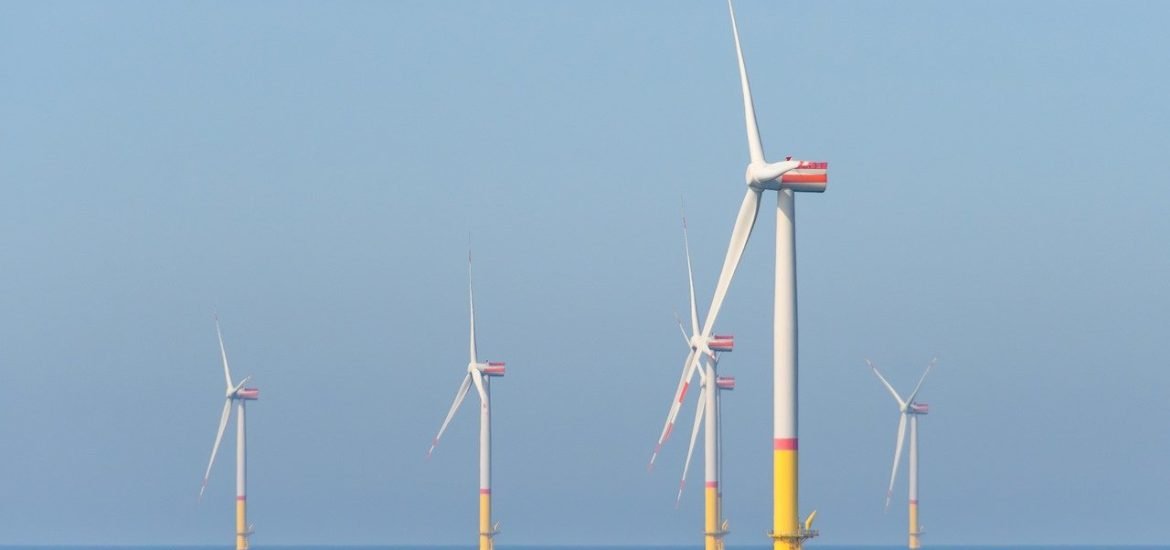
Offshore wind turbines alter the flow of air and water around them, with effects that can spread across the wider North Sea, according to a study published in the journal Nature.
A team of researchers from the Helmholtz-Zentrum Hereon in Germany has simulated the combined long-term effects of both wind and tidal disturbances caused by offshore wind turbines. The study looked ahead to what the North Sea could look like under the planned expansion of offshore wind energy by 2050.
Wind turbines affect ocean currents in two ways. Above the water, the spinning rotors extract energy from the wind, which in turn affects the surface currents below. Beneath the water, the turbine foundations act as physical obstacles that slow down tidal flows. These two types of disturbance are known as wake effects and interact with each other and together create a more complex picture than either would alone.
The authors found that this interaction results in slower currents and changes water flow patterns across the German Bight, the southeastern corner of the North Sea. In their 2050 expansion computer model, surface current speeds slowed by up to 20% in some areas.
“Our simulations paint a new, finely structured flow pattern that is not only evident within the wind farms but can also spread across the North Sea – with surface speeds slowing by up to 20 percent in an expansion scenario for 2050,” said lead researcher Dr Nils Christiansen of the Hereon Institute of Coastal Systems.
These changes are important as ocean currents play a key role in shaping the marine environment. Shifts in current patterns affect how sediment moves along the seabed, how seawater mixes at different depths, and eventually how marine ecosystems function. They can also affect the accuracy of current forecasts used by shipping, disaster management, and the fishing industry.
The study also explored ways to reduce these impacts. The simulations suggest that the spacing between turbines, the location of wind farms, and local tidal conditions all play a significant role to determine how much disruption occurs. The authors found that increasing the distance between individual turbines can significantly reduce the build-up of turbulence from tidal wakes, leading to less disruption of water mixing.
These findings could help inform smarter planning decisions as offshore wind continues to expand. “Offshore wind power is a key component of the energy transition and decarbonization. At the same time, we need to understand how different types of offshore installations and the size of the turbines affect the North Sea. Only then can we provide society and the economy with sound information and develop measures to minimize potential risks at an early stage,” concluded Dr Christiansen.
Christiansen, N., Daewel, U. & Schrum, C. Cumulative hydrodynamic impacts of offshore wind farms on North Sea currents and surface temperatures. Commun Earth Environ 7, 164 (2026). https://doi.org/10.1038/s43247-026-03186-8