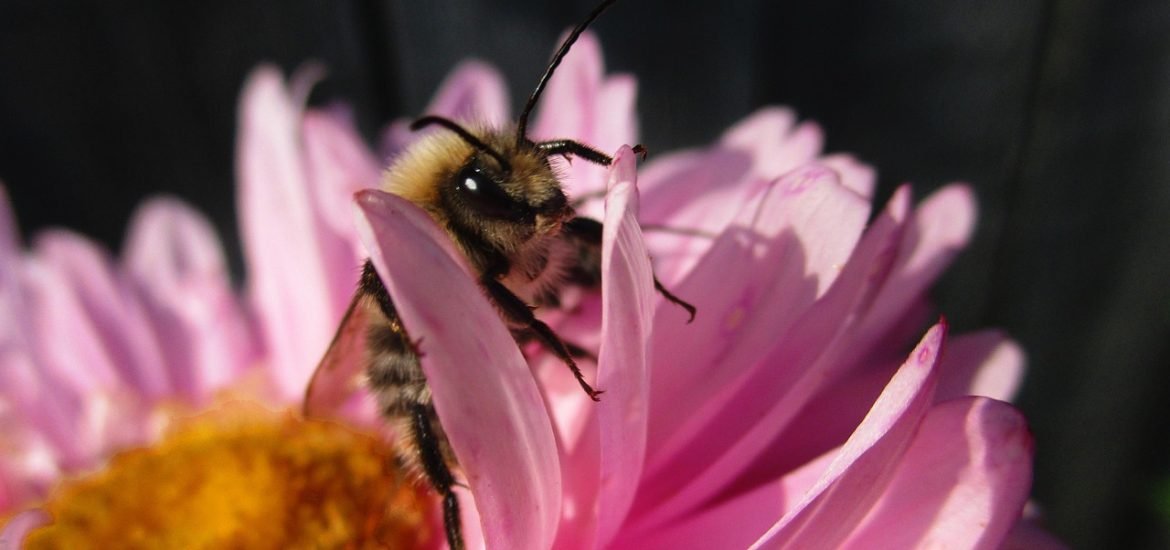
Bumblebees can take mental shortcuts when making decisions, storing only the information they truly need and ignoring the rest, according to a study published in the journal Science Advances.
When you pick strawberries at the supermarket, you probably go for the reddest ones first. If they all look equally red, you might start sniffing them instead. It turns out bumblebees use a remarkably similar approach when choosing which flowers to visit. Researchers from the University of Konstanz, in cooperation with the University of Würzburg, found that their decision-making is surprisingly efficient.
Bumblebees visit hundreds of flowers each day while foraging for their colony, and each visit involves a decision: is this flower likely to contain nectar or pollen? To make those decisions quickly, they rely on their memory of which flowers have previously been rewarding.
“As they make so many decisions in very short periods, bumblebees are particularly well suited for studying decision-making processes,” said Anna Stöckl, neuroethologist at the University of Konstanz and co-author of the study. “To remember a good source, they primarily rely on the flowers’ colours. However, they are also capable of recognizing shapes, patterns and scents.”
To test how bumblebees make these choices, researchers trained the insects to associate certain combinations of colour and shape with a sugary reward. For example, bumblebees would be rewarded for visiting a blue, star-shaped flower but find only water in a yellow, round one. After several rounds of training, the bees reliably headed for the rewarding flower, showing they had learned its features.
The researchers then mixed up the colours and shapes the bees had learned, forcing them to choose between the two. The result was clear: the bees followed colour, not shape. When colour was a reliable guide, they simply didn’t bother memorising shape at all.
But when the flower colours in training were very similar (such as yellow and orange), the bees had to learn the shapes too, as an extra clue. And it took them longer to do so. “Bumblebees that were trained with flowers of clearly distinguishable colours needed significantly less time to learn which flowers they had to visit for a reward. Those trained with similar colours, in contrast, required more time to complete the learning process,” said biologist and co-author Johannes Spaethe from the University of Würzburg.
The pattern that emerged was one of elegant efficiency. Stöckl explained: “Learning and storing only the colour probably requires less processing effort than remembering colour and shape at the same time. Only when the colours were similar did the bumblebees also learn shapes and patterns, which makes the learning process take longer. In this way, the insects consistently achieve the best possible outcome by following the principle of ‘as much as necessary, as little as possible’.”
In other words, bumblebees don’t overload their memories with unnecessary detail. They learn what they need, and no more — a strategy that saves energy and speeds up decision-making in the field.
As Stöckl puts it, the parallel with human behaviour is striking: “When faced with many unripe green strawberries, most people will naturally choose the red ones. But if all the strawberries on display are deep red, it becomes helpful to know what ripe strawberries smell like.”
Johannes Spaethe et al., Bees flexibly adjust decision strategies to information content in a foraging task.Sci. Adv.12,eadw9320(2026).DOI:10.1126/sciadv.adw9320