From Static Answers to Dynamic Belief Updating
Artificial intelligence is increasingly evaluated through its ability to produce correct answers, solve problems and operate across a growing range of tasks. More recently, however, these systems have begun to evolve into agents capable of planning, interacting and adapting to dynamic environments. This transition, from static output generation to sequential decision-making, brings into focus a more fundamental question that is often overlooked: not what these systems answer, but how they update what they take to be true.
This distinction matters because intelligence cannot be reduced to correctness at a single point in time. It depends on the ability to remain coherent as new information is introduced, particularly when that information is incomplete, uncertain or even contradictory. In such conditions, the quality of reasoning is determined less by isolated outputs than by the consistency of the underlying belief dynamics.
Bayesian Reasoning as the Foundation of Epistemic Integrity in Agents
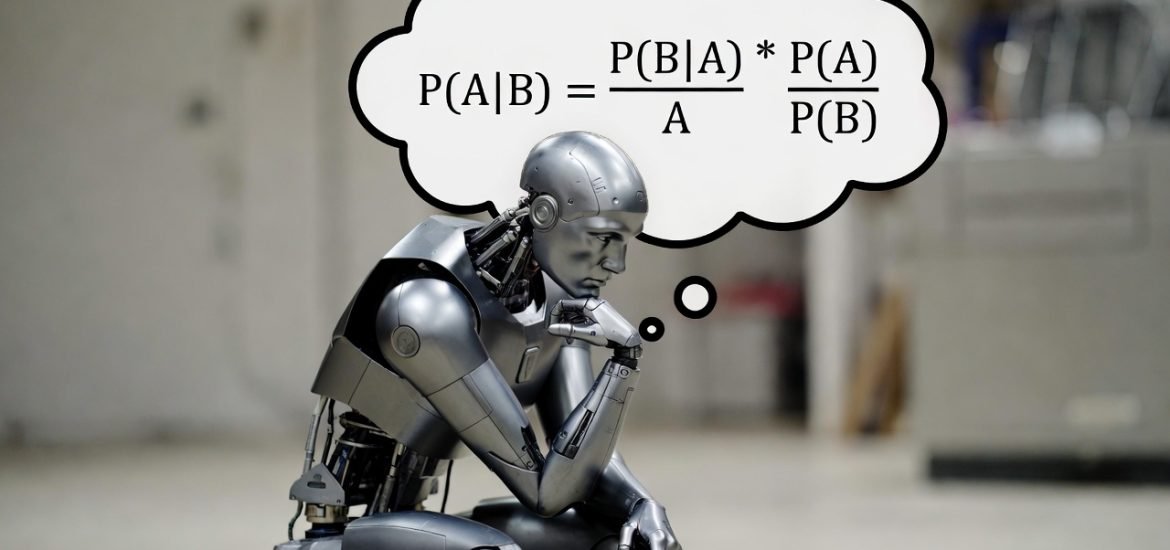
It is precisely this problem that the Bayesian framework was designed to address. Bayes’ theorem formalises a simple but powerful principle: beliefs should be revised in proportion to evidence. A prior belief is updated into a posterior according to the strength of new information, ensuring that changes in confidence remain justified and proportionate. Far from being a purely mathematical identity, this principle captures a core aspect of rational behaviour, the capacity to change one’s mind in a disciplined and accountable way.
When this mechanism fails in human reasoning, the consequences are well documented. Overconfidence, neglect of prior information and disproportionate reactions to weak signals all reflect breakdowns in belief-updating. What is less immediately apparent is that similar patterns can be observed in contemporary AI systems. Large language models often generate highly convincing responses, yet they struggle to maintain consistency when information is introduced sequentially. They may over-adjust to new inputs, disregard earlier context or express levels of confidence that are not aligned with the available evidence. In such cases, the issue is not necessarily incorrect answers, but instability in the reasoning process itself. This is not a marginal limitation. It points to a structural difficulty in how current systems handle evolving information.
Beyond Accuracy: Measuring Intelligence Through Belief Dynamics
This limitation becomes significantly more consequential as systems take on agentic roles. An agent is not evaluated on a single response, but on a sequence of decisions that unfold over time. It must integrate new information, revise its assumptions and maintain a coherent trajectory of reasoning. Without stable belief-updating, errors do not remain isolated; they accumulate, propagate and ultimately undermine reliability.
In this context, Bayesian reasoning takes on a new role. It is no longer simply a reference for probabilistic inference, but a standard against which the epistemic behaviour of AI systems can be assessed. If an agent operates under uncertainty, its internal dynamics should reflect proportional updating, calibrated confidence and consistency across successive steps. Otherwise, it may appear reliable at the surface level while remaining structurally fragile.
This observation has important implications for how such systems are evaluated. Current benchmarks tend to focus on accuracy at a given moment, measuring whether a response is correct without considering how that response evolves as conditions change. Yet the ability to update beliefs coherently is precisely what determines whether a system remains stable in practice. Evaluating reasoning as a dynamic process, rather than a static outcome, introduces a different standard of reliability, one that is more closely aligned with the requirements of autonomous systems.
Why Coherent Belief Updating Will Define the Next Generation of AI
A growing body of work is beginning to address this gap by treating belief-updating as an object of evaluation in its own right. The underlying idea is straightforward: an intelligent system should not only produce correct answers, but do so through reasoning processes that remain consistent, interpretable and proportionate to the evidence it encounters. In this sense, epistemic integrity becomes a defining property of trustworthy AI.
As these systems become more deeply embedded in decision-making contexts, from scientific reasoning to financial analysis and policy support, this distinction becomes increasingly significant. A model that answers correctly in isolation may still fail when confronted with evolving information if it cannot maintain coherence in its updates. By contrast, a system that revises its beliefs in a disciplined manner is more likely to remain reliable over time.
Bayesian reasoning, in this perspective, does not merely provide a technical tool. It offers a way of understanding intelligence as a process governed by the evolution of beliefs under uncertainty. What matters is not only what a system concludes, but whether its conclusions remain defensible as the information changes.