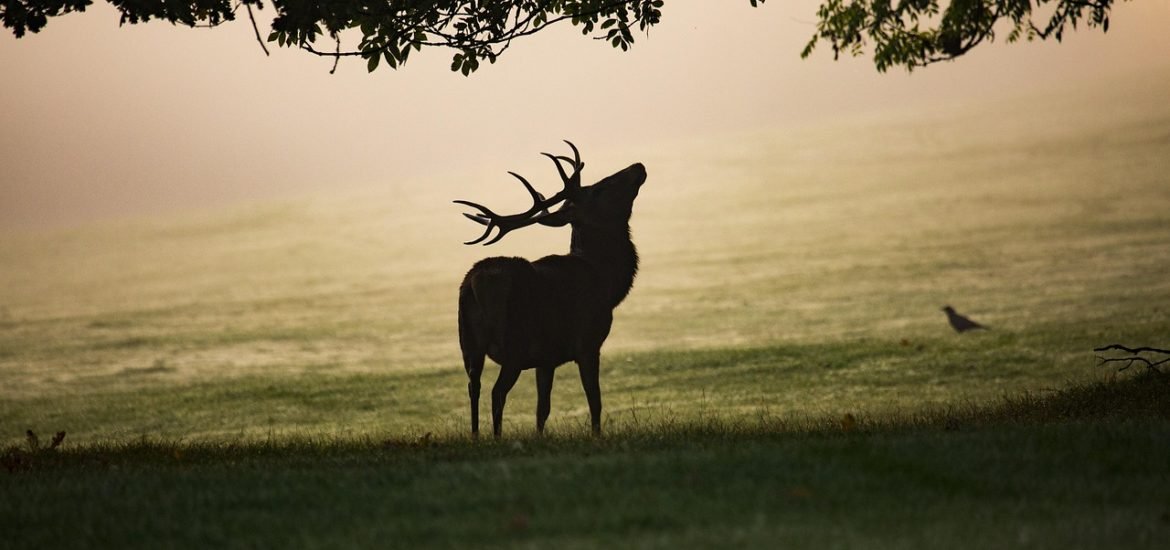
Deer can be deterred from damaging young trees simply by the smell of a predator nearby, even without the predator actually being there, according to a study published in the Journal of Applied Ecology.
The study was carried out in forests in south-eastern Germany by researchers from the University of Freiburg. Results show that plots of tree saplings marked with the scent of lynx or wolf were visited less by deer, and suffered less browsing damage, than plots without predator scent.
Over-browsing by deer is a serious problem for forest recovery across Europe. When deer eat too many young saplings, it slows or prevents the regeneration of woodland. It also reduces biodiversity and costs the forestry industry significant sums of money. Protecting saplings usually requires considerable effort and expense.
The experiment involved setting up plots at 11 locations in the forest, each containing four groups of 30 saplings marked with the scent of either wolf, lynx, cow or water as a control. Researchers monitored browsing damage regularly and used camera traps to observe how often deer visited each plot and how long they spent there.
The results showed that predator scent, particularly that of lynx, made deer more cautious. They visited those plots less frequently and spent less time feeding when they did. “At a time when debates around large carnivore conservation often focus on conflicts, our study highlights the benefits these species bring to landscapes. The presence of carnivores, even just their scent, could help reduce the ecological and economic problems associated with browsing from overabundant deer populations,” said Walter Di Nicola, one of the lead researchers.
The stronger response to lynx compared to wolf is likely down to hunting style. Lynx are ambush predators that stalk their prey from close range, so deer may perceive the smell of a lynx as a more immediate threat. Wolves were also relatively new to the area at the time of the study, meaning the local deer had more experience of lynx as a danger.
The findings are particularly relevant for countries like the UK, where both lynx and wolves have been absent for generations. The researchers say a similar effect would be expected there, though perhaps not as strong.
“In the UK we would expect similar but probably weaker effects. Deer still have some innate fear of predators, even if those predators have been absent for generations. Where predators return, we expect these responses – and their ecological benefits – to become stronger over time,” said Walter Di Nicola.
The researchers acknowledge that their experiment used concentrated predator scents, which are easier for deer to detect than the more scattered, unpredictable cues found in the wild. Nevertheless, they say the findings make a strong case for including large carnivores (or at least their scent) in strategies to protect recovering forests.
van Beeck Calkoen, S. T. S., Di Nicola, W., Smit, C., Kuijper, D. P. J., & Heurich, M. (2026). Experimental evidence for large carnivore risk cues reducing deer browsing intensity in a temperate forest. Journal of Applied Ecology, 63, e70267. https://doi.org/10.1111/1365-2664.70267