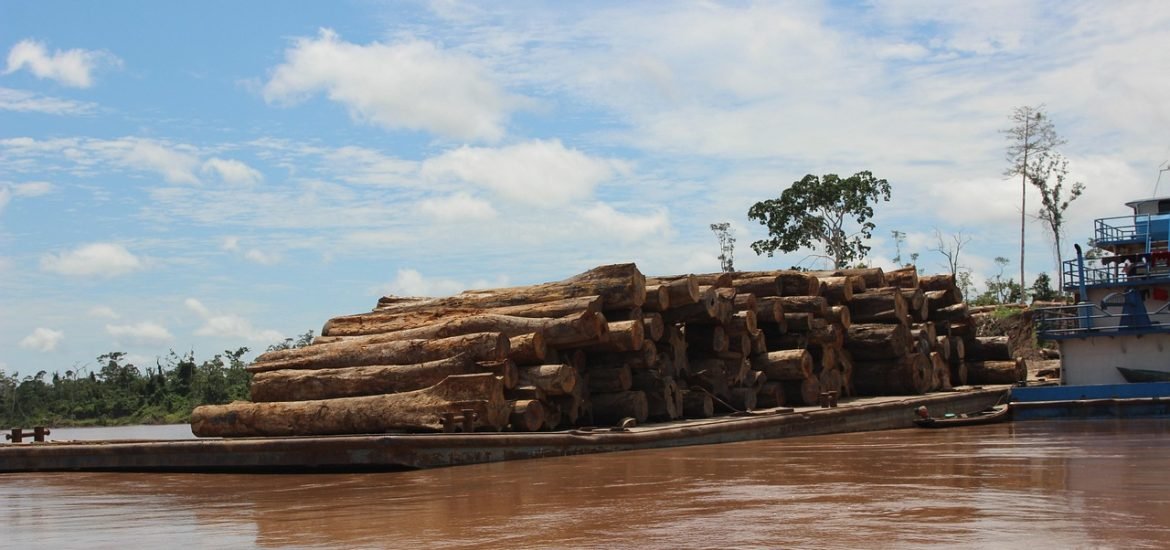
Brazil has made genuine progress in slowing deforestation, but those same policies have largely failed to stop a different and potentially more dangerous form of forest destruction, according to a study led by the University of Cambridge and published in the Proceedings of the National Academy of Sciences.
Antonio, a firefighter in the Brazilian Amazon since 2019, has spent seven years running toward fires that most people flee. Working inside the Chico Mendes Extractive Reserve (one of the most biodiverse places on Earth), Antonio has seen things change dramatically in a very short time. “2024 was the most extreme year for fires,” he said. “I had never seen anything like it. The forest burned like dry pasture – it was frightening for those of us who risk our lives to protect it.”
Deforestation vs. Degradation
Most people are familiar with deforestation, involving trees completely cleared to make way for farms, roads, or industry. Degradation is harder to see, but no less destructive. A degraded forest still has trees standing, but it has been so weakened by fire, illegal logging, drought, and fragmentation that it has lost most of what made it valuable.
“There’s still a forest there, but it’s so damaged that the carbon it once stored starts leaking, the animals have disappeared, and new grass species colonise the forest edges,” said lead author Federico Cammelli from Cambridge’s Department of Geography. “Tropical forest fires are low intensity, flames often go undetected under the canopy, but after one or two years, trees die while standing, and the forest transforms into a cemetery of dead standing trees.”
Earlier research found that between 2001 and 2018, carbon emissions from forest degradation in the Brazilian Amazon were comparable to or even higher than those from outright deforestation. By 2050, degradation could affect the entire Brazilian Amazon. Yet it has barely featured in the policies meant to protect it.
Real Progress, Real Gaps
Brazil’s efforts on deforestation deserve credit. Government plans launched in the mid-2000s reduced tree clearing by an estimated 60 to 80%. Private sector agreements, including a ban on soybeans from deforested land and commitments from meat packers, also helped.
But when the researchers examined four major deforestation policies across three Brazilian states, they found none of them had meaningfully reduced degradation.
There was even one troubling unintended consequence. The G4 cattle agreement, signed by Brazil’s four biggest meat packers, appeared to be linked to a rise in timber extraction possibly because as cattle ranching faced tighter rules, some businesses shifted toward the less-regulated logging sector.
“We found no conclusive evidence that any of the supply chain policies, like the soy moratorium or the cattle agreements, tackled other big drivers of anthropogenic degradation, like fires, logging and fragmentation,” said Cammelli.
The Bigger Picture
The researchers are also calling out international policy for falling short. The EU Deforestation Regulation, which bans imports linked to forest destruction, defines degradation too narrowly, they say, largely missing the fire damage and fragmentation caused by soy and beef production. They are urging the EU to broaden that definition.
Closer to home, the researchers found no publicly documented examples of companies operating in the Brazilian Amazon that had set concrete targets to address forest degradation at all.
“Avoiding deforestation and degradation is so much more important for climate and nature than restoring what’s already gone,” said senior author Professor Rachael Garrett, also from Cambridge. “There are certain things you can’t get back.”
A Warning From the Forest Floor
Back in Chico Mendes, Antonio notices the dry season lasting longer each year, the forest growing more fragile, and the rains arriving suddenly and violently, washing out bridges and blocking roads. He is not reassured by the current state of environmental law. “Environmental laws should be stricter, and offenders should be properly punished,” he said. “If we lose the forest, we indirectly lose our lives. Every year, the forest and wildlife become more vulnerable.”
The science is saying the same thing and the window to act is narrowing.
F. Cammelli, H.K. Gibbs, F. Gollnow, S.A. Levy, M. Stigler, & R.D. Garrett, Deforestation-focused policies do not reduce degradation in the Brazilian Amazon, Proc. Natl. Acad. Sci. U.S.A.123 (18) e2507793123, https://doi.org/10.1073/pnas.2507793123(2026).