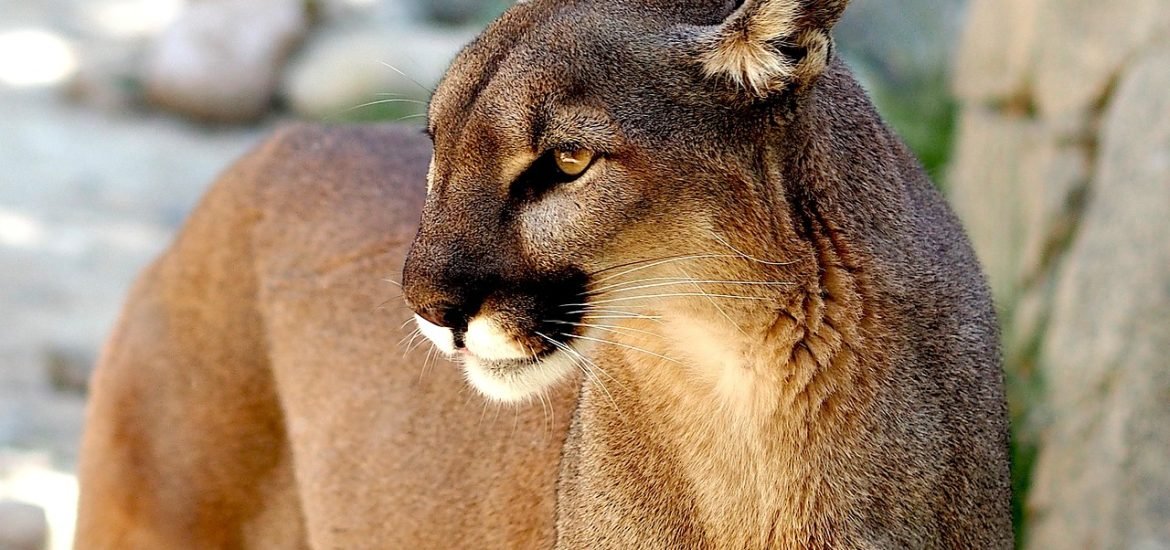
Pumas returning to the Patagonian coast in Argentina have killed more than 7,000 penguins over four years but they’re not likely to affect the colony’s long-term survival, according to a study published in the Journal for Nature Conservation.
A team of Argentinian scientists and Oxford University’s Wildlife Conservation Research Unit (WildCRU) offers the first detailed picture of how a recovering predator is affecting a penguin population that never had to deal with land-based threats.
The story begins with the abandonment of cattle ranching in southern Argentina in 1990. As farming retreated, pumas began recolonising their historical ranges along the Patagonian coast. At the same time, Magellanic penguins had moved from nearby islands to the mainland, partly drawn by the lack of terrestrial predators. However, when pumas arrived, the penguins became easy targets.
Researchers monitored penguin carcasses at Monte León National Park between 2007 and 2010, estimating that pumas killed more than 7,000 adult penguins over that period. This is about 8% of the colony’s adult population of around 93,000 birds. Strikingly, many of the penguins were left uneaten, suggesting the kills were not driven by hunger.
“The number of carcasses showing signs of predation we found in the colony is overwhelming, and the fact that they were left uneaten means pumas were killing more penguins than they required for food. This is consistent with what ecologists describe as ‘surplus killing’. It is comparable to what is seen in domestic cats when prey are abundant and/or vulnerable: ease of capture can lead to cats hunting more birds, even when they do not end up actually eating them. We needed to understand if the penguin colony’s persistence could be threatened due to this behaviour,” said lead author Melisa Lera, from WildCRU, Oxford University.
When the team modelled the long-term impact of puma predation on the colony, however, the results were reassuring in one respect: pumas alone were unlikely to drive the colony to extinction. More dangerous threats to the penguins’ future include how successfully they breed and how many young birds make it to adulthood. “This study captures an emerging conservation challenge, where recovering carnivores are encountering novel prey. Understanding how these dietary shifts affect both predators and prey is essential to inform conservation,” said co-author Dr Jorgelina Marino of WildCRU, Oxford University.
The researchers highlight that climate change may already be affecting the food and environmental conditions that penguins need to breed successfully, adding another layer of pressure on top of predation. They also note that as large predators continue to expand into coastal areas around the world, other seabird and coastal species may face similar challenges. Feral hogs are already a major predator of sea turtle eggs along the Georgia coast in the United States, and coyotes are spreading into coastal ecosystems in eastern North America.
The authors call for continued monitoring of both puma and penguin populations at Monte León National Park to catch any signs of decline early and allow timely conservation action.
Melisa Lera, Esteban Frere, Jorgelina Marino, Annick Morgenthaler, Sandra Lai, Ana Millones. Shifting predator–prey dynamics at the land–sea interface: The case of Magellanic penguins and pumas. Journal for Nature Conservation Volume 91, June 2026, 127208