How to interpret Ursula von der Leyen’s about-face, as well as President Macron’s latest statements on nuclear power. What is this strategic mistake? Christian Semperes kindly agreed to answer our questions and share his interpretation. His leitmotiv: “Hearing a political leader admit a mistake is rare! But when several do it in chorus and at the same time, it becomes suspicious.” Quite a program.
The European Scientist: At the nuclear summit, Ursula von der Leyen has just acknowledged that it was a strategic mistake on the part of the European Union to stop nuclear production. How do you interpret this statement? Do you think it is sincere?
Christian Semperes: I suggest putting this statement back into its context. First, the German Chancellor recognized the mistake made in shutting down the German nuclear fleet. Then, Ms. Ursula von der Leyen called the sidelining of nuclear in Europe a “strategic mistake.” Finally, Mr. the President of the Republic, Emmanuel Macron, followed suit during the nuclear energy summit on March 10 last.
At first glance, and without knowing the subject in depth, one could naively rejoice at the sudden clairvoyance of our political leaders and their apparent transparency in recognizing their “mistakes.” It must be acknowledged, hearing a political leader admit a mistake is rare! But when several do it in chorus and at the same time, it becomes suspicious.
TES: Do you think that politicians who change their minds do so having truly understood that the ecologist ideology was leading to a dead end, or are they still under the grip of their cognitive biases?
CS: We must distinguish two points of view. On one side, that of the Greens, whether German or French, who have made nuclear their absolute enemy. On the other, that of the German State, which, for years, has sought to reduce the price of its electricity to bring it back to the level of the French price, in order to avoid penalizing its economic activity.
In their governmental coalition, the German State and the German Greens thus found a common crusade against European nuclear power and French in particular. According to the logic “the enemy of my enemy is my friend,” the gas companies, for whom nuclear represents a formidable competitor, were invited to join this crusade.
TES: Why this about-face? Why a profession of faith in favor of nuclear today? From what I understand, it would not be a real mea culpa. What, in your eyes, would make it possible to say that it is not simply pure political declarations?
CS: When one knows the subject and has experienced it from the inside, as I have, during 37 years of nuclear operation, this “mistake” jointly recognized was in reality a German strategy aimed at achieving an objective that is today achieved.
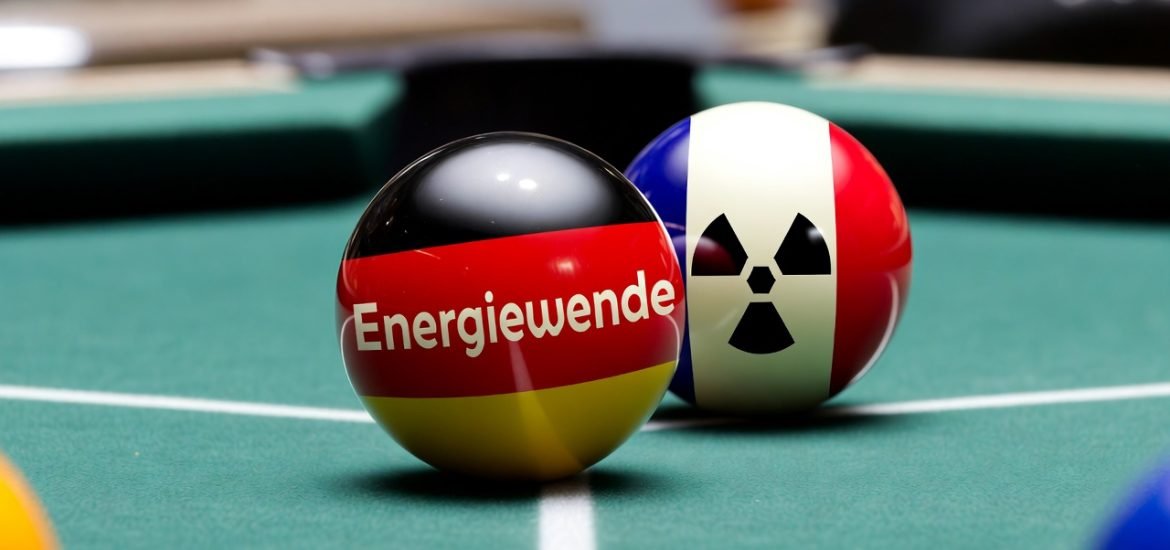
The French “mistake,” operational translation of the German objective, is in fact a betrayal of our energy, economic, and geopolitical sovereignty, not to mention that it constitutes an ecocide. To support this accusation, we must retrace a bit of history, because it is a subtle game of billiards with several cushions.
TES: We are listening. Remind us of the events.
CS: Since the end of the construction of its nuclear fleet, France enjoyed a major competitive advantage over Germany:
– Its electricity has been very low-carbon for 45 years. In 1989, Michel Rocard, then Prime Minister, already wrote it in a report on greenhouse gas emissions(1).
– Its price remained systematically lower than that of German electricity.
The 2025 figures still confirm it, with 70% nuclear-origin electricity, the price in France (0.195 €/kWh TTC) is not only lower than the European average, but also half as high as that of Germany (0.38 €/kWh TTC), the most expensive in Europe.(2)
And as additional proof, French electricity is abundant, dispatchable, and cheap, whatever the weather conditions. EDF’s record exports to Europe prove it with more than 92 TWh very low-carbon in 2025.
TES: That’s the objective. And the strategy, then?
CS: Under the pressure of the German anti-nuclear Greens, integrated into the governmental coalition, Germany exerted constant pressure on the European Commission. Thanks to its electricity market liberalization directives (adopted as early as 1996, strengthened in 2003 and 2009) and its legal pressure, the Commission forced France to create the ARENH to “liberalize” the market.
To avoid sanctions, France proposed in 2009 the ARENH mechanism, integrated into the NOME law of 2010. The Fukushima accident served as an opportunity to fan the fear of nuclear and accelerate the process.
From 2011 to 2025, the ARENH obliged EDF to sell at a loss up to 25% of its nuclear production (very low-carbon) at a regulated price of 42 €/MWh to “alternative suppliers.” Without investing anything, without producing anything, without transporting anything, and without distributing anything, they, like TotalEnergies, resold this electricity at market price, up to 2,988 €/MWh on April 4, 2022 at 8 a.m., in the midst of the Russian gas crisis.
Meanwhile, EDF, deprived of 25% of its production, had to buy back electricity on the market at the same exorbitant price.
TES: What is the link with the objective of balancing German and French electricity prices?
CS: The strategy was clear:
1. Favor gas companies for whom nuclear is a formidable competitor and who become the substitute for dispatchable means.
2. Ruin EDF’s finances to prevent it from self-financing and building new reactors, making impossible the renewal of the French nuclear fleet.
3. Position the European Commission as arbiter of the financing of the “new eco MWh” (renewables) rather than very low-carbon (nuclear).
That was the first cushion of the billiards.
The second cushion targeted the operating fleet. That’s where the French Greens came into play:
– They supported François Hollande’s access to power.
– In collaboration with the German Greens, they obtained the closure of Fessenheim.
– Ségolène Royal capped the nuclear share at 50% in French production.
– Under Macron’s first five-year term, law no. 2019-1908 of 04/30/2019 planned the closure of 12 additional reactors (in addition to Fessenheim) starting in 2025. This threat was ultimately not carried out, but these reactors, deemed safe by the Nuclear Safety Authority, were indeed threatened.
The ARENH, the closure of Fessenheim, and the law on the 12 reactors were the operational translation of the German objective, namely to break our long-term competitive advantage.
In conclusion, the “mistake” mentioned by Ursula von der Leyen was a deliberate strategy. The “mistake” recognized today by France, via Emmanuel Macron, is a betrayal of our energy, economic, and geopolitical sovereignty, not to mention that it constitutes an ecocide. Let us recall that the French nuclear MWh is by far the lowest carbon, even compared to the renewable MWh, whose solar panels come from Asia by fuel ships, with an industrially epsilon-like capacity factor.
TES: Would there be a third cushion in this game of billiards?
CS: Yes, and it is crucial. The rule is simple: “Heads, Germany, I win; tails, France, you lose.” I explain.
In France, the law imposes immediate decommissioning of nuclear installations as soon as the shutdown decree is published. From the shutdown of Fessenheim, EDF proceeded with the “chemical washing of the primary circuit,” an irreversible operation that reduces the thickness of the piping to decrease the dosimetry of the workers. This operation makes any restart technically impossible.
Conversely, the German reactors placed “under cocoon” and not decommissioned could be restarted. It would be the last act of a Wagnerian opera, “The Flying Dutchman,” a tragedy of love and curse, that of the Franco-German couple.
TES: Emmanuel Macron was at Penly and made statements in the direction of a voluntarist relaunch of nuclear. What do you think? Is it a rhetorical use of “at the same time”? Has he understood that nuclear is the best solution for the climate and for the price of electricity in the long term?
CS: The recognition of the virtues of nuclear, first by the German Chancellor, then by Ursula von der Leyen, finally by Emmanuel Macron, comes at the moment when the objective is achieved. The harm is done, and it risks being lasting. I explain.
EDF’s finances were voluntarily degraded by the ARENH. Moreover, the nuclear construction industrial fabric has been weakened. Remember. The 58 French reactors were built and started in 22 years (i.e., 2.7 reactors/year), with an average construction time of 6 years, as the Chinese do today. The French State imposed a construction “black-out,” causing the French industrial fabric to lose its skills. The objective of sabotaging our construction know-how is achieved. The planning and construction of Flamanville 3, a prototype and only one, which wanted to wash whiter than white, showed it.
Now, the politicians in power can make honorable amends and buy back our trust. But when one has experienced from the inside, for decades, the methodical demolition of our ecological, energy, and economic advantage, one can only denounce this hypocrisy.
TES: You don’t seem very optimistic…
CS: My point was first to recall facts that take on a very negative aspect for our competitiveness, we must admit it. But there are also reasons to be optimistic.
EDF remains the only industrial group in the world to accumulate more than 2,000 years of experience in operating pressurized water reactors (PWR). Do the math: 58 reactors × 40 years average age. Its engineering has an invaluable internal data bank, offering it a unique capacity to rebound. The management of the stress corrosion crisis in 2022 and the spectacular recovery of its operating results are proof, if needed.
There are other encouraging signs. The Arabelle turbines from Belfort, flagship of the sector, have returned to French control after being sold to the Americans. Since 2022, EDF holds 100% of Framatome, thus consolidating mastery of the entire historical know-how for building large nuclear boiler components, preserved thanks to Chinese and British projects. The prospect of an ambitious EPR2 program gives the French industrial fabric the necessary guarantees to invest in euros as in skills, in the long term.
Yes, the Phoenix will rise from its ashes.
But beware! 6 EPR2 will not be enough to replace the 56 reactors currently in operation, with an average age of 40 years. If the program stops there, the German objective will be achieved. When the French reactors reach the end of their life, the price of French electricity will join that of Germany, 10 times more carbonated with its gas, coal, and lignite. Remember. In its March 2020 report (page 120/192), the National Low-Carbon Strategy (SNBC) already planned the construction of 20 gas plants to compensate for the loss of 50% of nuclear. However, the war in Ukraine and recent tensions in the Middle East remind us that the price of gas is at the very least volatile. In this scenario, the price of French electricity will join that of German electricity.
(1) https://inis.iaea.org/records/hfh13-53m08
(2) https://ekwateur.fr/blog/marche-de-l-energie/prix-electricite-allemagne/#prix
This post is also available in: FR