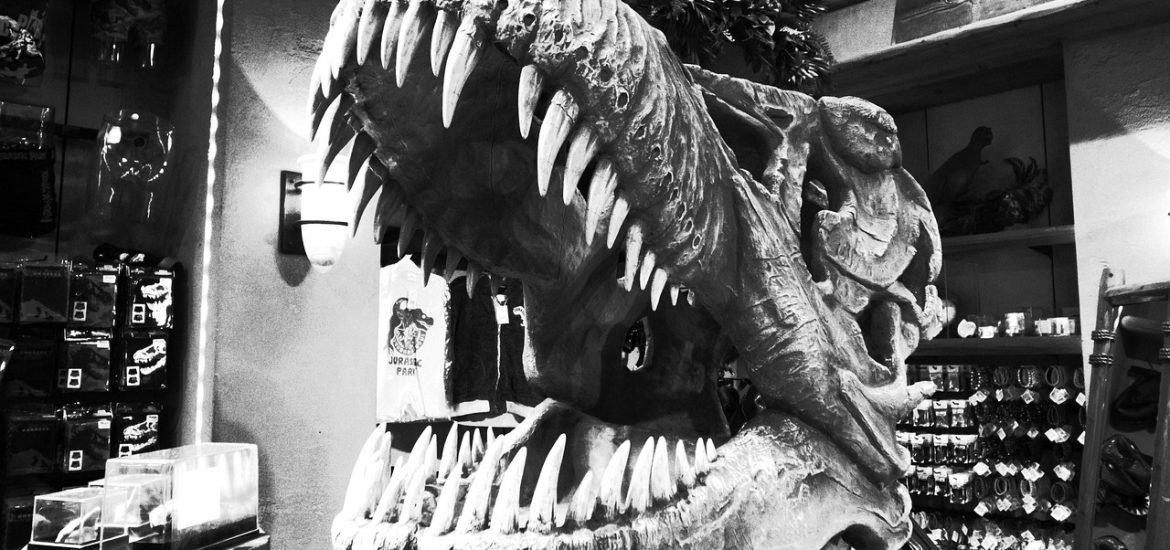
New method uses fossilised dinosaur teeth to reconstruct the climate during the Mesozoic era, according to a study published in PNAS. A team of researchers from the Universities of Göttingen, Mainz, and Bochum used fossilized dinosaur teeth to show that the atmosphere during the Mesozoic era, between 252 and 66 million years ago, contained far more carbon dioxide than it does today. In addition, the researchers found that total photosynthesis by plants worldwide was twice what it is today.
For this study, the team analysed the enamel of dinosaur teeth found in North America, Africa, and Europe, dating from the late Jurassic and late Cretaceous periods, to measure different oxygen isotopes that the dinosaurs inhaled with every breath. The ratio of these isotopes is affected by changes in atmospheric carbon dioxide levels and by plant photosynthesis. This correlation allows researchers to draw conclusions about the climate and vegetation during the age of the dinosaurs.
Teeth from two dinosaurs – Tyrannosaurus rex and Kaatedocus siberi – contained an unusual composition of oxygen isotopes. This points to CO₂ spikes linked to significant events, such as volcanic eruptions—for example, the massive eruptions of the Deccan Traps in what is now India, which occurred during the Cretaceous period. Plants were carrying out more photosynthesis at that time, which was probably associated with higher CO₂ levels and higher average annual temperatures.
Results show that around 150 million years ago (in the late Jurassic period), the air contained about 4 times as much carbon dioxide as it did before humans began emitting large quantities of greenhouse gases into the atmosphere. In the late Cretaceous period, around 73 to 66 million years ago, the level was three times higher than today.
Until now, carbonates found in soil and “marine proxies” have been the primary tools for reconstructing past climate. These indicators, including fossils and chemical signatures in sediments, help scientists understand past environmental conditions. However, these methods are not very accurate.
By analysing oxygen isotopes in teeth, the authors developed a new method for analysing vertebrates on land. “Our method gives us a completely new view of the Earth’s past,” explained lead author Dr Dingsu Feng at the University of Göttingen’s Department of Geochemistry. “It opens up the possibility of using fossilized tooth enamel to investigate the composition of the early Earth’s atmosphere and the productivity of plants at that time. This is crucial for understanding long-term climate dynamics.” Dinosaurs could be the new climate scientists, according to Feng: “Long ago their teeth recorded the climate for a period of over 150 million years – finally we are getting the message.”
Dingsu Feng, Thomas Tütken, Eva Maria Griebeler, Daniel Herwartz & Andreas Pack. Mesozoic atmospheric CO2 concentrations reconstructed from dinosaur tooth enamel. Proceedings of the National Academy of Sciences (PNAS) (2025). DOI: 10.1073/pnas.2504324122